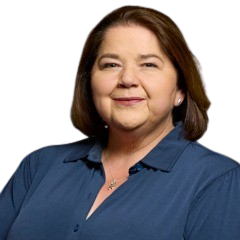
Julie Minns is the Labour MP for Carlisle, having first been elected to parliament at the 2024 general election.
In the 2024 general election, Minns won 18,129 votes, representing 39.4% of the vote. The Conservative candidate, John Stevenson, received 12,929 votes (28.1%), while the Reform UK candidate, Stephen Ward, secured 9,295 votes (20.2%). Minns was duly elected with a majority of 5,200.
The Carlisle constituency is located in Cumbria in the North West of England. The seat was held by the Conservative Party from 2010 to 2024, and before that by Labour from 1964 to 2010.
Minns’s immediate predecessor as the MP for Carlisle was John Stevenson (2010-2024) of the Conservative Party.
Political Career
Minns served as a parliamentary private secretary (PPS) in the Department for Transport from November 2024 to April 2026. A PPS acts as an unpaid parliamentary assistant, providing a link between the senior frontbencher and backbench MPs. The role is widely regarded as the first step on the ministerial ladder.
In May 2026, Minns was among the over 100 Labour MPs who signed a joint statement insisting it was “no time for a leadership contest.” The letter was an intervention in the political crisis engulfing Keir Starmer’s premiership, after Labour suffered heavy losses in the 2026 local elections and devolved elections to the Scottish Parliament and Senedd Cymru. It was organised as a counterweight to a mounting rebellion that had seen high-profile figures, including some ministers, call for Starmer’s resignation.
The statement read: “Last week we had a devastatingly tough set of election results. It shows we have a hard job ahead to win back trust from the electorate.
“That job needs to start today – with all of us working together to deliver the change the country needs.
“We must focus on that. This is no time for a leadership contest.”
In January 2025, Minns introduced the Elections (Accessibility for Blind Voters) Bill as a private members’ bill (PMB) under the 10-minute rule procedure. The proposed legislation sought to improve electoral access and guarantee that voters with sight loss could participate effectively.
The Elections (Accessibility for Blind Voters) Bill would have created a statutory requirement for polling stations to provide audio and tactile tools to enable “blind voters to vote independently and in secret”. Furthermore, the bill mandated that the secretary of state develop new accessible technologies for the future and conduct a review of the postal voting system.
Speaking in the commons, Minns stated: “Blind voters report feeling humiliated and let down by the system when having to share their vote out loud in public and in some cases not being certain who they voted for.
“Our democracy is all the poorer for this, and that is why this Bill seeks to ensure that all voters with sight loss are consistently able to access information about the election and candidates independently.”
She added: “This is not out of reach: the technology exists and the solutions are low-cost and effective….
“An accessible voting system is essential for the health of our democracy, and this Bill is a vital step to correcting an injustice and building a democracy where voters such as John [a constituent] are not left behind.”
Minns has sat as a member of the House of Commons energy security and net zero committee (2024-2025).
Minns delivered her maiden speech on 5 September 2024 during a debate on the Great British Energy Bill.
In it, she said: “I am delighted to have the opportunity to make my maiden speech in this context. It is also apt that I make it during a debate on Great British Energy. It is apt not just because the transition to clean energy and tackling climate change are critical to Carlisle…
“It is also personally apt that I speak on this topic. My great-grandfather, a Conservative alderman and councillor for Carlisle, was a man of unusually progressive thinking. In 1909, he urged our city’s industries to set aside coal and instead harness the hydroelectric power of the three rivers on which our great border city stands.
“I like to think that, whatever our political differences, my great-grandfather and I would have agreed that Great British Energy is not just right, but essential for Carlisle, for Cumbria, and for our country.”
She added: “I could not be prouder to represent the city where I was born and raised. I owe a debt to Robert Ferguson school and Trinity school for helping a working-class child from Denton Holme to become the first in her family to go to university.
“Without university, I would not have become involved in politics and would not have had the privilege of campaigning for John Smith, a great parliamentarian, to become leader of our party.
“Nor would I have realised the ambition of my distant cousin Ernest Lowthian, who was Labour’s first parliamentary candidate for Carlisle back in 1918.”
Before entering parliament, Minns served as a Labour councillor on Lambeth London Borough Council from 1998 to 2002. She stepped down from the council to focus on raising her daughter.
Political Views
Leadership elections
Labour deputy leadership 2025: Minns was one of 175 Labour MPs who nominated Bridget Phillipson for the party’s deputy leadership in September 2025. The election followed the resignation of Angela Rayner, who stepped down as deputy prime minister and deputy party leader after an investigation into her tax affairs. It marked the first time since 2007 that Labour had held a deputy leadership contest while in government.
Phillipson, the serving education secretary, was widely viewed as the candidate favoured by Downing Street and the party leadership. She secured 175 nominations from the Parliamentary Labour Party (PLP), comfortably exceeding the 80 required to reach the final ballot. She was ultimately defeated by Lucy Powell.
Factional identity and party tradition
Red Wall Caucus: Minns is a member of the Labour Red Wall Caucus, a parliamentary pressure group of Labour MPs representing constituencies in the Midlands and Northern England. Formed in November 2024 and led by Bassetlaw MP Jo White, the caucus serves as a voice for the so-called “red wall” seats that returned to Labour en masse at the 2024 general election.
In May 2025, following a series of disappointing local election results for the Labour Party, the caucus issued a statement calling for a shift in government strategy. The group argued that Keir Starmer’s “plan for change” messaging had “fallen on deaf ears”, inviting ministers to “visit our areas, listen and rebuild the social contract between government and the people.”
The statement added: “The demands raised by new MPs from post-industrial towns where infrastructure is poor with years of underinvestment must be taken off the too-difficult-to-do list.
“Breakaway from Treasury orthodoxy otherwise we will never get the investment we desperately need. The government needs to it improve messaging by telling our story and articulating our values in the language that resonates and is heard.”
In a subsequent letter to Nigel Farage, the leader of Reform UK, on 27 August 2025, the MPs said they were elected “with commitments to destroy the criminal smuggling gang networks, ensure that our border is secure… and to quickly remove those who have no entitlement to be here.”
They went on to critique Farage’s deportations plan.
The MPs added: “We believe that migrants who pose a threat to public safety should be tagged, and that we should expand right-to-work checks to crack down on illegal working. We believe sex offenders should never get asylum in the UK. We believe that the criminal people smuggling gangs should be treated like terrorists.”
Labour Growth Group: Minns has been listed as a member of the Labour Growth Group (LGG) – a vocal faction of backbenchers committed to ensuring economic growth remains the central mission of the government. The group, largely composed of MPs from the 2024 intake, positions itself as the voice of “the builders, not the blockers” and provides organised support for ministers taking on politically difficult decisions in the name of economic expansion.
In an open letter addressed to Keir Starmer, issued upon the group’s founding in July 2024, LGG MPs said it was imperative that “the government grasps the nettle and goes for growth”.
They added: “This absolutely has to start with the sweeping planning reforms to get Britain building again. Under the Tories, planning permissions for new homes hit record lows and housebuilding cratered. Indeed, not once in their 14 years in power did the Conservatives meet their housing targets.
“Energy and transport projects were promised but not built. That’s why we are writing to you to make clear that it’s in the national interest to start delivering on our manifesto promise, including 1.5 million more homes across this parliament at the earliest opportunity.
“A failure to act will not be forgiven by the public. Britain has a housing crisis and a huge infrastructure deficit – without strong and immediate action, this will only worsen.”
SERA: Minns has been listed as a member of the Socialist Environment and Resources Association (SERA) – a socialist society affiliated with the Labour Party. Founded in 1973, SERA is the party’s official environmental campaign group. The organisation campaigns on a wide range of issues, including renewable energy, biodiversity, air quality and the transition to a green economy. SERA describes its member MPs as “champions for the environment”.
Labour Movement for Europe: Minns was endorsed by the Labour Movement for Europe (LME) in the 2024 general election. Founded in 1981, LME is a pro-European socialist society affiliated with the Labour Party. It campaigns for a close relationship between the United Kingdom and the European Union. The organisation refers to itself as the “home of the pro-Europeans in the Labour and trade union movement”.
Welfare
Welfare vote (July 2025): Minns voted in favour of the government’s flagship welfare bill at second reading. The vote came after ministers agreed to significant concessions to avoid defeat via a mass rebellion of Labour MPs on 1 July 2025.
Assisted dying
Minns voted against the Terminally Ill Adults (End of Life) Bill, better known as the assisted dying bill, at second reading (November 2024).
In a statement at the tim, Minns said: “This was never going to be an easy decision. I am instinctively pro-choice. But I have concluded that I cannot support the Bill for three key reasons:
“The reservations expressed by many disabled people and disability organisations.
“To vote in favour is, in effect, a vote to fund one – and only one – form of death. Everyone should have the right to a good death. This bill only deals with one.
“There is nothing definitive about a six month terminal prognosis, yet the bill will require this – nor do I believe there can be watertight safeguards against coercion.”
Before Politics
Born in Carlisle on 11 December 1968, Minns’ father was a painter and decorator for the electricity board and her mother was a home help. Her father died from an industrial related illness in 2007.
She attended Robert Ferguson Primary School and Trinity School. She was the first member of her family to go to university.
Minns’ later worked in parliament running the office of Labour MP Keith Hill, overseeing his advice surgeries and casework. She worked on John Smith’s 1992 Labour leadership campaign.
Minns’ also worked in the campaigns departments for the disability charity Scope and later the children’s charity NSPCC.
From 2005 to 2008, Minns was a director of the charity Living Streets.
Immediately prior to entering parliament, Minns worked as a freelance communications consultant.
Personal Life
Minns is a single parent to one daughter.
She enjoys walking her dogs, walking in Carlisle and coldwater swimming.
Trivia
Minns is the first woman to represent Carlisle in parliament.
Minns’ distant cousin, Ernest Lowthian, was Labour’s first parliamentary candidate in Carlisle. Her great-grandfather, John Hodgson Minns, chaired the council committee that oversaw the building of the new Eden Harraby and St Nicholas Bridges.


Julie Minns: ‘Democracy suffers when blind and partially sighted voters can’t make their mark with dignity’
22 April 2025