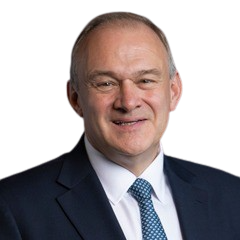
Jenny Riddell-Carpenter is the Labour MP for Suffolk Coastal, having first been elected to parliament at the 2024 general election.
In the 2024 general election, Riddell-Carpenter won 15,672 votes, representing 31.7% of the vote. The Conservative candidate, Thérèse Coffey, received 14,602 votes (29.5%), while the Reform UK candidate, Matthew Jackson, secured 7,850 votes (15.9%). Riddell-Carpenter was duly elected with a majority of 1,070.
The Suffolk Coastal constituency is located in the county of Suffolk in the East of England. The constituency was held by the Conservative Party from its creation in 1983 to 2024. Riddell-Carpenter’s victory marked the first time Labour had won the seat.
Riddell-Carpenter’s immediate predecessor as the MP for Suffolk Coastal was Thérèse Coffey of the Conservative Party (2010-2024). John Gummer, later Lord Deben, held the seat from 1983 to 2010.
Political Career
Riddell-Carpenter currently serves as parliamentary under-secretary of state in the Department for Environment, Food and Rural Affairs. She was appointed to this role in July 2026, following the Labour leadership contest and Andy Burnham’s elevation as prime minister.
In May 2026, Riddell-Carpenter was among the over 100 Labour MPs who signed a joint statement insisting it was “no time for a leadership contest.” The letter was an intervention in the political crisis engulfing Keir Starmer’s premiership, after Labour suffered heavy losses in the 2026 local elections and devolved elections to the Scottish Parliament and Senedd Cymru. It was organised as a counterweight to a mounting rebellion that had seen high-profile figures, including some ministers, call for Starmer’s resignation.
The statement read: “Last week we had a devastatingly tough set of election results. It shows we have a hard job ahead to win back trust from the electorate.
“That job needs to start today – with all of us working together to deliver the change the country needs.
“We must focus on that. This is no time for a leadership contest.”
Riddell-Carpenter chairs the Labour Rural Research Group (LRRG) – a caucus made up of MPs representing Labour’s so-called “rural wall”. Launched in August 2025, the group’s primary aim is to ensure that policy is developed with a clear understanding of the distinct challenges and priorities of rural and semi-rural communities.
The LRRG conducts research and consultations to challenge what it sees as a “rural blind spot” in Whitehall. Its first report, “Understanding Rural Britain”, surveyed voters on issues from healthcare and the economy to housing and the environment, seeking to build an evidence-based policy platform. The survey found nearly three quarters (74.4%) of respondents believe rural communities had been overlooked over the past 15 years. On the back of the report, Riddell-Carpenter stated that labelling rural voters as Nimbys (not in my back yard) was “toxic” and maintained “many people rightly despise the term”.
In a September 2025 LabourList article, Riddell-Carpenter said the LRRG was formed to “ensure rural voices are no longer ignored and that our rural communities are at the centre of national conversations about growth, opportunity, and our country’s future.”
She wrote: “My constituents – just like the majority of rural voters – despise being called Nimbys… And why wouldn’t they? They are progressive, and many of them voted Labour.
“In fact, 65.2% of rural voters polled agree that development in their area should proceed, as long as it is delivered thoughtfully, and with consideration for local needs and identity.”
Riddell-Carpenter has sat as a member of the House of Commons environment, food and rural affairs select committee (2024-2026).
Riddell-Carpenter has been listed as a member of the all-party parliamentary groups (APPGs) for maritime and ports (chair), healthy homes and buildings and the volunteer rescue service.
Riddell-Carpenter delivered her maiden speech on 24 October 2024 during a debate on Black History Month.
In it, she said: “For all its charm and beauty, however, there is much that lies beneath, hiding in plain sight in our beautiful seaside towns and charming villages. We have a special educational needs and disabilities crisis that is no less severe in Suffolk Coastal than it is across the rest of Suffolk and the east of England.
“We have real deprivation in some of our rural towns. This rural poverty cuts across all age groups: we have young families struggling with the cost of living, we have people struggling to access and stay in work, and we have an older population who are often isolated in rural communities, with few or no bus services to connect them to the amenities and health services that they need most.”
She added: “It is these things that fuel my determination to make every day in this place count and ensure that I speak up for those who have been forgotten and left behind or do not have a voice to speak up for themselves.”
Political views
Leadership elections
Labour deputy leadership 2025: Riddell-Carpenter was one of 117 Labour MPs who nominated Lucy Powell for the party’s deputy leadership in September 2025. The election followed the resignation of Angela Rayner, who stepped down as deputy prime minister and deputy party leader after an investigation into her tax affairs. It marked the first time since 2007 that Labour had held a deputy leadership contest while in government.
Powell, the former leader of the House of Commons, was seen as a candidate representing the party’s “soft left”; she was supported by leading soft left figures including Ed Miliband and Andy Burnham. She secured 117 nominations from the Parliamentary Labour Party (PLP), above the 80 required, and went on to win the election – defeating Bridget Phillipson with 54.3% of the vote.
Factional identity and party tradition
SERA: Riddell-Carpenter has been listed as a member of the Socialist Environment and Resources Association (SERA) – a socialist society affiliated with the Labour Party. Founded in 1973, SERA is the party’s official environmental campaign group. The organisation campaigns on a wide range of issues, including renewable energy, biodiversity, air quality and the transition to a green economy. SERA describes its member MPs as “champions for the environment”.
Electoral reform
Fair elections APPG: Riddell-Carpenter is listed as a supporter of the all-party parliamentary group (APPG) for fair elections – a cross-party group of MPs and peers that campaigns for electoral reform. The group’s stated aims include replacing the first past the post (FPTP) voting system with a form of proportional representation, eliminating “dark money” and “undemocratic influence” from politics, and countering disinformation.
Electoral reform amendment: In May 2026, Riddell-Carpenter was one of over 70 Labour MPs who signed an amendment to the Representation of the People Bill, calling on the government to establish a “national commission on electoral reform”. Tabled by Alex Sobel as chair of the fair elections APPG, the amendment aimed to force a rethink of the first past the post voting system.
At the time, Sobel described FPTP as “one of the biggest examples of a broken status quo in UK politics.” He invited colleagues to join this “common sense call to take a fresh look at how parliament is elected in modern Britain.”
Proportional representation bill: In December 2024, Riddell-Carpenter voted in favour of the Elections (Proportional Representation) Bill – introduced by Liberal Democrat frontbencher Sarah Olney under the 10-minute rule procedure. The bill sought to “introduce a system of proportional representation for parliamentary elections and for local government elections in England”.
A total of 138 MPs supported the bill – with 136 opposed. Notably, 59 Labour MPs backed Olney’s bill.
Introducing the bill, Olney told the House: “First past the post is a broken and unfair system. This summer, the Labour party won a landslide election victory, securing 63% of seats in the House of Commons in return for just 34% of the vote.
“The system leaves millions of voices unheard and creates a divisive, adversarial political climate where collaboration is discouraged and accountability is often sidestepped.”
Welfare
Welfare ‘reasoned amendment’ (June 2025): Riddell-Carpenter was one of the over 120 Labour MPs to sign the reasoned amendment to the government’s flagship welfare bill which aimed to reject the proposed legislation.
The amendment, in the name of senior Labour MP Dame Meg Hillier, objected to the fact that the bill had not been subject to a “formal consultation with disabled people” and that “250,000 people will be pushed into poverty” as a result of it, according to a government impact assessment.
The motion also called on the government to wait for the publication of the review into the Personal Independence Payment (Pip), helmed by minister Sir Stephen Timms, and the independent review, conducted by Sir Charlie Mayfield, into how the employment of disabled people could be boosted.
Welfare vote (July 2025): Riddell-Carpenter voted in favour of the government’s flagship welfare bill at second reading. The vote came after ministers agreed to significant concessions to avoid defeat via a mass rebellion of Labour MPs on 1 July 2025.
Assisted dying
Riddell-Carpenter voted in favour of the Terminally Ill Adults (End of Life) Bill, better known as the assisted dying bill, at both second reading (November 2024) and third reading (June 2025).
Social values and conscience issues
Abortion decriminalisation (2025): Riddell-Carpenter voted in favour of a backbench amendment to the Crime and Policing Bill that sought to decriminalise abortion in England and Wales in June 2025. The amendment, which was passed by a majority of 242 votes, removed women from the threat of prosecution for ending a pregnancy at any stage. As an issue of conscience, MPs were allowed to vote according to their personal beliefs.
Palestine
Palestinian recognition letter (July 2025): In July 2025, Riddell-Carpenter was among the over 254 MPs to sign a cross-party letter calling for the government to immediately recognise the state of Palestine. The letter called on the prime minister and foreign secretary to recognise Palestine at the UN Conference then taking place in New York.
Before Politics
Jennifer Barbara Riddell-Carpenter was born in 1986. Her mother was a nurse; her father was a supply teacher and worked in a pupil referral unit. She attended Welbeck College and Woodbridge School.
Riddell-Carpenter studied history and politics at SOAS University of London, graduating in 2008. She obtained a master’s degree in Islamic history from the same institution in 2009.
Riddell-Carpenter later completed a further master’s degree at Henley Business School.
Riddell-Carpenter’s career before entering parliament centred on public relations, communications and government relations roles.
Notably, she was managing director of Cratus Group.
Personal Life
Riddell-Carpenter is married.
Trivia
Riddell-Carpenter is chair of the Labour Rural Research Group (LRRG).
Jenny Riddell-Carpenter has not written for Politics.co.uk.