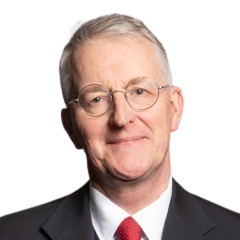
Hilary Benn is the Labour MP for Leeds South, having first been elected to parliament for the predecessor seat of Leeds Central in a by-election on 10 June 1999.
In the 2024 general election, Benn received 17,117 votes in Leeds South, representing 54.0% of the vote share. The Green Party candidate, Ed Carlisle, received 5,838 votes (18.4%), while the Conservative candidate, Karen Cooksley, secured 4,172 votes (13.2%). Benn was duly elected with a majority of 11,279 votes.
The Leeds South constituency covers inner-city areas of Leeds in West Yorkshire. It replaced the Leeds Central constituency following boundary changes, excluding the city centre but incorporating areas like Beeston, Holbeck, Hunslet, Middleton Park, and parts of Burmantofts and Richmond Hill. It is considered a safe Labour seat; the previous Leeds Central seat included two universities and was historically represented by former Labour leader Hugh Gaitskell.
Political Career
Benn served as secretary of state for Northern Ireland from July 2024 to July 2026. He left government as part of the July 2026 cabinet reshuffle conducted by Andy Burnham upon his appointment as prime minister.
Prior to the 2024 general election, which saw Labour returned to power after 14 years in opposition, Benn was shadow secretary of state for Northern Ireland (September 2023 – July 2024).
Benn has served extensively on the Labour frontbench.
In the wake of the 2015 general election, Benn was appointed shadow foreign secretary in the interim/caretaker shadow cabinet. He was retained in this role following the Labour leadership contest of the same year, which resulted in Jeremy Corbyn’s election as leader.
Benn served as shadow foreign secretary from May 2015 to June 2016.
A joint statement from Benn and Corbyn, issued September 2015, confirmed Labour would make the case for continued British membership of the European Union (EU) in the upcoming referendum campaign.
The pair stated: “So will Labour be campaigning to stay in regardless of the outcome of the government’s renegotiation [with the EU]?
“Yes. We believe that Britain is better off staying in Europe, and any unacceptable changes the government makes as part of its renegotiation, we will commit to reverse when we have the opportunity by campaigning for change within the EU.”
As shadow foreign secretary, Benn delivered a speech arguing in favour of military action against Isis in Syria – which went against Corbyn’s position.
https://x.com/stellacreasy/status/672177814284693504
In his peroration, Benn stated: “What we know about fascists is that they need to be defeated. It is why, as we have heard tonight, socialists, trade unionists and others joined the International Brigade in the 1930s to fight against Franco.
“It is why this entire House stood up against Hitler and Mussolini. It is why our party has always stood up against the denial of human rights and for justice. My view is that we must now confront this evil. It is now time for us to do our bit in Syria. That is why I ask my colleagues to vote for the motion tonight.”
In a rare break with commons convention, the speech was applauded by MPs from across the House – though notably not by Corbyn or the Labour leader’s supporters.
The foreign secretary, Philp Hammond, responded that Benn’s contribution would “go down as one of the truly great speeches made in the House of Commons.”
The following day, John McDonnell, the shadow chancellor, compared Benn’s speech to that delivered by prime minister Tony Blair in 2003 ahead of the Iraq War.
McDonnell told BBC Radio 4‘s Today programme: “[Benn’s] oratory was great. He reminded me of Tony Blair’s speech, external taking us into the Iraq war and I am always anxious that the greatest oratory can lead us to the greatest mistakes as well.”
In June 2016, Benn was dismissed from the shadow cabinet after he attempted to oust Corbyn as leader.
During a phone call in the early hours of 26 June, the Observer newspaper reported that Benn “called fellow MPs over the weekend to suggest that he will ask Corbyn to stand down if there is significant support for a move against the leader.”
The report added: “[Benn] has also asked shadow cabinet colleagues to join him in resigning if the Labour leader ignores that request.”
It came amid criticism of Corbyn’s leadership and his approach to the EU referendum.
After a phone conversation with Corbyn, in which he reportedly said that Labour MPs and shadow cabinet members had “no confidence in our ability to win the election”, Corbyn sacked Benn.
In a statement issued at 3:30, Benn said: “It has now become clear that there is widespread concern among Labour MPs and in the shadow cabinet about Jeremy Corbyn’s leadership of our party. In particular, there is no confidence in our ability to win the next election, which may come much sooner than expected, if Jeremy continues as leader.”
Hours later, shortly after 8:00 am, Heidi Alexander resigned as shadow health secretary. As such, Benn’s dismissal triggered a wave of shadow cabinet resignations – as well as an informal vote of no confidence in Corbyn’s leadership and a leadership contest, which the incumbent ultimately won.
From 2016 to 2021, Benn chaired the House of Commons exiting the European Union select committee and its successor, the committee on the future relationship with the European Union.
In September 2019, Benn introduced the European Union (Withdrawal) (No. 2) Act, often referred to as the Benn Act, which aimed to prevent a no-deal Brexit by requiring the prime minister, Boris Johnson, to seek an extension to the Article 50 period if no withdrawal agreement was approved by parliament.
Benn said the purpose of his bill was “simple: to ensure that the United Kingdom does not leave the European Union on 31 October without an agreement.”
The bill passed its second reading by 329 votes to 300 and its third reading later the same day by 327 to 299.
The prime minister declared he would “rather be dead in a ditch” than ask Brussels for a delay. However, he complied with the terms of the Benn Act on 19 October and an extension was agreed until 31 January 2020.
Under Ed Miliband’s leadership, Benn served as shadow leader of the house of commons (2010-2011) and shadow secretary of state for communities and local government (2011-2015).
Benn held senior positions in the New Labour government, attending cabinet.
Benn was secretary of state for environment, food and rural affairs under Gordon Brown (2007-2010). Under Tony Blair, he served as secretary of state for international development (2003-2007), having previously been minister of state (2003) and parliamentary under-secretary of state (2001-2002) in the same department.
In 2007, Benn was a candidate for the deputy leadership of the Labour Party following John Prescott’s resignation. He was reportedly the bookmakers’ favourite and the grassroots members’ favourite in early polling, but ultimately placed fourth.
Benn served as parliamentary under-secretary of state at the home office (2002-2003).
In July 2001, Benn was among a group of “up and coming young” Labour MPs and ministers to call on the government in which they served to abandon its “control-freak” policy towards public services. A report, published in the Labour journal Renewal, argued that a “second-term government needs to control and measure less, but explain and inspire much more.”
The MP group, which also included John Healey , urged the government to be “more upfront” with its goals of social justice, calling for a commitment to “devolve ever more responsibility and power from central government” in order to thwart the “perils of centralisation”.
Benn delivered his maiden speech on 23 June 1999.
In it, he stated: “The true test of our democratic system – and of the House, in the eyes of those who put us here – is whether we can demonstrate in practice to people in a constituency such as Leeds, Central that they can use this place to make a difference to their own lives.
“As the community police officer for Lincoln Green said to me last Friday, when I was talking to him about the area which he knows very well and cares about so passionately: ‘People are looking for a sign that things will get better’.”
He added: “That statement summarises why the ballot box has to be an instrument of hope as well as of democracy, a means of economic and political progress, and a way out of poverty and despair.
“It was that instrument of hope that, at the end of the second world war, created the national health service, and, under the current government, created the minimum wage and the new deal, of which we are justly proud. I believe that it is that instrument of hope that remains our best chance of meeting the challenges of the new century that will shortly dawn.”
Before entering parliament, Benn served as a councillor on Ealing borough council from 1979 to 1990. He was deputy leader of the Labour group and served as deputy leader of the council from 1986-1990. He unsuccessfully contested the Ealing North parliamentary seat for Labour in the 1983 and 1987 general elections.
Political Views
Leadership elections and loyalty
Labour leadership 2020: Benn was one of 82 Labour MPs who nominated Keir Starmer for the party’s leadership in early 2020. The election was triggered by the resignation of Jeremy Corbyn following the party’s defeat in the 2019 general election, which resulted in Labour’s fewest seats in the House of Commons since 1935.
Starmer’s 82 nominations were the highest of any candidate. The shadow Brexit secretary won a decisive victory in the first round with 56.2% of the vote, defeating Rebecca Long-Bailey and Lisa Nandy.
Labour leadership 2015: Benn was one of 68 Labour MPs who nominated Andy Burnham for the party’s leadership in June 2015. The election followed the resignation of Ed Miliband after the party’s defeat in the 2015 general election. It was the first contest held under the “one member, one vote” system, which replaced the previous electoral college.
Burnham, the shadow health secretary, was initially considered the frontrunner. He secured 68 nominations from the Parliamentary Labour Party (PLP), comfortably exceeding the 35 required to reach the final ballot. He ultimately finished second in the contest with 19% of the vote, losing to Jeremy Corbyn in the first round.
Corbyn loyalty list: In March 2016, Benn was labelled as “core group negative” by the Corbyn leadership in a leaked list which categorised Labour MPs by their perceived loyalty. This label suggested the Corbyn leadership viewed Benn as a critic but not openly hostile.
Labour leadership 2016: Benn supported Angela Eagle for the party’s leadership in July 2016. The election was triggered by a challenge to Jeremy Corbyn following the EU referendum, which led to a wave of shadow cabinet resignations and a vote of no confidence supported by 172 MPs.
Eagle, the former shadow first secretary of state, was the first to formally launch a challenge against Corbyn. However, she withdrew from the race on 19 July after attracting fewer nominations than Owen Smith.
Benn went on to support Smith’s unsuccessful candidacy. In the end, Corbyn won with an increased mandate of 61.8% of the vote.
Labour leadership 2010: Benn was one of 63 Labour MPs who nominated Ed Miliband for the party’s leadership in May 2010. The election followed the resignation of Gordon Brown, who stepped down as prime minister and Labour leader after the 2010 general election.
Miliband, the former energy and climate change secretary, was seen as the candidate of the “soft left” and secured significant backing from affiliated trade unions. He secured 63 nominations from the Parliamentary Labour Party (PLP), exceeding the 33 required to reach the final ballot. Miliband went on to narrowly defeat his brother, David, in the final round by 50.7% to 49.3%.
Brexit and Europe
Brexit referendum: Benn was a prominent opponent of Brexit, and therefore agreed with a majority of constituents, 54% of whom voted to remain in the 2016 referendum.
Article 50: In February 2017, Benn voted in favour of the European Union (Notification of Withdrawal) Bill. The legislation empowered the prime minister to notify the Council of the European Union of the UK’s intention to withdraw, formally triggering the process set out in Article 50 of the Treaty on European Union. MPs supported the bill by 498 votes to 114 at second reading.
Remain pledge: During the 2019 general election campaign, Benn was one of 193 Labour candidates to sign the anti-Brexit “Remain pledge”, drawn up by the campaign group Remain Labour.
It stated: “Labour is committed to a confirmatory referendum, to give you the final say on Brexit. If elected as your Labour MP, I pledge to campaign to Remain in the EU.”
https://x.com/hilarybennmp/status/1122887224838754304
Welfare
Welfare vote (July 2025): Benn voted in favour of the government’s flagship welfare bill at second reading. The vote came after ministers agreed to significant concessions to avoid defeat via a mass rebellion of Labour MPs on 1 July 2025.
Assisted dying
Benn voted in favour of the Terminally Ill Adults (End of Life) Bill, better known as the assisted dying bill, at second reading (November 2024) and third reading (June 2025).
In a statement setting out his position, Benn said: “For a long time I felt very torn about this matter. On the one hand, I am resolutely opposed to anything that might lead elderly or disabled people to be pressured by their families or others to bring their lives to an end; that would be wholly wrong. On the other hand, there are many cases in which people with terminal illnesses, often with very distressing symptoms, want to be able to choose the moment of their leaving of this world but currently cannot do so.”
He added: “I remain of the view that those who are facing the prospect of their own imminent death as a result of a terminal illness should be able to determine the timing and the manner of it, surrounded by those who love them and whom they love.
“Can I also say that if the law were to change, I believe that assisted dying should not become an alternative to high-quality palliative and end of life care. People deserve dignity in dying, and each person nearing the end of their life should feel reassured and safe in the knowledge they will receive the very best care.”
Social values and conscience issues
Abortion decriminalisation (2025): Benn voted in favour of a backbench amendment to the Crime and Policing Bill that sought to decriminalise abortion in England and Wales in June 2025. The amendment, which was passed by a majority of 242 votes, removed women from the threat of prosecution for ending a pregnancy at any stage. As an issue of conscience, MPs were allowed to vote according to their personal beliefs.
Same-sex marriage (2013): In February 2013, Benn voted in favour of the Marriage (Same Sex Couples) Bill at its second reading. The landmark piece of legislation, which received its second reading by 400 votes to 175, legalised marriage for same-sex couples in England and Wales.
Foreign policy and security
Trident renewal (2016): Benn voted in favour of a government motion calling for the renewal of the Trident nuclear deterrent system in July 2016. The motion, which was passed by 472 votes to 117, committed the UK to constructing a new fleet of submarines to carry the nation’s nuclear weapons. Labour was split over the issue with 140 of its 230 MPs going against leader Jeremy Corbyn and backing the motion.
Palestinian recognition vote (2014): In October 2014, Benn was one of 192 Labour MPs who voted in favour of recognising Palestine as a state. The motion, passed by 274 votes to 12, called on the government to “recognise the state of Palestine alongside the state of Israel as a contribution to securing a negotiated two-state solution”.
Syria airstrikes (2013): Benn voted against the government’s motion on the principle of military intervention in Syria in August 2013. The government motion was defeated by 285 votes to 272, a move which effectively ruled out UK participation in any US-led military strikes.
Iraq War authorisation vote (2003): In March 2003, Benn voted in favour of the government motion authorising military action against Iraq. The vote, one of the most contentious in recent parliamentary history, gave the prime minister, Tony Blair, the authority to join the US-led invasion.
Before Politics
Born Hilary James Wedgwood Benn on 26 November 1953 in Hammersmith, London, he is the son of the prominent left-wing Labour politician Tony Benn and educationalist Caroline Benn.
Benn attended Holland Park comprehensive school in London and then studied Russian and eastern European studies at the University of Sussex, graduating in 1974.
After university, Benn worked as a research officer for the trade union ASTMS (Association of Scientific, Technical and Managerial Staffs). He later became head of research, then head of policy and communications, for its successor union MSF (Manufacturing, Science, Finance).
From 1997 to 1999, Benn worked as special adviser to David Blunkett at the department for education and employment.
Personal Life
Benn’s first wife, Rosalind Retey, whom he married in 1973, died in 1979. He married his second wife, Sally Clark, in 1982. He has four children.
Benn is part of a well-known political family; his brother is Stephen Benn, 3rd Viscount Stansgate, his sister is writer Melissa Benn and his grandfather William Wedgwood Benn was also an MP, who served as secretary of state for India from 1929 to 1931.
Trivia
Benn enjoys gardening and watching sport. He is a teetotaller and vegetarian.
The Benn political family has achieved the unique distinction of having a member serve in every Labour cabinet to date.
Hilary Benn has not written for Politics.co.uk.