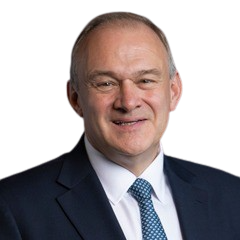
Henry Tufnell is the Labour MP for Mid and South Pembrokeshire, having first been elected to parliament at the 2024 general election.
In the 2024 general election, Tufnell won 16,505 votes, representing 35.4% of the vote. The Conservative candidate, Stephen Crabb, received 14,627 votes (31.4%), while the Reform UK candidate, Stuart Marchant, secured 7,828 votes (16.8%). Tufnell was duly elected with a majority of 1,878.
The Mid and South Pembrokeshire constituency, located in Pembrokeshire, Wales, was newly ahead of the 2024 election. It incorporated areas previously part of the Preseli Pembrokeshire constituency (represented by Conservative Stephen Crabb) and the Carmarthen West and South Pembrokeshire constituency (represented by Conservative Simon Hart).
Political Career
Tufnell is a member of the House of Commons environment, food and rural affairs select committee (since October 2024) – the committee responsible for scrutinising the work of the Department for Environment, Food and Rural Affairs (Defra). It looks at issues from farming to the water sector to a circular economy.
Tufnell is also a member of the House of Commons Welsh affairs select committee (since October 2024) – the committee that examines the UK government’s policy and spending as it relates to Wales. Its primary role is to scrutinise the work of the secretary of state for Wales and the Wales Office.
In January 2026, Tufnell was one of over 60 Labour MPs to sign a letter to the prime minister calling for the introduction of an Australia-style ban on social media access for children under the age of 16. Organised by Plymouth Moor View MP Fred Thomas, the initiative brought together a cross-factional coalition of backbenchers – spanning the Socialist Campaign Group, Tribune Group and Blue Labour – to demand action.
The letter called on Keir Starmer to “show leadership” by introducing a minimum age for social media access “to protect young people from the consequences of unregulated, addictive social media platforms”.
It stated: “We are all strong supporters of technology, and of this Labour government’s ambition to use tech to improve lives. But successive governments have done far too little to protect young people from the consequences of unregulated, addictive social media platforms.”
In March 2025, Tufnell became one of the first Labour MPs to publicly criticise the government’s changes to inheritance tax, which had sparked considerable opposition among farming communities.
He stated: “Me and a number of other MPs who are part of this new, broader, coalition within the Labour Party have to stand up and inform government that this is affecting our constituents.”
Tufnell is listed as a member of the all-party parliamentary groups (APPGs) for carbon capture, utilisation and storage (co-chair), the Celtic Sea (co-chair), energy studies and project delivery (chair).
Tufnell delivered his maiden speech on 15 October 2024 during a debate on the House of Lords (Hereditary Peers) Bill.
In it, he said: “Country first, party second…
“I chose to join the Labour party, and now, perhaps to my father’s despair, I choose to vote and do away with hereditary peers. I say sorry to my dad, who is sitting in the Public Gallery today, but I am here to serve the many, not the few.”
He added: “In my county, where we have the highest child poverty rates in Wales, those words are as true now as they were then.
“I will use my time in this House to fight for fairness, to deliver real change and to stand up for all the people who live, learn and work in the wonderful community that sent me to parliament. The work is urgent, the time for action is now, and I am here to serve.”
Political Views
Leadership elections
Labour deputy leadership 2025: Tufnell was one of 175 Labour MPs who nominated Bridget Phillipson for the party’s deputy leadership in September 2025. The election followed the resignation of Angela Rayner, who stepped down as deputy prime minister and deputy party leader after an investigation into her tax affairs. It marked the first time since 2007 that Labour had held a deputy leadership contest while in government.
Phillipson, the serving education secretary, was widely viewed as the candidate favoured by Downing Street and the party leadership. She secured 175 nominations from the Parliamentary Labour Party (PLP), comfortably exceeding the 80 required to reach the final ballot. She was ultimately defeated by Lucy Powell.
Factional identity and party tradition
Labour Rural Research Group: Tufnell has been listed as a member of the Labour Rural Research Group (LRRG) – a caucus made up of MPs representing Labour’s so-called “rural wall”. Launched in August 2025, the group’s primary aim is to ensure that policy is developed with a clear understanding of the distinct challenges and priorities of rural and semi-rural communities.
The LRRG, chaired by the Suffolk Coastal MP Jenny Riddell-Carpenter, conducts research and consultations to challenge what it sees as a “rural blind spot” in Whitehall. Its first report, “Understanding Rural Britain”, surveyed voters on issues from healthcare and the economy to housing and the environment, seeking to build an evidence-based policy platform. The survey found nearly three quarters (74.4%) of respondents believe rural communities had been overlooked over the past 15 years. On the back of the report, Riddell-Carpenter stated that using the labelling rural voters as Nimbys (not in my back yard) was “toxic” and maintained “many people rightly despise the term”.
Labour Growth Group: Tufnell has been listed as a member of the Labour Growth Group (LGG) – a vocal faction of backbenchers committed to ensuring economic growth remains the central mission of the government. The group, largely composed of MPs from the 2024 intake, positions itself as the voice of “the builders, not the blockers” and provides organised support for ministers taking on politically difficult decisions in the name of economic expansion.
In an open letter addressed to Keir Starmer, issued upon the group’s founding in July 2024, LGG MPs said it was imperative that “the government grasps the nettle and goes for growth”.
They added: “This absolutely has to start with the sweeping planning reforms to get Britain building again. Under the Tories, planning permissions for new homes hit record lows and housebuilding cratered. Indeed, not once in their 14 years in power did the Conservatives meet their housing targets.”
Welfare
Welfare ‘reasoned amendment’ (June 2025): Tufnell was one of the over 120 Labour MPs to sign the reasoned amendment to the government’s flagship welfare bill which aimed to reject the proposed legislation.
The amendment, in the name of senior Labour MP Dame Meg Hillier, objected to the fact that the bill had not been subject to a “formal consultation with disabled people” and that “250,000 people will be pushed into poverty” as a result of it, according to a government impact assessment.
The motion also called on the government to wait for the publication of the review into the Personal Independence Payment (Pip), helmed by minister Sir Stephen Timms, and the independent review, conducted by Sir Charlie Mayfield, into how the employment of disabled people could be boosted.
Welfare vote (July 2025): Tufnell voted in favour of the government’s flagship welfare bill at second reading. The vote came after ministers agreed to significant concessions to avoid defeat via a mass rebellion of Labour MPs on 1 July 2025.
Assisted dying
Tufnell voted in favour of the Terminally Ill Adults (End of Life) Bill, better known as the assisted dying bill, at both second reading (November 2024) and third reading (June 2025).
Social values and conscience issues
Abortion decriminalisation (2025): Tufnell voted in favour of a backbench amendment to the Crime and Policing Bill that sought to decriminalise abortion in England and Wales in June 2025. The amendment, which was passed by a majority of 242 votes, removed women from the threat of prosecution for ending a pregnancy at any stage. As an issue of conscience, MPs were allowed to vote according to their personal beliefs.
Palestine
Palestinian recognition letter (July 2025): In July 2025, Tufnell was among the over 254 MPs to sign a cross-party letter calling for the government to immediately recognise the state of Palestine. The letter called on the prime minister and foreign secretary to recognise Palestine at the UN Conference then taking place in New York.
Before Politics
Tufnell was born on 19 June 1992. He attended Radley College in Oxford.
Tufnell studied history at Brown University in the United States. He completed a graduate diploma in law and the bar professional training course at City Law School in London in 2017/2018.
Tufnell’s career before entering frontline politics centred on legal posts and trade union roles. He practised as a barrister at Crown Office Row.
Personal Life
Tufnell is married.
Tufnell comes from a Gloucestershire landowning family. His father, Mark Tufnell, is a former president of the Country Land and Business Association (CLA).
In his 2024 maiden speech, Tufnell told the House: “I say sorry to my dad, who is sitting in the Public Gallery today, but I am here to serve the many, not the few.”
Trivia
Tufnell competed in middle-distance running at a national level, finishing third in the 800 metres event at the British Athletics Championships in 2014.
He was a member of the track and field/cross country team while attending Brown University.
Henry Tufnell has not written for Politics.co.uk.