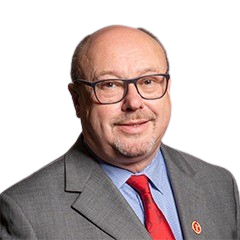
Grahame Morris is the Labour MP for Easington, having first been elected to parliament at the 2010 general election.
In the 2024 general election, Morris won 16,774 votes, representing 48.9% of the vote. The Reform UK candidate, Lynn Murphy, received 10,232 votes (29.8%), while the Conservative candidate, Joanne Howey, secured 3,753 votes (10.9%). Morris was duly elected with a majority of 6,542 votes.
The Easington constituency is located in County Durham, North East England, including towns such as Seaham and Peterlee. It is considered one of the safest Labour seats in the country, held by the party continuously since its creation in 1950. Ramsay MacDonald, the first Labour prime minister, represented the former seat of Seaham from 1929 to 1935.
Political Career
At the beginning of the parliament elected in 2024, Morris stood unsuccessfully for election as chair of the transport committee. In the contest, the results of which were announced in September 2024, Morris secured 83 votes, placing fourth. They were eliminated in the first round. They were ultimately defeated by Ruth Cadbury, who won the support of 328 colleagues.
Morris served in the shadow cabinet as shadow secretary of state for communities and local government and shadow minister for the constitutional convention from June to October 2016 under Jeremy Corbyn.
Previously, Morris served as the opposition whip from September 2015 until June 2016.
In 2014, Morris led a debate in the House of Commons on a motion calling on the government to recognise Palestinian statehood. The motion called on the government to “recognise the state of Palestine alongside the state of Israel as a contribution to securing a negotiated two-state solution”.
During the debate, Morris told the commons: “It is clear that both Israel-Palestine relations and our foreign policy are at an impasse, which must be broken. We hear a great deal of talk about the two-state solution.
“Today, through validating both states, members will have the opportunity to translate all that principled talk into action, but we should be under no illusions – today might be a symbolically important step, but it will not change the facts on the ground.”
He added; “The continuous blockade of the Gaza strip will not relent and the day-to-day reality of life under occupation will not change for the ordinary Palestinians. Opponents of the motion will use the well-worn argument that statehood should come through negotiations and not unilateral action.”
The non-binding motion was passed by 274 votes to 12.
Morris was a member of the House of Commons transport committee (2018-2024) and the health and social care committee (2010-2015).
Morris is listed as a member of the all-party parliamentary groups (APPGs) for Cuba, drugs, alcohol and justice, racing and bloodstock and radiotherapy.
Morris delivered his maiden speech on 3 June 2010 during a debate on European affairs.
In it, he said: “The lasting legacy of coal mining in Easington, however, is tarnished by the joblessness and economic activity that followed the reckless actions of previous Tory administrations.
“Easington has prospered and seen significant improvements over the past decade, but more recently it has been at the forefront of job losses and economic decline, due to the global financial crisis and recession, which is why the successes of Caterpillar in Peterlee and the automotive industry – directly related to the success of Nissan in Sunderland – are so important.”
He added: “As several of my colleagues have said, to represent the people of your home constituency – in my case, Easington – is a great privilege. It is all the more special for me as I represent the constituency in which I was born and where I have lived, brought up my family and worked all my life.
“As honourable members may be aware – or perhaps not – Easington has an illustrious list of former members of parliament and a proud tradition of trade union and Labour party representation.”
Before entering parliament, Morris served as a Labour councillor on Easington district council from 1987 to 2002.
Political views
Leadership elections and loyalty
Labour deputy leadership 2025: Morris was one of 24 Labour MPs who nominated Bell Ribeiro-Addy for the party’s deputy leadership in September 2025. The election followed the resignation of Angela Rayner, who stepped down as deputy prime minister and deputy party leader after an investigation into her tax affairs. It marked the first time since 2007 that Labour had held a deputy leadership contest while in government.
Ribeiro-Addy, a member of the Socialist Campaign Group (SCG), was seen as the candidate on the left of the party. She secured only 24 nominations from the Parliamentary Labour Party (PLP), far short of the 80 required under rules introduced in 2021.
Labour leadership 2020: Morris was one of 33 Labour MPs who nominated Rebecca Long-Bailey for the party’s leadership in early 2020. The election was triggered by the resignation of Jeremy Corbyn following the party’s defeat in the 2019 general election, which resulted in Labour’s fewest seats in the House of Commons since 1935.
Long-Bailey, then the shadow business secretary, was widely regarded as the continuity candidate for the party’s left/Corbynite wing. Long-Bailey finished second with 27.6% of the vote, losing to Keir Starmer, who won a decisive victory in the first round with 56.2%.
Labour leadership 2015: Morris was one of 36 Labour MPs who nominated Jeremy Corbyn for the party’s leadership in June 2015. The election followed the resignation of Ed Miliband after the party’s defeat in the 2015 general election. It was the first contest held under the “one member, one vote” system, which replaced the previous electoral college.
Corbyn, a veteran backbencher, secured the 36 nominations required – just one over the threshold – but only after several MPs lent him their support to ensure a broader ideological debate. His anti-austerity platform gained significant momentum, and he won a landslide victory in the first round with 59.5% of the vote.
Corbyn loyalty list: In March 2016, Morris was labelled as “core group” by the Corbyn leadership in a leaked list which categorised Labour MPs by their perceived loyalty. This label suggested the Corbyn leadership viewed Morris as among its closest allies, even as an inner circle member.
Labour leadership 2016: Morris was one of the minority of Labour MPs who endorsed Jeremy Corbyn during his successful defence of the party leadership in September 2016. The election was triggered following a period of intense tension after the EU referendum, which saw a wave of shadow cabinet resignations and a vote of no confidence supported by 172 MPs.
Corbyn, who was automatically included on the ballot as the incumbent, was challenged by Owen Smith, the former shadow work and pensions secretary. Corbyn won the election with an increased mandate, securing 61.8% of the vote compared to 38.2% for Smith.
Labour leadership 2010: Morris was one of 63 Labour MPs who nominated Ed Miliband for the party’s leadership in May 2010. The election followed the resignation of Gordon Brown, who stepped down as prime minister and Labour leader after the 2010 general election.
Miliband, the former energy and climate change secretary, was seen as the candidate of the “soft left” and secured significant backing from affiliated trade unions. He secured 63 nominations from the Parliamentary Labour Party (PLP), exceeding the 33 required to reach the final ballot. Miliband went on to narrowly defeat his brother, David, in the final round by 50.7% to 49.3%.
Factional identity and party tradition
Socialist Campaign Group: Morris has been listed as a member of the Socialist Campaign Group – the standard-bearer of the left wing within the Parliamentary Labour Party (PLP). Founded in 1982 by followers of Tony Benn, the group has traditionally advocated policies such as widespread public ownership, wealth redistribution and strengthened trade union rights.
Corbyn suspension: In November 2020, Morris was among the 32 SCG MPs to sign a statement declaring that they opposed the suspension of Jeremy Corbyn and calling for the disciplinary action to be “swiftly reversed”.
The statement read: “This decision and the division it causes severely undermines efforts to unite to defeat antisemitism and fully implement the EHRC [Equality and Human Rights Commission] recommendations and to challenge and defeat this disastrous Conservative government.”
Corbyn’s suspension came after he issued a response to the EHRC report, arguing “the scale of the [antisemitism] problem was also dramatically overstated for political reasons by our opponents”.
Momentum endorsement: Morris was endorsed by the left-wing campaign group Momentum in the 2024 general election. Momentum was founded in 2015 to support the leadership of Jeremy Corbyn and to campaign for socialist policies within the Labour party.
Spycops vote (2020): In October 2020, Morris was one of the 34 Labour MPs to break the party whip by voting against the covert Human Intelligence Sources (Criminal Conduct) Bill at its commons third reading. The proposed legislation, often referred to as the “spycops bill”, was introduced by the Conservative government to authorise undercover agents and informants to commit crimes while on operations. The Labour Party had whipped its representatives to abstain on the bill on the basis that the legislation is “far from perfect” yet “necessary” due to “the need to provide a clear lawful framework for the use of human intelligence sources”.
Anti-austerity letter (2015): Morris was among the 16 Labour MPs – generally associated with the party’s left wing – who signed a statement demanding then-leader Ed Miliband oppose further austerity, take rail franchises back into public ownership and strengthen collective bargaining arrangement. Jeremy Corbyn, Diane Abbott and John McDonnell were among the signatories.
The statement, issued in January 2015, read: “There is an alternative way out of endless austerity. We need public investment to kickstart the economy out of faltering growth and to generate real job creation and rising incomes.”
Brexit and Europe
Brexit referendum: Morris supported Remain in the 2016 Brexit referendum, and therefore disagreed with a majority of his constituents, 66% of whom voted to Leave.
Article 50: In February 2017, Morris voted in favour of the European Union (Notification of Withdrawal) Bill. The legislation empowered the prime minister to notify the Council of the European Union of the UK’s intention to withdraw, formally triggering the process set out in Article 50 of the Treaty on European Union. MPs supported the bill by 498 votes to 114 at second reading.
Electoral reform
Electoral reform amendment: In May 2026, Morris was one of over 70 Labour MPs who signed an amendment to the Representation of the People Bill, calling on the government to establish a “national commission on electoral reform”. Tabled by Alex Sobel as chair of the fair elections APPG, the amendment aimed to force a rethink of the first past the post voting system.
At the time, Sobel described FPTP as “one of the biggest examples of a broken status quo in UK politics.” He invited colleagues to join this “common sense call to take a fresh look at how parliament is elected in modern Britain.”
Welfare
Welfare ‘reasoned amendment’ (June 2025): Morris was one of the over 120 Labour MPs to sign the reasoned amendment to the government’s flagship welfare bill which aimed to reject the proposed legislation.
The amendment, in the name of senior Labour MP Dame Meg Hillier, objected to the fact that the bill had not been subject to a “formal consultation with disabled people” and that “250,000 people will be pushed into poverty” as a result of it, according to a government impact assessment.
The motion also called on the government to wait for the publication of the review into the Personal Independence Payment (Pip), helmed by minister Sir Stephen Timms, and the independent review, conducted by Sir Charlie Mayfield, into how the employment of disabled people could be boosted.
In May 2025, Morris had signed a letter warning the government that the cuts were “impossible to support” and calling for a change in direction.
The letter, signed by 42 Labour MPs, read: “The planned cuts of more than £7bn represent the biggest attack on the welfare state since George Osborne ushered in the years of austerity and over 3 million of our poorest and most disadvantaged will be affected.
“Whilst the government may have correctly diagnosed the problem of a broken benefits system and a lack of job opportunities for those who are able to work, they have come up with the wrong medicine. Cuts don’t create jobs, they just cause more hardship.”
Welfare vote (July 2025): Morris went on to vote against the bill at second reading. The vote came after ministers agreed to significant concessions to avoid defeat via a mass rebellion of Labour MPs on 1 July 2025.
Winter fuel payment EDM: In September 2024, Morris signed an early day motion (EDM) expressing concern over the government’s proposed changes to the winter fuel payment. The motion called on the government to “postpone the ending of winter fuel payments and establish a comprehensive strategy to tackle fuel poverty, health inequality and low incomes among older people.”
Welfare vote (July 2015): Alongside almost one quarter of his colleagues, Morris voted against the Conservative government’s Welfare Reform and Work Bill at second reading – defying the party whip which instructed Labour MPs to abstain. This decision to abstain, taken by interim Labour leader Harriet Harman, caused a furious backlash within the party, particularly from its left wing. It became a defining issue in the ongoing leadership contest. Jeremy Corbyn was the only candidate to vote against the bill. Overall, 48 Labour MPs voted against the proposed legislation.
Assisted dying
Morris voted against the Terminally Ill Adults (End of Life) Bill, better known as the assisted dying bill, at both second reading (November 2024) and third reading (June 2025).
Social values and conscience issues
Same-sex marriage (2013): In February 2013, Morris voted in favour of the Marriage (Same Sex Couples) Bill at its second reading. The landmark piece of legislation, which received its second reading by 400 votes to 175, legalised marriage for same-sex couples in England and Wales.
Foreign policy and security
Syria airstrikes (2015): Morris voted against a government motion to extend UK airstrikes against Isis from Iraq into Syria in December 2015. The motion, which was passed by 397 votes to 223 after a ten-hour debate in the House of Commons, authorised the RAF to conduct strikes against Isis targets in Syria.
Syria airstrikes (2013): Morris voted against the government’s motion on the principle of military intervention in Syria in August 2013. The government motion was defeated by 285 votes to 272, a move which effectively ruled out UK participation in any US-led military strikes.
Palestine
LFPME: Morris has been listed as a member of Labour Friends of Palestine and the Middle East (LFPME). The organisation’s stated aim is to promote peace and justice in the region through the application of international law and respect for human rights.
Morris formerly chaired the group.
Palestinian recognition letter (July 2025): In July 2025, Morris was among the over 254 MPs to sign a cross-party letter calling for the government to immediately recognise the state of Palestine. The letter called on the prime minister and foreign secretary to recognise Palestine at the UN Conference then taking place in New York.
Palestine Action vote: Also in July 2025, Morris was one of 26 MPs to vote against the proscription of Palestine Action under the Terrorism Act 2000. The ban, passed by 385 votes to 26, came after the Home Office accused the group of “aggressive and intimidatory attacks against businesses, institutions and the public”. However, civil liberties organisations argued proscription represented an overreach of state power and a threat to the right to protest.
Ceasefire vote (November 2023): Morris was among 56 Labour MPs to vote in favour of a Scottish National Party (SNP) amendment to the King’s Speech in the House of Commons calling for an “immediate ceasefire” in Gaza – defying the instruction set out by the party’s frontbench. Labour had tabled its own motion, making a more moderate appeal for a “humanitarian pause” in the conflict and ordered its representatives to support that stance.
Civil liberties
Covid passes campaign (2021): Morris was one of over 70 MPs and peers who launched a cross-party campaign against the “divisive and discriminatory use” of Covid passes in April 2021. The campaign was triggered by government reviews into “vaccine passports”, which signatories argued would create a two-tier society and infringe upon fundamental civil liberties.
Before Politics
Born Grahame Morris in Easington on 13 March 1961. His father was a coal miner.
Morris attended Howletch Comprehensive School. He studied medical laboratory sciences at Newcastle Polytechnic and worked as a medical laboratory scientific officer in Sunderland NHS hospitals.
Morris joined the Labour Party aged 15 in 1976.
Morris worked as a parliamentary assistant to his predecessor as MP for Easington, John Cummings, from 1997 until 2010.
Personal Life
Morris has two sons and lives in Dawdon within his constituency.
He married during the 1984/85 Miners’ Strike.
In March 2024, he told the Northern Echo: “The Miners’ Strike personally touched me very deeply.
“My father was a coal miner and was on strike for the duration of the 84/85 Miners’ Strike. I had deep family connections, in fact my mother worked in the pit canteen and was a member of the NUM.
“At the time I was working in the NHS, at the Sunderland hospitals and got married during the Miners’ Strike.
“But I was living at home and I was a member of the Labour Party and my trade union very much supported the miners in what wasn’t a struggle about wages, it was a struggle for survival.”
He added: “When Margaret Thatcher effectively went to war against the mining communities there is no doubt about it in my mind get the role that she played in politicising the police and the state institutions – and it was a struggle for existence.
“When commentators at the time said the miners’ leaders were scaremongering about the plans to close down the industry and the impact that it would have – well unfortunately their predictions were completely true.”
Trivia
Morris is a supporter of Sunderland FC.

Government cuts to supported housing could force services to close
5 August 2016