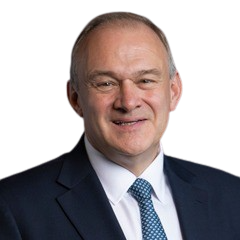
Emma Hardy is the Labour MP for Kingston upon Hull West and Haltemprice, having first been elected to parliament at the 2017 general election.
In the 2024 general election for the new Kingston upon Hull West and Haltemprice constituency, Hardy received 17,875 votes (46.8%). The Reform UK candidate received 8,896 votes (23.3%), and the Conservative candidate secured 6,924 votes (18.1%). Hardy was duly elected with a majority of 8,979.
The Kingston upon Hull West and Haltemprice constituency covers the western side of the city of Kingston upon Hull, including the city centre and port areas, the town of Hessle, and suburban villages formerly in the Haltemprice area, such as Anlaby, Kirk Ella, and Willerby.
The seat was created for the 2024 election, merging the safe Labour Hull West and Hessle seat (held by Labour since WWII) with more affluent areas from the former Conservative seat of Haltemprice and Howden (represented by Conservative MP David Davis from 1997 to 2024).
Hardy’s immediate predecessor as the MP for Labour Hull West and Hessle was Alan Johnson, who represented the seat from 1997 to 2017. Johnson held a series of senior frontbench roles during his tenure as a parliamentarian, including home secretary from 2009 to 2010.
In her 2017 maiden speech, Hardy recounted that since her election, she had frequently been greeted as “the new Alan Johnson” and stated that, despite the “obvious differences” between them, this was a comparison she was “very proud” of.
Political Career
Hardy currently serves as minister of state in the Department for Environment, Food and Rural Affairs. She was appointed to this role in July 2026, following the Labour leadership contest and Andy Burnham’s elevation as prime minister.
Hardy served as the parliamentary under-secretary of state for water and flooding at the Department for Environment, Food and Rural Affairs (Defra) from July 2024 to July 2026.
Prior to the 2024 general election, which saw Labour returned to power after 14 years in opposition, Hardy served in the shadow Defra team as shadow minister for environmental quality and resilience (September 2023 – July 2024). Before that, she was shadow minister for further education and universities from January 2020 until March 2021, when she stepped down citing increased constituency workload during the pandemic.
In her resignation letter, Hardy said the number of people seeking her help had “risen dramatically” due to the coronavirus pandemic. She blamed the government’s handling of the pandemic for “taking a heavy toll on the place I love”.
“In the past year, the number of residents contacting me needing help and support has risen dramatically; I was elected as their representative and their needs will always come first”, she wrote.
Hardy added: “This Conservative government is no friend to the residents of Hull and Hessle and the promises it made at the last election are already ringing hollow. I invite you to join me in the struggle for a fairer and more equal society and for the Labour government our country desperately needs.”
https://x.com/sarah_politics/status/1368957803310747651
From 2017 to 2020, Hardy served as parliamentary private secretary (PPS) to Keir Starmer during his tenure as shadow secretary of state for exiting the European Union (shadow Brexit secretary). A PPS acts as an unpaid parliamentary assistant, providing a link between the senior frontbencher and backbench MPs.
Hardy has introduced private members’ bills (PMBs) on issues ranging from national infrastructure planning and consumer rights to equality in the workplace:
- The Telecommunications Infrastructure (Requirement to Share Apparatus) Bill, introduced in March 2024, which would require network providers to share infrastructure like poles and ducts to speed up the rollout of broadband and reduce the number of new masts being built.
- The Private Parking (Regulator) Bill, also from March 2024, which sought to create a statutory regulator for the private parking industry to tackle unfair fines and aggressive debt collection practices.
- The Personal Protective Equipment at Work (Protected Characteristics) Bill from March 2024. This bill aimed to ensure workers are provided with PPE that fits them properly, addressing the safety risk that “one-size-fits-all” equipment, often designed for men, poses to female workers.
- The Humber2100+ Project Bill, introduced in March 2023, sought to give the environment agency specific legal powers to deliver a major, long-term flood defence strategy for the Humber estuary, an area that includes her Hull constituency.
- The Flooding (Prevention and Insurance) Bill from November 2021 aimed to make flood protection measures mandatory for new homes and, crucially, to expand the government-backed “flood re” insurance scheme to cover homes built after 2009 and small businesses.
- The Compulsory Purchase and Planning Bill from September 2019 sought to give local councils stronger powers to buy up derelict land and to tackle “land banking” by developers in order to speed up regeneration.
In a September 2019 article for The House magazine, Hardy argued that “land banking” by developers was a form of “historical and cultural vandalism”.
Presenting the The Flooding (Prevention and Insurance) Bill to parliament, Hardy said: “This is not a party political issue, nor should it be a subject of party political point scoring.
“It is an issue that affects people and businesses in constituencies right across the nation, represented by [MPs] from all parties. It is an issue that will continue to affect those people and businesses and, as the effects of climate change become more acute, it will become deeper and wider.”
Hardy was a member of the Treasury committee from April 2021 to March 2024, and the education committee from September 2017 to November 2019.
Hardy delivered her maiden speech on 18 July 2017 during a debate on drugs policy.
In it, she said: “It is not a stereotype to say that people from the north are friendly and compassionate; it is quite simply a statement of fact. But never mistake friendliness and compassion for weakness.
“Charles I learned not to underestimate the people of Hull when he was turned away from the city in 1642, leading to the siege of Hull, which was a major step on the road to the English civil war.”
She added: “This government’s political choices to cut benefits – especially to disabled people – to under-invest in education and our NHS and to deny our public sector workers a pay rise are making people in Hull West and Hessle suffer…
“I stand here with my colleagues on the opposition benches to say that there is an alternative. Austerity is a political choice – one that I will always choose to oppose.”
Political Views
After the 2019 general election, Hardy urged her colleagues not to turn Labour’s defeat into a “factional thing” or blame it on any one factor for “their own reasons”.
“We need to be honest about the problems we faced in the election”, she told Hull Live. “There were three issues – Brexit, the leadership, and the fact that people did not believe we could deliver our manifesto.”
In a 2020 interview with FE Week, Hardy described herself as “Team Labour”.
She added: “The way I see it, the Labour Party is bigger than all of us. When Jeremy [Corbyn] is gone and I’ve gone and Keir is gone, it will still be here. If you believe that, then the factionalism doesn’t matter.”
Writing for Schools Week in 2015, during her tenure as deputy general secretary of the Socialist Education Association, Hardy wrote: “While I am not quite ready to say #JezWeCan to everything, as someone who has fought against cuts, championed teachers, argued against free schools and the closure of Sure Start centres, it would be impossible for a bit of that optimistic wave not to touch me.
“But, as I have said before, there is no glory in principled opposition, only defeat and misery. Teachers have had enough misery.”
Hardy has been associated with the Open Labour grouping – a faction generally described as representing Labour’s “soft left”.
In an October 2022 article for The House magazine, written in response to the Liz Truss government’s “mini-budget”, Hardy argued that investment, not tax cuts and deregulation, is the key to economic growth.
She wrote: “This country is committed to net-zero by 2050 and the changes we – and the rest of the world – will need to make to achieve that represent the biggest and widest ranging opportunities for growing the economy for a generation. Tax cuts and deregulation don’t grow economies – investment does, both private and government.”
Leadership elections and loyalty
Labour deputy leadership 2025: Hardy was one of 117 Labour MPs who nominated Lucy Powell for the party’s deputy leadership in September 2025. The election followed the resignation of Angela Rayner, who stepped down as deputy prime minister and deputy party leader after an investigation into her tax affairs. It marked the first time since 2007 that Labour had held a deputy leadership contest while in government.
Powell, the former leader of the House of Commons, was seen as a candidate representing the party’s “soft left”; she was support by leading soft left figures including Ed Miliband and Andy Burnham. She secured 117 nominations from the Parliamentary Labour Party (PLP), above the 80 required, and went on to win the election – defeating Bridget Phillipson with 54.3% of the vote.
Labour leadership 2020: Hardy was one of 82 Labour MPs who nominated Keir Starmer for the party’s leadership in early 2020. The election was triggered by the resignation of Jeremy Corbyn following the party’s defeat in the 2019 general election, which resulted in Labour’s fewest seats in the House of Commons since 1935.
Starmer’s 82 nominations were the highest of any candidate. The shadow Brexit secretary won a decisive victory in the first round with 56.2% of the vote, defeating Rebecca Long-Bailey and Lisa Nandy.
Brexit and Europe
Brexit referendum: Hardy supported the Remain campaign in the 2016 referendum on Britain’s membership of the European Union (EU), and therefore disagreed with a majority of her constituents, 68% of whom voted to Leave.
Welfare
Welfare vote (July 2025): Hardy voted in favour of the government’s flagship welfare bill at second reading. The vote came after ministers agreed to significant concessions to avoid defeat via a mass rebellion of Labour MPs on 1 July 2025.
Assisted dying
Hardy actively abstained in the vote on the Terminally Ill Adults (End of Life) Bill, better known as the assisted dying bill, at second reading (November 2024). That meant she voted both for and against the bill – not indicating any preference.
Hardy went on to vote against at the bill’s third reading (June 2025).
In a statement setting out her position, issued May 2025, she said: “Creating a legal framework within which terminally ill patients may be given assistance to end their lives represents a seismic shift in how we approach end of life care not only in relation to those patients, but also the rights and duties of the medical community to enable this to happen.”
She added: “I remain concerned about coercion. We all know people who believe they are a ‘burden’ to their families when they become ill and frail and require high levels of care. I fear that these people could be coerced into ‘doing the right thing’ for their family by choosing to end their life. I fear that it would be impossible to detect this.
“The bill currently allows doctors to suggest assisted dying to a patient who has not raised it themselves. This presents a serious risk that terminally ill patients, already highly vulnerable, will feel pressured into ending their lives sooner than they wish to.”
Social values and conscience issues
Abortion decriminalisation (2025): Hardy voted in favour of a backbench amendment to the Crime and Policing Bill that sought to decriminalise abortion in England and Wales in June 2025. The amendment, which was passed by a majority of 242 votes, removed women from the threat of prosecution for ending a pregnancy at any stage. As an issue of conscience, MPs were allowed to vote according to their personal beliefs.
Before Politics
Born Emma Ann Hardy on 17 July 1979 in North Newbald, East Riding of Yorkshire, she attended local schools before studying politics at the University of Liverpool and later gaining a postgraduate certificate in education from the University of Leeds.
Hardy worked as a teacher at Willerby Carr Lane Primary School for over ten years. She subsequently became a full-time organiser for the National Union of Teachers and served as deputy general secretary of the Socialist Education Association (SEA).
Hardy also served as a member of Hessle Town Council until May 2019, focusing on education and the NHS.
She joined the Labour Party aged 17.
Personal Life
Hardy lives in Hessle with her partner, James. They have two daughters, Olivia and Isabelle.
In her 2017 maiden speech, Hardy told the House: “My dad left education with next to nothing in the way of qualifications, and it was through evening classes and further education that he went on to become a local primary headteacher.”
Emma Hardy has not written for Politics.co.uk.