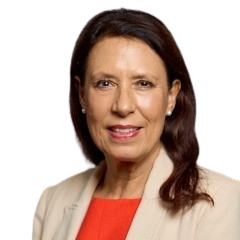
Debbie Abrahams is the Labour MP for Oldham East and Saddleworth, having first been elected to parliament in a by-election on 13 January 2011.
In the 2024 general election, Abrahams won 14,091 votes, representing 35.2% of the vote. The Reform UK candidate, Jacob Barden, received 7,734 votes (19.3%), while the Conservative Party candidate, Tom Fish, secured 6,838 votes (17.1%). Abrahams was duly elected with a majority of 6,357 votes.
The constituency of Oldham East and Saddleworth is located in Greater Manchester, in the North West region of England. It was created in 1997, drawing from parts of the former Littleborough & Saddleworth and Oldham Central & Royton constituencies. The seat has been held by Labour since its creation. Its immediate predecessor MP was Phil Woolas, also of the Labour Party.
Political Career
Abrahams currently serves as chair of the work and pensions select committee (since September 2024). By virtue of this role, Abrahams sits on the liaison committee – the so-called “super committee” composed of the cross-party chairs of all the other commons select committees. It has a broad oversight role, but is best known for its questioning of the prime minister in sessions that take place two or three times a year.
In November 2025, Abrahams was among the seven Labour MPs who set out to revive the parliamentary Tribune Group – an influential caucus representing the party’s “soft left”. Led by former cabinet minister Louise Haigh and Vicky Foxcroft, the group was relaunched to provide an organised voice for the centre-left wing of the parliamentary Labour Party (PLP).
The Tribune group was initially formed in 1964 to support the newspaper of the same name. It served as a prominent forum for those parliamentarians situated on the left of the Labour Party – but it split over Tony Benn’s campaign for the deputy leadership in 1981. Benn’s supporters founded the Campaign group – which evolved into the Socialist Campaign Group (SCG). Today, the Bennite SCG is strongly associated with the Labour left tradition.
During the 1980s, the Tribune group emerged as a more natural home for those on Labour’s “soft left”.
In 2017, the group was relaunched by veteran Labour MP Clive Efford with a mission statement calling for “opportunity and aspiration” to be placed at the heart of the party’s programme. Efford said he had reformed the group to ensure that the centre-left would “have a space in which to put forward ideas and debate which has not been there under successive leaders”.
Abrahams was among those who again relaunched the group in November 2025. Its leading figures included Haigh, Foxcroft, Beccy Cooper, Justin Madders, Sarah Owen and Yuan Yang.
In a January 2026 article for LabourList, co-written by this collective, the MPs argued that the party leadership had not “clarified who we stand for, clarity is just as often gained by who we stand against.”
The article added: “So what does a centre-left economic vision look like in practice? First, an economy that serves people, communities, and the common good. That’s why measures like bringing our railways back into public ownership matter.
“When we own essential natural monopolies such as these, we can demand the service we deserve and protect ourselves from predatory practices…
“Labour wins when – as the Tribunes of Rome were charged with doing – it protects and leads the people. We are here to help the Party to remember that mission and to deliver on it.”
Abrahams was previously a member of the shadow cabinet, serving under Jeremy Corbyn from October 2016 to March 2018 as shadow secretary of state for work and pensions. Prior to this, she was shadow minister for disabled people from September 2015 to October 2016.
In March 2018, Abrahams was suspended from her position as shadow work and pensions secretary following a Labour Party investigation over a “workplace issue”, reported to be connected to claims of bullying. Abrahams strongly rejected the allegations, saying she had experienced “aggressive, intimidating and wholly unprofessional” behaviour from unnamed individuals in Corbyn’s office.
She said in a statement: “My treatment by certain individuals in the leader’s office over the last 10 months has been aggressive, intimidating and wholly unprofessional. My treatment in the last week has shown a bullying culture of the worst kind. As such I am making a formal complaint to both the Labour party and parliamentary authorities.”
In May 2018, Labour said that following a “thorough investigation”, Abrahams had been referred to the disputes panel of the ruling national executive committee (NEC). The MP dismissed the probe as “neither thorough, fair, nor independent“.
Andy Burnham, the mayor of Greater Manchester, intervened to argue Abrahams had been “hounded out” of the shadow cabinet. Speaking to BBC Radio Manchester, he added: “I have a huge amount of sympathy for her.”
In February 2021, Abrahams, alongside two other MPs, successfully took legal action against the Department of Health and Social Care regarding contracts awarded during the Covid-19 pandemic. After the Good Law Project’s challenge, supported by Abrahams, Caroline Lucas and Layla Moran, a judge ruled the health secretary, Matt Hancock, had “breached his legal obligation” by not publishing details within 30 days of contracts being signed.
The judge called it an “historic failure” by the department, adding: “The public were entitled see who this money was going to, what it was being spent on and how the relevant contracts were awarded.”
https://x.com/Debbie_abrahams/status/1362838336419876864
Upon entering parliament, Abrahams was appointed parliamentary private secretary (PPS) to Burnham, then shadow secretary of state for health. She also served as chair of the Parliamentary Labour Party’s Health Committee.
Abrahams was a member of the House of Commons work and pensions committee from June 2011 to September 2015, and again from April 2018 to November 2019, and from March 2020 to the present.
Abrahams is listed as chair of the all-party parliamentary groups (APPGs) on Palestine and dementia. She is vice chair of the APPGs on healthy places and Kashmir. She is also an officer of the APPG on myalgic encephalomyelitis (ME).
Debbie Abrahams delivered her maiden speech on 31 January 2011 during a debate on the Health and Social Care Bill. In it, she stated: “My constituency is a beautiful place with a remarkable history. For example, it was not only where the Independent Labour party was born and where Winston Churchill started his political career, but where the suffragette Annie Kenney originated from.”
She added: “I asked to deliver my maiden speech on second reading of the Health and Social Care Bill because, as some people will know, my professional background is in health. I am passionate about the NHS. For me, it not only plans and provides our health services, but reflects the very values of our society.
“In ’97, the NHS was on its knees. Staff were leaving in droves, and the level of spending on health was one of the lowest in Europe. Labour more than trebled investment in the NHS, enabling us to recruit more doctors and nurses and to improve access to care. Gone are the days when people waited two years or more for a hip replacement or to have their cataracts removed.”
Abrahams stood as the Labour candidate in Colne Valley at the 2010 general election, finishing third with 26.4% of the vote.
Political Views
Leadership elections and loyalty
Starmer stand down: In May 2026, Abrahams publicly called for Keir Starmer, the prime minister, to step down/set out a timetable for his departure. The move followed the 2026 local elections and devolved elections to the Scottish Parliament and Senedd Cymru.
Labour deputy leadership 2025: Debbie Abrahams was one of 117 Labour MPs who nominated Lucy Powell for the party’s deputy leadership in September 2025. The election followed the resignation of Angela Rayner, who stepped down as deputy prime minister and deputy party leader after an investigation into her tax affairs. It marked the first time since 2007 that Labour had held a deputy leadership contest while in government.
Powell, the former leader of the House of Commons, was seen as a candidate representing the party’s “soft left”; she was support by leading soft left figures including Ed Miliband and Andy Burnham. She secured 117 nominations from the Parliamentary Labour Party (PLP), above the 80 required, and went on to win the election – defeating Bridget Phillipson with 54.3% of the vote.
Labour leadership 2020: Abrahams was one of 82 Labour MPs who nominated Keir Starmer for the party’s leadership in early 2020. The election was triggered by the resignation of Jeremy Corbyn following the party’s defeat in the 2019 general election, which resulted in Labour’s fewest seats in the House of Commons since 1935.
Starmer’s 82 nominations were the highest of any candidate. The shadow Brexit secretary won a decisive victory in the first round with 56.2% of the vote, defeating Rebecca Long-Bailey and Lisa Nandy.
Corbyn loyalty list: In March 2016, Abrahams was labelled as “core group plus” by the Corbyn leadership in a leaked list which categorised Labour MPs by their perceived loyalty. This label suggested the Corbyn leadership viewed Abrahams as a reliable supporter.
https://x.com/Keir_Starmer/status/1219600495314198528
Labour leadership 2015: Abrahams was one of 68 Labour MPs who nominated Andy Burnham for the party’s leadership in June 2015. The election followed the resignation of Ed Miliband after the party’s defeat in the 2015 general election. It was the first contest held under the “one member, one vote” system, which replaced the previous electoral college.
Burnham, the shadow health secretary, was initially considered the frontrunner. He secured 68 nominations from the Parliamentary Labour Party (PLP), comfortably exceeding the 35 required to reach the final ballot. He ultimately finished second in the contest with 19% of the vote, losing to Jeremy Corbyn in the first round.
Factional identity and party tradition
Living standards coalition: Abrahams is a member of the living standards coalition. Established in July 2025, the group’s stated aim was to develop and promote policy ideas that directly reduce everyday costs for households, particularly in areas such as food, energy, housing and childcare. In an open letter published upon its founding, addressed to Keir Starmer, the MPs wrote: “Our constituents will ask one question at the next election: did this Labour government make me better off?”
They added: “To raise living standards, we support government interventions that will help to increase incomes and lower costs.”
https://x.com/JeevunSandher/status/1943203921557651754
Disability Labour: Abrahams is a patron of Disability Labour – a socialist society affiliated with the Labour Party that represents and supports disabled members. Founded in 1996, it campaigns for disability rights and to ensure that the perspectives of disabled people are central to the formulation of Labour Party policy.
Brexit and Europe
Brexit referendum: Abrahams campaigned for remain in the 2016 referendum on Britain’s membership of the European Union (EU), and therefore disagreed with a majority of constituents, 59.9% of whom voted to Leave.
Article 50: In February 2017, Abrahams voted in favour of the European Union (Notification of Withdrawal) Bill. The legislation empowered the prime minister to notify the Council of the European Union of the UK’s intention to withdraw, formally triggering the process set out in Article 50 of the Treaty on European Union. MPs supported the bill by 498 votes to 114 at second reading.
People’s vote support (2019): Abrahams signed a January 2019 statement by Labour MPs calling for a ‘people’s vote’ or second referendum.
The statement, signed by 71 Labour MPs, read: “Defeat of the Tory [Brexit] deal in a public vote would give us all a chance to campaign for the anti-austerity policies and a Labour government that deals with the true causes of the Brexit vote, and a reformed Europe that works for all people.”
Electoral reform
Fair Elections APPG: Abrahams is listed as a member of the all-party parliamentary group (APPG) for fair elections – a cross-party group of MPs and peers that campaigns for electoral reform. The group’s stated aims include replacing the first past the post (FPTP) voting system with a form of proportional representation, eliminating “dark money” and “undemocratic influence” from politics, and countering disinformation.
Electoral reform amendment: In May 2026, Abrahams was one of over 70 Labour MPs who signed an amendment to the Representation of the People Bill, calling on the government to establish a “national commission on electoral reform”. Tabled by Alex Sobel as chair of the fair elections APPG, the amendment aimed to force a rethink of the first past the post voting system.
At the time, Sobel described FPTP as “one of the biggest examples of a broken status quo in UK politics.” He invited colleagues to join this “common sense call to take a fresh look at how parliament is elected in modern Britain.”
Welfare
Welfare ‘reasoned amendment’ (June 2025): Abrahams was one of the over 120 Labour MPs to sign the reasoned amendment to the government’s flagship welfare bill which aimed to reject the proposed legislation.
The amendment, in the name of senior Labour MP Dame Meg Hillier, objected to the fact that the bill had not been subject to a “formal consultation with disabled people” and that “250,000 people will be pushed into poverty” as a result of it, according to a government impact assessment.
https://x.com/SaulStaniforth/status/1909614483573502425
The motion also called on the government to wait for the publication of the review into the Personal Independence Payment (Pip), helmed by minister Sir Stephen Timms, and the independent review, conducted by Sir Charlie Mayfield, into how the employment of disabled people could be boosted.
Welfare vote (July 2025): Abrahams went on to vote in favour of the bill at second reading on 1 July 2025. The vote came after ministers agreed to significant concessions to avoid defeat via a mass rebellion of Labour MPs.
As chair of the work and pensions select committee, Abrahams was one of the most senior and vocal critics of the government’s proposals. She was reported to be one of three senior figures to negotiate directly with 10 Downing Street over the proposals.
https://x.com/ITVNewsPolitics/status/1939696258198782377
Welfare vote (July 2015): Alongside almost one quarter of her colleagues, Abrahams voted against the Conservative government’s Welfare Reform and Work Bill at second reading – defying the party whip which instructed Labour MPs to abstain. This decision to abstain, taken by interim Labour leader Harriet Harman, caused a furious backlash within the party, particularly from its left wing. It became a defining issue in the ongoing leadership contest. Jeremy Corbyn was the only candidate to vote against the bill. Overall, 48 Labour MPs voted against the proposed legislation.
Assisted dying bill
On the second reading of the Terminally Ill Adults (End of Life) Bill (Assisted Dying Bill) in November 2024, Abrahams abstained. However, they went on to vote against at third reading (June 2025).
In a statement setting out her position, Abrahams said: “Primarily I’m concerned that if the bill was approved, society would have accepted that under certain circumstances the state will assist someone to die.
“Although this Bill limits this to someone who is terminally ill with 6 months left to live, the principle for the state to assist someone to die would have been accepted. As we have seen in Canada and Belgium this has led to additional groups of people being deemed eligible for an assisted death.”
https://x.com/Debbie_abrahams/status/1862176002903835007
Social values and conscience issues
Same-sex marriage: In February 2013, Abrahams voted in favour of the Marriage (Same Sex Couples) Bill at its second reading. The landmark piece of legislation, which received its second reading by 400 votes to 175, legalised marriage for same-sex couples in England and Wales.
Abortion: In June 2025, Abrahams voted in favour of a backbench amendment to the Crime and Policing Bill that sought to decriminalise abortion in England and Wales. The amendment, which was ultimately passed by a majority of 242 votes, removed women from the threat of prosecution for ending a pregnancy at any stage. As an issue of conscience, MPs were allowed to vote according to their personal beliefs.
Foreign policy and security
Syria airstrikes (2013): Abrahams voted against the government’s motion on the principle of military intervention in Syria in August 2013. The government motion was defeated by 285 votes to 272, a move which effectively ruled out UK participation in any US-led military strikes.
Syria airstrikes (2015): Abrahams voted against a government motion to extend UK airstrikes against Isis from Iraq into Syria in December 2015. The motion, which was passed by 397 votes to 223 after a ten-hour debate in the House of Commons, authorised the RAF to conduct strikes against Isis targets in Syria.
https://x.com/PhilipHammondUK/status/672200278272319492
Sanctioned (Russia): In April 2022, Abrahams was among the group of MPs placed on a sanctions list by the Russian government. The measure barred them from entering Russia and was presented by Moscow as a retaliatory response to the UK’s stance on the invasion of Ukraine.
Palestine
LFPME: Abrahams is a member of Labour Friends of Palestine and the Middle East (LFPME). The organisation’s stated aim is to promote peace and justice in the region through the application of international law and respect for human rights.
Palestinian recognition letter (July 2025): Abrahams was among the over 254 MPs to sign a cross-party letter calling for the government to immediately recognise the state of Palestine. The letter called on the prime minister and foreign secretary to recognise Palestine at the UN Conference then taking place in New York.
https://x.com/SarahChampionMP/status/1949769513123094568
Palestinian recognition vote (2014): In October 2014, Abrahams was one of 192 Labour MPs who voted in favour of recognising Palestine as a state. The motion, passed by 274 votes to 12, called on the government to “recognise the state of Palestine alongside the state of Israel as a contribution to securing a negotiated two-state solution”.
Before Politics
Born on 15 September 1960 in Sheffield, Abrahams was educated at the University of Salford, where she received a Bachelor of Science degree in biochemistry and physiology, and the University of Liverpool.
Prior to entering Parliament, Abrahams worked as a public health academic and practitioner, focusing on health inequalities. She also worked as a community worker for a charity in Wythenshawe, setting up job training programmes for teenagers. She was head of healthy cities for Knowsley and served on the board of Bury and Rochdale Health Authority.
Abrahams was chair of Rochdale Primary Care Trust between 2002 and 2007. She resigned from this role in protest at the use of private companies in the NHS.
In a statement at the time, Abrahams said: “I have become very concerned about the use of private providers. They have a place, but what we are seeing is an increased use of private providers and there will ultimately be a point of no return.
“The use of private providers will ultimately force PCTs [primary care trusts] to close as they will become unviable and will destroy the NHS as we know it. I believe passionately in the NHS. It is not just about how we provide healthcare, it reflects and represents the values of our society.
“Private providers care primarily about making money while the NHS cares about what is best for the patient and when profitability is in the equation, patient care will suffer. There is an increased use of private providers funded with NHS money and they have a very different set of values.”
Abrahams joined the Labour Party with the stated aim of challenging health policy at local and national levels to reflect the core values of the NHS.
Personal Life
Abrahams married John Abrahams in 1986. John is a former captain of Lancashire County Cricket Club. They have two daughters.
Trivia
Abrahams is the first woman to serve as the MP for Oldham.


Back to work support has failed the people who need it most
19 November 2015