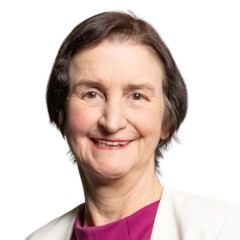
Dame Nia Griffith is the Labour MP for Llanelli, having first been elected to parliament at the 2005 general election.
In the 2024 general election, Dame Nia received 12,751 votes (31.3%). The Reform UK candidate received 11,247 votes (27.6%), and the Plaid Cymru candidate secured 9,511 votes (23.3%). Dame Nia was duly elected with a majority of 1,504.
The Llanelli constituency is located on the South Wales coast, west of Swansea, and is primarily centred on the town of Llanelli, also including Burry Port. It is an area with a history of coal mining and steel industries. Llanelli has been represented by Labour MPs continuously since 1922 and was historically considered a very safe seat, though the majority was significantly reduced in 2024.
Griffith’s immediate predecessor as the MP for Llanelli was Denzil Davies, who represented the seat from 1970 to 2005 and served on the Labour frontbenches of Jim Callaghan, Michael Foot and Neil Kinnock. Llanelli has only had three MPs since 1936, when Jim Griffiths – Davies’ immediate predecessor – won the seat in a by-election. Griffiths, deputy leader of the Labour Party from 1956 to 1959, served in the cabinets of Labour prime ministers Harold Wilson and Clement Atlee.
Dame Nia was appointed a Dame Commander of the Order of the British Empire (DBE) in the 2022 Birthday Honours for political and public service.
Political Career
Griffith is a member of the House of Commons women and equalities select committee (since November 2025) – the committee responsible for holding the government to account on equality law and policy, including the Equality Act 2010, as well as cross government activity on equalities. It also scrutinises the Equality and Human Rights Commission (EHRC).
Griffith served as parliamentary under-secretary of state in the Wales Office from July 2024 to September 2025. She served simultaneously as parliamentary under-secretary of state for equalities from October 2024 to September 2025.
Prior to the 2024 general election, which saw Labour returned to power after 14 years in opposition, Griffith served extensively on her party’s frontbench. She sat in the shadow cabinet on three occasions in two different roles: as shadow secretary of state for Wales from September 2015 to June 2016, and again from April 2020 to November 2021; and shadow secretary of state for defence from October 2016 to April 2020.
More recently, Griffith was shadow minister in the Cabinet Office from September 2023 to May 2024. Griffith was also shadow minister for Wales from October 2011 to September 2015, shadow minister for international trade from December 2021 to September 2023, and shadow business minister from October 2010 to October 2011. In these capacities, Griffith served under Keir Starmer, Jeremy Corbyn and Ed Miliband as leaders of the opposition.
Previously, Griffith was parliamentary private secretary (PPS) to Hilary Benn in his capacity as secretary of state for the environment, food and rural affairs. A PPS acts as an unpaid parliamentary assistant, providing a link between the senior frontbencher and backbench MPs.
Griffith later served as a PPS to Harriet Harman, supporting her work as leader of the House of Commons, minister for women and equalities and acting leader of the Labour Party.
In June 2016, Griffith was among those to resign from the shadow frontbench in protest at Jeremy Corbyn’s leadership and his approach to the 2016 referendum on Britain’s membership of the European Union (EU).
In a resignation statement, stepping down as shadow Welsh secretary, Griffith said Corbyn had “lost the confidence of the party”.
She commented: “I made clear to Jeremy that I have always admired his commitment to the causes that matter to him, but last week’s referendum result and the likelihood of an early general election mean that the party now requires new leadership.
“Jeremy has lost the confidence of the party, including many members who initially supported him, and he should now do the honourable thing and resign.”
In September 2016, three months after her resignation, Griffith said she would be willing to serve under Corbyn again – were he to win the unfolding leadership contest versus challenger Owen Smith.
Griffith told the BBC’s Newyddion 9 programme: “I think it is very important that people come together. In that context I’m willing to serve if I’m part of a team that reflects every wing of the party.”
Griffith went on to be appointed as shadow defence secretary.
In May 2017, Griffith appeared to rebuke her shadow cabinet colleague Emily Thornberry, the shadow foreign secretary, for suggesting Trident could be subject to a review if Labour won power. Thornberry had told LBC Radio that she was “sceptical” about Trident.
Asked to confirm that it would remain Labour policy after a defence review, Thornberry added: “Well no, of course not, if you are going to have a review, you have to have a review.”
Griffith later told BBC Newsnight: “With all due respect, Emily is not the shadow defence secretary. I am.”
She insisted that her party was “fully committed” to having a nuclear deterrent and that the defence review would look at how a Labour government would spend money.
She added: “What it is not about is actually questioning whether we would have a Trident nuclear deterrent because we settled that last year.”
In March 2018, Griffith appeared to break ranks with the Labour leadership after she strongly criticised Russia over the Salisbury poisonings that left the former double agent Sergei Skripal and his daughter Yulia critically ill.
Griffith told BBC Radio 4’s Today programme that the party accepted “Russia was responsible”.
She commented: “We very much accept what the prime minister said – this is a very sophisticated nerve agent and Russia is responsible for this attack and therefore we’re fully supporting the measures which the government is taking, including the expulsion of 23 diplomats.”
Asked if she was at odds with Corbyn on the issue, Griffith said she was more “plain speaking” than her leader.
The comment came after Corbyn condemned the “appalling” attack but pressed the prime minister, Theresa May, on whether the UK had supplied traces of the nerve agent used in the attack to Russia for analysis before Wednesday’s deadline, as the Kremlin had asked.
In a later Facebook post, Corbyn called for the Russian authorities to “be held to account on the basis of the evidence and our response must be both decisive and proportionate”.
In May 2019, an open letter with 1,500 signatories demanded Griffith’s resignation as defence spokesperson after she appeared to express support for the government proposals to grant veterans immunity from prosecution. Penny Mordaunt, then the defence secretary, had revealed plans to introduce an amnesty for alleged offences committed by British soldiers in the course of duty over 10 years ago.
Griffith responded that she was “glad” to hear the proposal. Labour members on the left expressed strong opposition to Griffiths’ apparent stance, which the open letter argued “legitimates the most reactionary elements of British society.”
https://x.com/NiaGriffithMP/status/1126551186302226433
Griffith was a member of the House of Commons European scrutiny committee from June 2005 to November 2007, and again from July 2010 to November 2015; and the Welsh affairs committee from July 2005 to November 2010, and again from November 2011 to March 2015.
She is a patron of LGBT+ Labour – a socialist society formally affiliated with the Labour Party.
Griffith delivered her maiden speech on 19 May 2005. In it, she said: “Since the election of a Labour Government in 1997, hope has returned and there has been regeneration on an unprecedented scale. We have seen the benefits of a well-managed economy reaching Llanelli, with unemployment levels falling dramatically.”
She added: “We need to look with increased urgency at the development of all forms of renewable energy, and at new technologies that help us to reduce energy consumption.
“Surrounded on three sides by tidal waters, the Llanelli constituency could be an ideal site for a tidal power station, perhaps spanning the Loughor estuary, in the same way as the Rance barrier in northern France has been producing electricity for some 40 years.”
Griffith was elected as a councillor on Carmarthen Town Council in 1987, serving as the sheriff in 1997 and deputy mayor in 1998.
Political Views
Leadership elections and loyalty
Oppose leadership election: In May 2026, Griffith was among the over 100 Labour MPs who signed a joint statement insisting it was “no time for a leadership contest.” The letter was an intervention in the political crisis engulfing Keir Starmer’s premiership, after Labour suffered heavy losses in the 2026 local elections and devolved elections to the Scottish Parliament and Senedd Cymru. It was organised as a counterweight to a mounting rebellion that had seen high-profile figures, including some ministers, call for Starmer’s resignation.
The statement read: “Last week we had a devastatingly tough set of election results. It shows we have a hard job ahead to win back trust from the electorate.
“That job needs to start today – with all of us working together to deliver the change the country needs.
“We must focus on that. This is no time for a leadership contest.”
Labour leadership 2020: Griffith was one of 22 Labour who nominated Emily Thornberry for the party’s leadership in early 2020. The election was triggered by the resignation of Jeremy Corbyn following the party’s defeat in the 2019 general election, which resulted in Labour’s fewest seats in the House of Commons since 1935.
Thornberry, then the shadow foreign secretary, was one of five candidates to reach the second stage of the contest. However, she was eliminated from the race on 15 February 2020 after failing to secure the required 33 nominations from Constituency Labour Parties (CLPs) or three affiliated groups. This left Keir Starmer, Rebecca Long-Bailey, and Lisa Nandy as the three candidates on the final membership ballot.
Labour leadership 2015: Griffith was one of 68 Labour MPs who nominated Andy Burnham for the party’s leadership in June 2015. The election followed the resignation of Ed Miliband after the party’s defeat in the 2015 general election. It was the first contest held under the “one member, one vote” system, which replaced the previous electoral college.
Burnham, the shadow health secretary, was initially considered the frontrunner. He secured 68 nominations from the Parliamentary Labour Party (PLP), comfortably exceeding the 35 required to reach the final ballot. He ultimately finished second in the contest with 19% of the vote, losing to Jeremy Corbyn in the first round.
Corbyn loyalty list: In March 2016, Griffith was labelled as “neutral but not hostile” by the Corbyn leadership in a leaked list which categorised Labour MPs by their perceived loyalty.
Labour leadership 2016: Griffith supported Angela Eagle for the party’s leadership in July 2016. The election was triggered by a challenge to Jeremy Corbyn following the EU referendum, which led to a wave of shadow cabinet resignations and a vote of no confidence supported by 172 MPs.
Eagle, the former shadow first secretary of state, was the first to formally launch a challenge against Corbyn. However, she withdrew from the race on 19 July after attracting fewer nominations than Owen Smith. Griffith subsequently shifted her support to Smith.
Corbyn was ultimately re-elected with an increased mandate of 61.8% of the vote.
Labour leadership 2010: Griffith was one of 33 Labour MPs who nominated Diane Abbott for the party’s leadership in May 2010. The election followed the resignation of Gordon Brown, who stepped down as prime minister and Labour leader after the 2010 general election.
Abbott, a member of the Socialist Campaign Group (SCG), secured the minimum 33 nominations from the Parliamentary Labour Party (PLP). It came after several senior figures, including Harriet Harman and David Miliband, lent her their support to ensure a ideologically diverse ballot. She finished fifth in the contest with 7.4% of the vote.
Factional identity and party tradition
Tribune group (2017): Griffith was listed among the supporters of the Tribune parliamentary group – a caucus generally described as representing the party’s “soft left”.
The Tribune group was initially formed in 1964 to support the newspaper of the same name. It served as a prominent forum for those parliamentarians situated on the left of the Labour Party – but it split over Tony Benn’s campaign for the deputy leadership in 1981. Benn’s supporters founded the Campaign group – which evolved into the Socialist Campaign Group (SCG). Today, the Bennite SCG is strongly associated with the Labour left tradition.
During the 1980s, the Tribune group emerged as a more natural home for those on Labour’s “soft left”.
In 2017, Efford officially re-launched the group with a new mission statement calling for “opportunity and aspiration” to be placed at the heart of the party’s programme. Efford said he had reformed the group to ensure that the centre-left of the Parliamentary Labour Party (PLP) “have a space in which to put forward ideas and debate which has not been there under successive leaders”.
He added: “The view of Labour MPs at the moment tends to be that too much are just Blairites who want to stab Jeremy Corbyn in the back. We want to show that is not where we are, and that we want to develop our own ideas that represent the centre-left of the party.”
Brexit and Europe
Brexit referendum: Griffith supported the Remain campaign in the 2016 EU referendum, and therefore disagreed with a majority of her constituents, 56.7% of whom voted to Leave.
Article 50: In February 2017, Griffith voted in favour of the European Union (Notification of Withdrawal) Bill. The legislation empowered the prime minister to notify the Council of the European Union of the UK’s intention to withdraw, formally triggering the process set out in Article 50 of the Treaty on European Union. MPs supported the bill by 498 votes to 114 at second reading.
Welfare
Welfare vote (July 2025): Griffith voted in favour of the government’s flagship welfare bill at second reading. The vote came after ministers agreed to significant concessions to avoid defeat via a mass rebellion of Labour MPs on 1 July 2025.
Assisted dying
Griffith voted against the Terminally Ill Adults (End of Life) Bill, better known as the assisted dying bill, at both second reading (November 2024) and third reading (June 2025).
In a statement setting out her position, issued ahead of the bill’s third reading, Griffith stated: “I have… considered the views of medical professionals, including doctors and nurses, who would be directly involved in decisions that could end a person’s life. Our palliative care system is already under considerable strain, and in debating this bill, we must ensure that the care provided to people at the end of life is of the highest possible standard.
“Throughout the stages of the bill, I have supported additional amendments to make sure the Bill has robust safeguards and functions responsibly in practice. Despite these efforts, I still remain concerned around its potential applications and consequences.”
Social values and conscience issues
Abortion decriminalisation (2025): Griffith voted in favour of a backbench amendment to the Crime and Policing Bill that sought to decriminalise abortion in England and Wales in June 2025. The amendment, which was passed by a majority of 242 votes, removed women from the threat of prosecution for ending a pregnancy at any stage. As an issue of conscience, MPs were allowed to vote according to their personal beliefs.
Same-sex marriage (2013): In February 2013, Griffith voted in favour of the Marriage (Same Sex Couples) Bill at its second reading. The landmark piece of legislation, which received its second reading by 400 votes to 175, legalised marriage for same-sex couples in England and Wales.
Foreign policy and security
Trident renewal (2016): Griffith voted against a government motion calling for the renewal of the Trident nuclear deterrent system in July 2016. The motion, which was passed by 472 votes to 117, committed the UK to constructing a new fleet of submarines to carry the nation’s nuclear weapons. Labour was split over the issue with 140 of its 230 MPs going against leader Jeremy Corbyn and backing the motion.
Syria airstrikes (2015): Griffith voted against a government motion to extend UK airstrikes against Isis from Iraq into Syria in December 2015. The motion, which was passed by 397 votes to 223 after a ten-hour debate in the House of Commons, authorised the RAF to conduct strikes against Isis targets in Syria.
Syria airstrikes (2013): Griffith voted against the government’s motion on the principle of military intervention in Syria in August 2013. The government motion was defeated by 285 votes to 272, a move which effectively ruled out UK participation in any US-led military strikes.
Palestine
Palestinian recognition vote (2014): In October 2014, Griffith voted in favour of recognising Palestine as a state. The motion, passed by 274 votes to 12, called on the government to “recognise the state of Palestine alongside the state of Israel as a contribution to securing a negotiated two-state solution”.
Before Politics
Born Nia Rhiannon Griffith in Dublin, Ireland on 4 December 1956, she attended Newland High School for Girls in Hull. She studied modern languages at Somerville College, Oxford University, graduating with a first-class degree in 1979. She later completed a Postgraduate Certificate in Education (PGCE) at Bangor University.
Before entering parliament, Dame Nia worked as a teacher of modern languages (French and Italian). She subsequently worked as a schools inspector for Estyn (the education and training inspectorate for Wales).
She joined the Labour Party in 1981 and was formerly secretary of the Carmarthenshire County Labour Party.
Personal Life
Griffith is divorced.
In 2024, PinkNews listed Griffith among a number of out LGBTQ+ parliamentarians.
She came out as a lesbian in 2016. She told the Independent that her sexuality had been known among friends, family and colleagues since the mid-1990s, but she “hasn’t made any great fuss about it in parliament”.
Griffith told The House magazine in 2017 that she came out publicly after it occurred to her “how invisible gay women still are.”
Trivia
Griffith’s hobbies include music, European cinema, gardening, walking and cycling.
She is an honorary associate of the National Secular Society.
Nia Griffith has not written for Politics.co.uk.