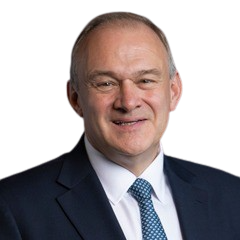
Catherine McKinnell is the Labour MP for Newcastle upon Tyne North, having first been elected to parliament at the 2010 general election.
In the 2024 general election, McKinnell won 24,440 votes, representing 50.3% of the vote. The Conservative candidate, Guy Renner-Thompson, received 6,678 votes (13.7%), while the Liberal Democrat candidate, Aidan King, secured 5,936 votes (12.2%). McKinnell was duly elected with a majority of 17,762 votes.
The Newcastle upon Tyne North constituency covers northern and western parts of the city. Historically held by the Conservatives until 1983, it has been a safe Labour seat since.
Political Career
McKinnell currently serves as minister of state in the Ministry of Justice. She was appointed to this role in July 2026, following the Labour leadership contest and Andy Burnham’s elevation as prime minister.
McKinnell was appointed as a trade envoy to Italy in January 2026. Appointed by the trade secretary, envoys are tasked with boosting British exports and attracting foreign investment. An envoy’s duties typically involve leading trade delegations, lobbying host governments on market access issues, and building relationships with overseas businesses.
McKinnell served as minister of state for school standards from July 2024 to September 2025. She left this post as part of Keir Starmer’s first major ministerial reshuffle as prime minister. Prior to the 2024 general election, which saw Labour returned to power after 14 years in opposition, McKinnell was shadow schools minister from September 2023 to July 2024.
McKinnell served as shadow attorney general from September 2015 until January 2016, when she became the first member of Jeremy Corbyn’s shadow cabinet to resign, citing party infighting and family commitments.
Speaking at the time, McKinnell said Labour was heading down an “increasingly negative path”. It followed a relatively far-reaching shadow ministerial reshuffle which saw Pat McFadden, a Corbyn critic, replaced as Europe spokesperson.
In her resignation letter, McKinnell wrote: “As somebody who came into politics with the sole motivation of making life better for my city, my region and, by extension, the country as a whole, I recognised that our electoral defeats in both 2010 and 2015 demanded a genuine and profound response from the Labour Party.
“I therefore shared your optimism for the ‘new kind of politics’ you spoke so compellingly about. However, as events have unfolded over recent weeks, my concern about the direction and internal conflict within the Labour party has only grown and I fear this is taking us down an increasingly negative path.
“I feel that I would like to channel my energy constructively, into making positive changes for my constituents.”
Previously, McKinnell was shadow exchequer secretary to the treasury (2013-2015), shadow minister for children and families (2011-2013), and shadow solicitor general (2010-2011).
McKinnell served as chair of the petitions committee from 2020 to 2023. This committee is responsible for considering e-petitions submitted on parliament’s petitions website and public (paper) petitions presented to the commons. By virtue of this role, McKinnell sat on the liaison committee – the so-called “super committee” composed of the cross-party chairs of all the other commons select committees. It has a broad oversight role, but is best known for its questioning of the prime minister in sessions that take place two or three times a year.
McKinnell was a member of the House of Commons public accounts committee (2025-2026), petitions committee (2016-2023), the Treasury committee (2017-2019), the education committee (2016-2017) and the political and constitutional reform committee (2010).
McKinnell was named as an honorary vice-chair of Labour Friends of Israel in December 2025.
McKinnell delivered her maiden speech on 3 June 2010 during a debate on European affairs.
In it, she said: “The constituency [I represent] has a proud industrial history, from extracting coal from the banks of the Tyne to manufactured engineering and glass and steel products exported all over the world. However, by the time my predecessor took on the honour and responsibility of representing the people of Newcastle upon Tyne North in 1987, the majority of industry was gone.”
She added: “I am incredibly proud to have been elected to represent Newcastle upon Tyne North, the constituency in which I was born and continue to live with my own young family and my extremely large extended family.”
Political views
Leadership elections and loyalty
Starmer stand down: In May 2026, McKinnell publicly called for Keir Starmer, the prime minister, to step down/set out a timetable for his departure. The move followed the 2026 local elections and devolved elections to the Scottish Parliament and Senedd Cymru.
Labour deputy leadership 2025: McKinnell was one of 175 Labour MPs who nominated Bridget Phillipson for the party’s deputy leadership in September 2025. The election followed the resignation of Angela Rayner, who stepped down as deputy prime minister and deputy party leader after an investigation into her tax affairs. It marked the first time since 2007 that Labour had held a deputy leadership contest while in government.
Phillipson, the serving education secretary, was widely viewed as the candidate favoured by Downing Street and the party leadership. She secured 175 nominations from the Parliamentary Labour Party (PLP), comfortably exceeding the 80 required to reach the final ballot. She was ultimately defeated by Lucy Powell.
Labour leadership 2020: McKinnell was one of 21 Labour MPs who nominated Jess Phillips for the party’s leadership in early 2020. The election was triggered by the resignation of Jeremy Corbyn following the party’s defeat in the 2019 general election, which resulted in Labour’s fewest seats in the House of Commons since 1935.
Phillips, the MP for Birmingham Yardley, had been a prominent critic of Corbyn’s leadership of the Labour Party. She withdrew from the contest on 21 January 2020, suggesting that she could not “unite all parts of our movement”.
Labour leadership 2015: McKinnell nominated Yvette Cooper for the party’s leadership in June 2015. The election followed the resignation of Ed Miliband after the party’s defeat in the 2015 general election. It was the first contest held under the “one member, one vote” system, which replaced the previous electoral college.
Cooper, the shadow home secretary, secured 59 nominations from the Parliamentary Labour Party (PLP), comfortably exceeding the 35 required to reach the final ballot. She ultimately finished third in the contest with 17% of the vote.
Corbyn loyalty list: In March 2016, McKinnell was labelled as “neutral but not hostile” by the Corbyn leadership in a leaked list which categorised Labour MPs by their perceived loyalty.
Labour leadership 2016: McKinnell was one of 162 Labour MPs who nominated Owen Smith for the party’s leadership in July 2016. The election was triggered by a challenge to Jeremy Corbyn following the EU referendum, which led to a wave of shadow cabinet resignations and a vote of no confidence supported by 172 MPs. Smith, the former shadow work and pensions secretary, was ultimately defeated by Corbyn, who won with an increased mandate of 61.8% of the vote.
Labour leadership 2010: McKinnell was one of 63 Labour MPs who nominated Ed Miliband for the party’s leadership in May 2010. The election followed the resignation of Gordon Brown, who stepped down as prime minister and Labour leader after the 2010 general election.
Miliband, the former energy and climate change secretary, was seen as the candidate of the “soft left” and secured significant backing from affiliated trade unions. He secured 63 nominations from the Parliamentary Labour Party (PLP), exceeding the 33 required to reach the final ballot. Miliband went on to narrowly defeat his brother, David, in the final round by 50.7% to 49.3%.
Factional identity and party tradition
Tribune group (2017): McKinnell was listed among the supporters of the Tribune parliamentary group – a caucus generally described as representing the party’s “soft left”.
The Tribune group was initially formed in 1964 to support the newspaper of the same name. It served as a prominent forum for those parliamentarians situated on the left of the Labour Party – but it split over Tony Benn’s campaign for the deputy leadership in 1981. Benn’s supporters founded the Campaign group – which evolved into the Socialist Campaign Group (SCG). Today, the Bennite SCG is strongly associated with the Labour left tradition.
During the 1980s, the Tribune group emerged as a more natural home for those on Labour’s “soft left”.
In 2017, Efford officially re-launched the group with a new mission statement calling for “opportunity and aspiration” to be placed at the heart of the party’s programme. Efford said he had reformed the group to ensure that the centre-left of the Parliamentary Labour Party (PLP) “have a space in which to put forward ideas and debate which has not been there under successive leaders”.
He added: “The view of Labour MPs at the moment tends to be that too much are just Blairites who want to stab Jeremy Corbyn in the back. We want to show that is not where we are, and that we want to develop our own ideas that represent the centre-left of the party.”
Brexit and Europe
Brexit referendum: McKinnell supported Remain in the 2016 Brexit referendum, and therefore disagreed with a majority of her constituents, 56.8% of whom voted to Leave.
Article 50: In February 2017, McKinnell voted against the European Union (Notification of Withdrawal) Bill. The legislation empowered the prime minister to notify the Council of the European Union of the UK’s intention to withdraw, formally triggering the process set out in Article 50 of the Treaty on European Union. MPs supported the bill by 498 votes to 114 at second reading. In voting against the bill, McKinnell defied the party whip – one of 47 Labour MPs to do so.
People’s vote support (2019): McKinnell signed a January 2019 statement by Labour MPs calling for a “people’s vote” or second referendum. The statement, signed by 71 Labour MPs, read: “Defeat of the Tory [Brexit] deal in a public vote would give us all a chance to campaign for the anti-austerity policies and a Labour government that deals with the true causes of the Brexit vote, and a reformed Europe that works for all people.”
Remain pledge: During the 2019 general election campaign, McKinnell was one of 193 Labour candidates to sign the anti-Brexit “Remain pledge”, drawn up by the campaign group Remain Labour.
It stated: “Labour is committed to a confirmatory referendum, to give you the final say on Brexit. If elected as your Labour MP, I pledge to campaign to Remain in the EU.”
Brexit trade deal: In December 2020, McKinnell was among the 37 Labour MPs to rebel against the leadership’s position on the EU (Future Relationship) Bill – which enabled the government to implement and ratify its post-Brexit trade deal with the EU. Keir Starmer, the newly elected Labour leader, argued that while the trade deal negotiated by Boris Johnson’s government was “thin” and flawed, the only alternative at that late stage was a “no-deal” exit. To enforce the leadership’s position, a three-line whip was imposed. McKinnell abstained over the bill. One Labour MP, Bell Ribeiro-Addy, voted against the bill.
Welfare
Welfare vote (July 2025): McKinnell voted in favour of the government’s flagship welfare bill at second reading. The vote came after ministers agreed to significant concessions to avoid defeat via a mass rebellion of Labour MPs on 1 July 2025.
Assisted dying
McKinnell voted against the Terminally Ill Adults (End of Life) Bill, better known as the assisted dying bill, at both second reading (November 2024) and third reading (June 2025).
Social values and conscience issues
Same-sex marriage (2013): In February 2013, McKinnell voted in favour of the Marriage (Same Sex Couples) Bill at its second reading. The landmark piece of legislation, which received its second reading by 400 votes to 175, legalised marriage for same-sex couples in England and Wales.
Social media ban: In January 2026, McKinnell was one of over 60 Labour MPs to sign a letter to the prime minister calling for the introduction of an Australia-style ban on social media access for children under the age of 16. Organised by Plymouth Moor View MP Fred Thomas, the initiative brought together a cross-factional coalition of backbenchers – spanning the Socialist Campaign Group, Tribune Group and Blue Labour – to demand action.
The letter called on Keir Starmer to “show leadership” by introducing a minimum age for social media access “to protect young people from the consequences of unregulated, addictive social media platforms”.
It stated: “We are all strong supporters of technology, and of this Labour government’s ambition to use tech to improve lives. But successive governments have done far too little to protect young people from the consequences of unregulated, addictive social media platforms.”
X letter: In November 2025, McKinnell was one of 34 cross-party MPs and peers who signed a letter to Ofcom demanding an investigation into the social media platform X (formerly Twitter). The letter, led by Joani Reid, chair of the all-party parliamentary group (APPG) on antisemitism, called on the regulator to determine whether the platform was in breach of its legal duties under the Online Safety Act following a reported surge in antisemitic content and calls for violence against Jews on X.
Foreign policy and security
Trident renewal (2016): McKinnell voted in favour of a government motion calling for the renewal of the Trident nuclear deterrent system in July 2016. The motion, which was passed by 472 votes to 117, committed the UK to constructing a new fleet of submarines to carry the nation’s nuclear weapons. Labour was split over the issue with 140 of its 230 MPs going against leader Jeremy Corbyn and backing the motion.
Syria airstrikes (2015): McKinnell voted against a government motion to extend UK airstrikes against Isis from Iraq into Syria in December 2015. The motion, which was passed by 397 votes to 223 after a ten-hour debate in the House of Commons, authorised the RAF to conduct strikes against Isis targets in Syria.
Syria airstrikes (2013): McKinnell voted against the government’s motion on the principle of military intervention in Syria in August 2013. The government motion was defeated by 285 votes to 272, a move which effectively ruled out UK participation in any US-led military strikes.
Palestine
Palestinian recognition vote (2014): In October 2014, McKinnell was one of 192 Labour MPs who voted in favour of recognising Palestine as a state. The motion, passed by 274 votes to 12, called on the government to “recognise the state of Palestine alongside the state of Israel as a contribution to securing a negotiated two-state solution”.
Before Politics
Born Catherine Grady in Denton, Newcastle upon Tyne on 8 June 1976, she grew up in the west end of Newcastle. She attended Sacred Heart comprehensive school in Fenham.
She studied politics and history at the university of Edinburgh and later law (LLB) at Northumbria university.
Before entering parliament, she worked as an employment solicitor at the Dickinson Dees law firm in Newcastle.
Personal Life
McKinnell is married to Rhys McKinnell. They have three children.
Trivia
McKinnell was the first Labour MP to resign from Jeremy Corbyn’s shadow cabinet.
Catherine McKinnell has not written for Politics.co.uk.