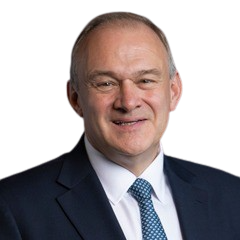
Carolyn Harris is the Labour MP for Neath and Swansea East, having first been elected at the 2015 general election.
In the 2024 general election for the new Neath and Swansea East constituency, Harris received 16,797 votes (41.8%). The Reform UK candidate received 10,170 votes (25.3%), and the Plaid Cymru candidate secured 5,350 votes (13.3%). Harris was duly elected with a majority of 6,627.
The Neath and Swansea East constituency covers parts of the city of Swansea (including Swansea Docks, Landore, Morriston) and the town of Neath in South Wales. The seat was created for the 2024 election, combining the majority of the Swansea East constituency (held by Labour since 1922) with parts of the Neath constituency (also held by Labour since 1922). The new seat is considered safe Labour territory, although the party’s majority decreased compared to the notional 2019 result.
Harris’ immediate predecessor as the MP for Swansea East was Siân James, who represented the seat from 2005 to 2015.
Political Career
Harris currently serves as the deputy leader of Welsh Labour, a position she has held since its creation in April 2018.
Harris was elected after securing 51.5% of the electoral college vote, narrowly defeating Julie Morgan on 48.5%. Harris won more votes among AMs (assembly members) and MPs, and groups linked to the Labour party including unions. Morgan, however, has secured the support of more party members (21.73% vs 11.6%). In September 2018, Welsh Labour announced it would use a one-member-one-vote system to elect its leadership figures.
In her victory speech, Harris said she would “campaign for every issue that affects the good people of our country.”
She said: “I’ve got a big heart, I’ve got a big mouth, and you’ve trusted me to give you the big platform. I will lead you in campaigning.
“I will campaign for every issue that affects the good people of our country. I said I will be a voice for all members, and I will.”
Harris also serves as a trade envoy to New Zealand (since January 2025). Appointed by the trade secretary, envoys are tasked with boosting British exports and attracting foreign investment. An envoy’s duties typically involve leading trade delegations, lobbying host governments on market access issues, and building relationships with overseas businesses.
In the House of Commons, Harris has been a member of the panel of chairs since October 2022. The panel of chairs is made up of MPs chosen by the House of Commons speaker, typically at the beginning of every parliament, to chair public bill committees and other commons general committees. In this capacity, Harris also chairs debates in Westminster Hall and may also act as temporary chair during a committee of the whole House.
Harris has been a member of the administration committee since October 2024. The administration committee is responsible for overseeing the internal running of the House and the services provided to its members and their staff. Its primary role is to ensure that the facilities and administrative support on the parliamentary estate are effective, efficient, and meet the needs of a modern legislature.
Harris previously served as parliamentary private secretary (PPS) to the leader of the opposition, Keir Starmer, from April 2020 until her resignation from the role in May 2021. A Guardian report, published upon Harris’ resignation, suggested she had stoked tensions between the leadership’s office and the Labour deputy leader, Angela Rayner. A PPS acts as an unpaid parliamentary assistant, providing a link between the senior frontbencher and backbench MPs.
The Times reported that Harris had been accused by some MPs of spreading unfounded allegations against Rayner. At the time, there had been increasing criticism of Starmer’s leadership following the loss of the Hartlepool by-election and a botched shadow cabinet reshuffle.
https://x.com/hzeffman/status/1392073585313951744
In a statement released by Starmer’s office, Harris said: “It has been the proudest moment of my career to co-chair the campaign that saw Keir Starmer elected as Labour leader, and to serve as his PPS for the past year.
“Stepping back from this role is the right thing at this moment, coming as it does after some trying personal times and an ever-increasing workload as deputy leader of Welsh Labour.
“I have enjoyed every minute, and look forward to supporting Keir the best way I can in the months ahead.”
Harris told LabourList that she was “really disappointed that people are briefing”.
She added: “Obviously I’m involved in things, in the inner sanctum if you like, and the things that have been said are not based in fact and I find it really disturbing that anybody’s trying to undermine all the good work that’s been done by coming up with tittle tattle.”
In March 2021, Harris said she had received “horrendous abuse” after a screenshot was shared on social media wrongly claiming to show her asleep in the House of Commons.
https://www.facebook.com/watch/?v=845370964340266
Harris was shadow minister for women and equalities from July 2017 to April 2020, and shadow minister for safeguarding and vulnerability from October 2016 to July 2017.
In June 2021, Harris introduced the Menopause (Support and Services) Bill to parliament. This high-profile bill was part of a successful campaign to improve menopause support and called for hormone replacement therapy (HRT) to be made free of charge in England.
Speaking during the bill’s second reading debate, Harris told the House: “The menopause doesn’t discriminate, so the cost to treat it shouldn’t either…We have got women struggling to find almost £20 a month, and it just isn’t right when this is a time in their life that women will reach – there’s no avoiding the menopause for half the population.”
She added: “The biggest complaint I’ve received over the last few months is from women who both need oestrogen and progesterone. Women who’ve had a hysterectomy can take oestrogen on its own, but for everyone else both are needed.”
The bill did not pass in its original form, however the pressure led to the government agreeing to significantly cut the cost of HRT prescriptions.
The government confirmed that changes will be made to reduce the cost of HRT prescriptions. Maria Caulfield, the then minister for patient safety and primary care, also committed to establishing a new menopause taskforce with Harris as a co-chair (October 2021).
Responding to this announcement, Harris said: “I look forward to working with the minister to revolutionise menopause support in this country and being world leaders in changing the narrative on something that has been a taboo subject for far too long.”
The UK Menopause Taskforce held its inaugural meeting in February 2022.
The NHS Pay Award (Report) Bill, introduced by Harris in April 2021, was a tactic to challenge the government’s proposed 1% pay rise for NHS staff following the COVID-19 pandemic, by attempting to force a binding vote in the commons on any award below the 2.1% that had been budgeted for.
Introducing the bill, under the 10-minute rule procedure, Harris told the House: “Nurses and NHS staff were promised at least a 2.1% pay rise, but the government have now retracted that and recommended 1% for all NHS staff, with the exception of junior doctors, GPs and dentists.
“The government pretend that this is a rise, but they are fooling no one.”
The Pensions (Review of Women’s Arrangements) Bill, introduced by Harris September 2017, sought to force a government review of the pension arrangements of “WASPI women” – women born in the 1950s affected by changes to the state pension age – and potential compensation schemes.
Harris is known for her successful cross-party campaigns. Motivated by the death of her eight-year-old son Martin in 1989 and the subsequent financial hardship, she campaigned for government support for bereaved parents, leading to the establishment of the Children’s Funeral Fund across the UK – a scheme to provide funding for the fees charged for any burial or cremation of a child under the age of 18.
Theresa May, the then-prime minister, praised the “dignity and strength” of Harris for leading the cross-party campaign.
May said: “I have been incredibly moved by the dignity and strength of campaigners like Carolyn Harris, who lost her own son Martin when he was just eight years old. Carolyn has passionately argued for a Children’s Funeral Fund to spare grieving families the burden of meeting funeral costs.
“In the darkest moment of any parent’s life there is little light – but there can be support.
“That is why I have asked for the Children’s Funeral Fund to be set up in England. For Carolyn, in memory of her son Martin, and in support of all those parents overwhelmed by such harrowing loss.”
In a May 2019 article for The House magazine, Harris voiced her frustration at the government’s delay in implementing the Children’s Funeral Fund. “It has now been more than a year since that announcement”, she wrote. “The Welsh Labour government have implemented the fund. The Scottish government have implemented the fund. Councils across Northern Ireland have implemented the fund.
“England is still waiting.”
https://x.com/carolynharris24/status/984159734256357376
Harris was also instrumental in the campaign to reduce the maximum stake on fixed-odds betting terminals (FOBTs) from £100 to £2, achieved in 2018.
Harris was a member of the home affairs committee from March 2022 to May 2024, the women and equalities committee from February 2022 to May 2024, the environmental audit committee from July 2015 to September 2016, and the Welsh affairs committee from July 2015 to July 2016.
Harris is listed as a member of the all-party parliamentary groups (APPGs) for gambling reform, commercial sexual exploitation, beauty and wellbeing, menopause and policing.
She delivered her maiden speech on 8 June 2015 during a debate on the Scotland Bill. In it, she said: “Swansea East forms part of the geographical area that [poet and writer] Dylan Thomas referred to as the ugly, lovely town – I am afraid though that I have to challenge that description as today the view from Dylan’s Kilvey is anything but ugly.
“In 2015, Swansea East boasts a vista that is economically exciting, architecturally beautiful, culturally and educationally groundbreaking, and environmentally innovative. It has a sporting track record that is the pride of Wales.”
She added: “Somebody once said that Swansea was the graveyard of ambition, but I hope that after this speech [MPs] will agree that Swansea East is a treasure chest of opportunity.”
Political Views
Leadership elections and loyalty
Oppose leadership election: In May 2026, Harris was among the over 100 Labour MPs who signed a joint statement insisting it was “no time for a leadership contest.” The letter was an intervention in the political crisis engulfing Keir Starmer’s premiership, after Labour suffered heavy losses in the 2026 local elections and devolved elections to the Scottish Parliament and Senedd Cymru. It was organised as a counterweight to a mounting rebellion that had seen high-profile figures, including some ministers, call for Starmer’s resignation.
The statement read: “Last week we had a devastatingly tough set of election results. It shows we have a hard job ahead to win back trust from the electorate.
“That job needs to start today – with all of us working together to deliver the change the country needs.
“We must focus on that. This is no time for a leadership contest.”
Labour leadership 2020: Harris was one of 82 Labour MPs who nominated Keir Starmer for the party’s leadership in early 2020. The election was triggered by the resignation of Jeremy Corbyn following the party’s defeat in the 2019 general election, which resulted in Labour’s fewest seats in the House of Commons since 1935.
Starmer’s 82 nominations were the highest of any candidate. The shadow Brexit secretary won a decisive victory in the first round with 56.2% of the vote, defeating Rebecca Long-Bailey and Lisa Nandy.
In an interview with LabourList, published April 2021, Harris said that she “could literally cry at how professional” Starmer was during his performances at prime minister’s questions.
She said: “It’s really given the Tories something to worry about, which they didn’t have before. PMQs was a bit of a joke to them over the last five years, but since Keir has taken over, they are really fearful of Keir’s ability.”
https://x.com/carolynharris24/status/1303655337459961856?lang=en-GB
In 2021, following her resignation as Starmer’s PPS, she described the Labour leader as “one of my besties.”
Labour leadership 2015: Harris was one of 68 Labour MPs who nominated Andy Burnham for the party’s leadership in June 2015. The election followed the resignation of Ed Miliband after the party’s defeat in the 2015 general election. It was the first contest held under the “one member, one vote” system, which replaced the previous electoral college.
Burnham, the shadow health secretary, was initially considered the frontrunner. He secured 68 nominations from the Parliamentary Labour Party (PLP), comfortably exceeding the 35 required to reach the final ballot. He ultimately finished second in the contest with 19% of the vote, losing to Jeremy Corbyn in the first round.
In March 2016, Harris was labelled as “core group plus” by the Corbyn leadership in a leaked list which categorised Labour MPs by their perceived loyalty. This label suggested the Corbyn leadership viewed Harris as a reliable supporter.
Labour leadership 2016: Harris was one of 162 Labour MPs who nominated Owen Smith for the party’s leadership in July 2016. The election was triggered by a challenge to Jeremy Corbyn following the EU referendum, which led to a wave of shadow cabinet resignations and a vote of no confidence supported by 172 MPs. Smith, the former shadow work and pensions secretary, was ultimately defeated by Corbyn, who won with an increased mandate of 61.8% of the vote.
Factional identity and party tradition
Speaking to ITV News in July 2021, Harris described herself as “probably more centrist” than then-first minister of Wales Mark Drakeford.
Brexit and Europe
Brexit referendum: Harris supported the Remain campaign in the 2016 referendum on Britain’s membership of the European Union (EU), and therefore disagreed with a majority of her constituents, 61.8% of whom voted to Leave.
Article 50: In February 2017, Harris voted in favour of the European Union (Notification of Withdrawal) Bill. The legislation empowered the prime minister to notify the Council of the European Union of the UK’s intention to withdraw, formally triggering the process set out in Article 50 of the Treaty on European Union. MPs supported the bill by 498 votes to 114 at second reading.
Welfare
Welfare vote (July 2025): Harris voted in favour of the government’s flagship welfare bill at second reading. The vote came after ministers agreed to significant concessions to avoid defeat via a mass rebellion of Labour MPs on 1 July 2025.
Welfare vote (July 2015): Alongside almost one quarter of her colleagues, Harris voted against the Conservative government’s Welfare Reform and Work Bill at second reading – defying the party whip which instructed Labour MPs to abstain. This decision to abstain, taken by interim Labour leader Harriet Harman, caused a furious backlash within the party, particularly from its left wing. It became a defining issue in the ongoing leadership contest. Jeremy Corbyn was the only candidate to vote against the bill. Overall, 48 Labour MPs voted against the proposed legislation.
Assisted dying
On the second reading of the Terminally Ill Adults (End of Life) Bill (Assisted Dying Bill) in November 2024, Harris did not record a vote.
On the third reading of the Terminally Ill Adults (End of Life) Bill (Assisted Dying Bill) in June 2025, Harris did not record a vote.
Social values and conscience issues
Abortion decriminalisation (2025): Harris voted in favour of a backbench amendment to the Crime and Policing Bill that sought to decriminalise abortion in England and Wales in June 2025. The amendment, which was passed by a majority of 242 votes, removed women from the threat of prosecution for ending a pregnancy at any stage. As an issue of conscience, MPs were allowed to vote according to their personal beliefs.
Foreign policy and security
Trident renewal (2016): Harris voted against a government motion calling for the renewal of the Trident nuclear deterrent system in July 2016. The motion, which was passed by 472 votes to 117, committed the UK to constructing a new fleet of submarines to carry the nation’s nuclear weapons. Labour was split over the issue with 140 of its 230 MPs going against leader Jeremy Corbyn and backing the motion.
Syria airstrikes (2015): Harris voted against a government motion to extend UK airstrikes against Isis from Iraq into Syria in December 2015. The motion, which was passed by 397 votes to 223 after a ten-hour debate in the House of Commons, authorised the RAF to conduct strikes against Isis targets in Syria.
IPAC: Harris is a member of the Inter-Parliamentary Alliance on China (IPAC) – an international, cross-party network of legislators from democratic countries focused on relations with the People’s Republic of China. The alliance, established on 4 June 2020, the anniversary of the 1989 Tiananmen Square protests and massacre, was formed to unite “lawmakers worldwide, promoting democracy and addressing threats to the rules-based and human rights systems posed by the rise of China.”
Sanctioned (Russia): In April 2022, Harris was among the group of MPs placed on a sanctions list by the Russian government. The measure barred them from entering Russia and was presented by Moscow as a retaliatory response to the UK’s stance on the invasion of Ukraine.
Before Politics
Born in Swansea, Wales on 18 September 1960, Carolyn Harris attended Swansea University from 1994 to 1998, graduating with a degree in social history and social policy.
Before entering parliament, she worked in various roles, including as a barmaid and dinner lady.
She worked in the charity sector, setting up youth centres, serving as a regional director for a non-profit organisation, and as a regional manager for a children’s cancer charity.
She worked as a parliamentary assistant to her predecessor as MP for Swansea East, Siân James.
Personal Life
Carolyn Harris’ son Martin died in a road accident in 1989, aged eight. She has said she “will always be depressed” because of this.
In an emotional commons speech, delivered November 2016, Harris said: “On 5 June 1989, my little world blacked over and nothing was to be the same again.
“My eight-year-old son, Martin – a bright, beautiful and wonderful little boy – stepped out onto the road and was tragically knocked down. Much of what happened over the following weeks was and still is a blur.”
She added: “I have chosen to share my story at this time because I am in a position to be the voice of bereaved parents. Approximately 5,000 babies and children pass away each year in this country, and it is not something any parent can or could be prepared for…
“It is a very small amount of money that I am asking the government to put in. For £10 million, the fees for children’s funerals could be covered right across the country.”
In the speech, Harris said she had contemplated suicide.
She told MPs: “At the time I was making a decision on the funeral, I was actually deciding whether to join my son on the other side or not; or to stay for Stuart, my then three-year-old who really needed his mam.
“I calculated – and I use that word deliberately – as I actually sat in the bath and assessed which of my two children needed me the most.”
In September 2021, Harris told GB News that she would “always be depressed” about losing Martin.
Carolyn Harris has not written for Politics.co.uk.