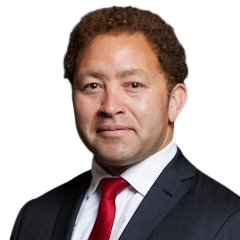
Calvin Bailey is the Labour Party MP for Leyton and Wanstead, having first been elected to parliament at the 2024 general election.
In the 2024 general election, Bailey won 20,755 votes, representing 47.5% of the vote. The Green Party candidate received 6,791 votes (15.5%), while the Conservative candidate secured 4,846 votes (11.1%). Bailey was duly elected with a majority of 13,964.
The Leyton and Wanstead constituency is located across the London Boroughs of Waltham Forest and Redbridge in East London. It has been represented by the Labour Party since its creation in 1997.
Bailey’s predecessor was John Cryer of the Labour Party, who represented the seat from 2010 to 2024.
Bailey was appointed a Member of the Order of the British Empire (MBE) in the 2015 New Year Honours.
Political Career
Bailey currently serves as the parliamentary under-secretary of state for veterans and people at the Ministry of Defence (since June 2026). He succeeded Al Carns in this position, who resigned over a dispute regarding military spending and the defence investment plan (DIP) specifically.
Bailey served as a trade envoy to Southern Africa (January 2025 – June 2026), the Republic of South Africa (January – June 2026) and Mauritius (January – June 2026). Appointed by the trade secretary, envoys are tasked with boosting British exports and attracting foreign investment. An envoy’s duties typically involve leading trade delegations, lobbying host governments on market access issues, and building relationships with overseas businesses.
In November 2024, Bailey referred to Labour’s “Africa reset” as a test of “progressive realism”.
Writing for The House magazine, he urged the UK to move away from “outdated and patronising images” of the continent in favour of a “respectful offer of partnership between equals” focused on shared economic and climate goals.
In a February 2026 article for LabourList, Bailey called for the Labour government to clearly define the “ends” of its policy programme to prevent populists from filling the political vacuum with “nationalist resentment” and “grievance.” He proposed a modern equivalent to the 1942 Beveridge Report, identifying three contemporary “giants” for the state to defeat: strategic dependence, division and disinformation.
He wrote: “The British public still does not clearly see why we are taking these steps or understand the ends we are building towards. This is dangerous, because if we do not define these ends, populists will define them for us.”
In June 2025, Bailey was one of 22 newly elected Labour MPs who co-signed a cross-party letter to the leader of the House of Commons, Lucy Powell, and the Independent Parliamentary Standards Authority (Ipsa) calling for improved paternity leave for parliamentary staff. The letter, organised in collaboration with the campaign group The Dad Shift, argued that the current provision of two weeks’ paid leave was “unfair” and left Parliament trailing behind leading private and public sector employers.
The letter said current rules meant MPs were “unable to support our staff appropriately at some of the most important times of their lives”.
They added: “Dads in our offices get just two weeks off, a situation that is unfair and puts parliament many steps behind top employers across the country.”
In response, a government spokesperson told PoliticsHome: “We are committed to making sure parents receive the best possible support to balance their work and home lives as part of our Plan to Make Work Pay.”
Bailey has sat as a member of the House of Commons defence committee (2024-2026).
Bailey has been listed as a member of the all-party parliamentary groups (APPGs) for armed forces community, Commonwealth War Graves Commission and commemoration, Kurdistan region in Iraq, and prostate cancer.
Bailey delivered his maiden speech in the House of Commons on 24 July 2024 in a debate on international immunities and privileges.
In it, he said: “Leytonstone is also home to one of the most financially deprived areas in the country, but it is a spirited community that seeks to heal itself.
“Community leadership from Cann Hall mosque ensures the provision to all local people of a much-needed food bank and a youth group. Similarly, at St Margaret with St Columba, others gather to preserve a sense of community despite their obvious hardships.”
He added: “Visible role models and leadership are essential for diverse communities. Without these inspirational characters, young black people like me will not see themselves in places of power. I reflect on the very low number of Black men in our politics, despite an increase in representation across all ethnic groups.
“Addressing this is key to fixing the inequalities that face young people, particularly in the area of knife crime…
“A pivotal moment in my upbringing was the murder of Stephen Lawrence. While we are aware of the continuing failure to provide justice to my friend Stuart’s family, we all know of the institutional failings that have led to this.”
In his victory speech on 5 July 2024, Bailey warned of the “rise of the right”.
He stated: “I have warned throughout this campaign that if we fail, if we squabble and allow internecine politics to inhibit our delivery of the changes we have promised our people, then those people will turn to the right and that we cannot allow.”
Political views
Leadership elections and loyalty
Oppose leadership election: In May 2026, Bailey was among the over 100 Labour MPs who signed a joint statement insisting it was “no time for a leadership contest.” The letter was an intervention in the political crisis engulfing Keir Starmer’s premiership, after Labour suffered heavy losses in the 2026 local elections and devolved elections to the Scottish Parliament and Senedd Cymru. It was organised as a counterweight to a mounting rebellion that had seen high-profile figures, including some ministers, call for Starmer’s resignation.
The statement read: “Last week we had a devastatingly tough set of election results. It shows we have a hard job ahead to win back trust from the electorate.
“That job needs to start today – with all of us working together to deliver the change the country needs.
“We must focus on that. This is no time for a leadership contest.”
Labour deputy leadership 2025: Bailey was one of 175 Labour MPs who nominated Bridget Phillipson for the party’s deputy leadership in September 2025. The election followed the resignation of Angela Rayner, who stepped down as deputy prime minister and deputy party leader after an investigation into her tax affairs. It marked the first time since 2007 that Labour had held a deputy leadership contest while in government.
Phillipson, the serving education secretary, was widely viewed as the candidate favoured by Downing Street and the party leadership. She secured 175 nominations from the Parliamentary Labour Party (PLP), comfortably exceeding the 80 required to reach the final ballot. She was ultimately defeated by Lucy Powell.
Factional identity and party tradition
Common Endeavour: Bailey has been identified with the Common Endeavour group, a collective of Labour MPs from the party’s “broad centre” which set out a series of essays alongside the Fabian society focused on how “Labour can apply its values to the problems we face in the second quarter of the 21st century.”
The Fabian Society pamphlet, Common Endeavour: Building a Stronger Britain (April 2026), defined four generational challenges: “affordability, capacity, security, and solidarity.”
The group’s platform, set out in the essays, included calls for a fundamental reappraisal of the UK’s international alliances, reduced strategic dependence on the United States and the pursuit of a closer, Swiss-style relationship with the European Union, including an “emergency brake” on freedom of movement.
The essays were penned by the Labour MPs Liam Byrne, Anna Gelderd, Andrew Lewin, Luke Murphy, Anneliese Dodds, Alex Baker, and Jeevun Sandher, alongside Bailey.
The introduction to the group of essays referred to the phrase used in Clause IV of the Labour Party constitution, which argues that the movement achieves more by “the strength of our common endeavour”.
In a New Statesman article, the MPs rejected the “embrace of ethnocratic division and plutocratic Thatcherism” by their political opponents.
The piece added: “Their values will make us weaker by dividing us ever further. They would have us draw away from like-minded allies in Europe and leave us more dependent on mad fossil fuel-obsessed dictators from abroad.
“And they’d indiscriminately deport our friends, neighbours, and those that sit by our relatives’ bedsides as they suffer. They’d make our nation weaker, because they do not think we achieve more together than we achieve alone.”
Labour Friends of Nato: Bailey is a patron of Labour Friends of Nato (LFN), a parliamentary network and pressure group established in January 2026 to reinforce the Labour Party’s commitment to the Atlantic alliance. According to a LabourList report, the group seeks to deepen understanding of Nato’s strategic role among MPs and party activists. It also seeks to provide a platform to rebut political arguments from both the left and right that seek to diminish Britain’s involvement in the treaty.
The formation of the network was framed by its founders as a return to the post-war traditions of the Clement Attlee government, which helped establish the alliance.
The group set up with plans to organise fact-finding missions to Nato’s military and political headquarters in Brussels and hosting an annual lecture in honour of Ernest Bevin, the former foreign secretary and Nato treaty signatory.
Welfare
Welfare vote (July 2025): Bailey voted in favour of the government’s flagship welfare bill at second reading. The vote came after ministers agreed to significant concessions to avoid defeat via a mass rebellion of Labour MPs on 1 July 2025.
Assisted dying
Bailey voted in favour of the Terminally Ill Adults (End of Life) Bill, better known as the assisted dying bill, at both second reading (November 2024) and third reading (June 2025).
Social values and conscience issues
Social media ban: In January 2026, Bailey was one of over 60 Labour MPs to sign a letter to the prime minister calling for the introduction of an Australia-style ban on social media access for children under the age of 16. Organised by Plymouth Moor View MP Fred Thomas, the initiative brought together a cross-factional coalition of backbenchers – spanning the Socialist Campaign Group, Tribune Group and Blue Labour – to demand action.
The letter called on Keir Starmer to “show leadership” by introducing a minimum age for social media access “to protect young people from the consequences of unregulated, addictive social media platforms”.
It stated: “We are all strong supporters of technology, and of this Labour government’s ambition to use tech to improve lives. But successive governments have done far too little to protect young people from the consequences of unregulated, addictive social media platforms.”
Before Politics
Born Calvin George Bailey in Zambia in the 1970s, he moved to London as a child and grew up in Plumstead.
Bailey graduated from the University of Exeter in 1999 with a master of engineering degree.
He later completed a master’s degree in war studies at King’s College London in 2017.
Before entering parliament, Bailey served for over 24 years in the Royal Air Force, retiring as a Wing Commander upon his election. He joined the Royal Air Force in 1999.
His military career included command roles, and he was detachment commander during Operation Pitting, the UK’s evacuation operation from Kabul, Afghanistan, in 2021.
Personal Life
Bailey has four children, two daughters and two sons.
He has spoken about growing up in Plumstead and being friends with the brother of Stephen Lawrence.
Bailey was 15 years old at the time of Lawrence’s murder.
He has said he used to carry a knife for protection in the aftermath of Lawrence’s murder.
In his 2024 maiden speech, Bailey stated: “I reflected during the campaign that when I was young I carried a knife, not because I wished to attack anyone, but because I was scared and felt that the fate that had befallen my friend’s brother could happen to me and others like me.
“Mistakenly, I assumed that I could look after myself similarly, but sadly, we know that is not the case, and that those who carry knives are more likely to be killed themselves. We need people like me to translate those experiences into policy.”
Trivia
Bailey has told the Guardian that he owes his “political reawakening” to Wes Streeting.
He recalled listening to a radio interview centred on Streeting’s life and thinking, “wow that’s really like mine”.
Calvin Bailey has not written for Politics.co.uk.