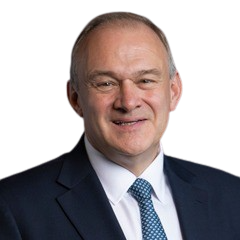
Bridget Phillipson is the Labour MP for Houghton and Sunderland South, having first been elected to parliament at the 2010 general election.
In the 2024 general election, Phillipson received 18,837 votes, representing 47.1% of the vote share. The Reform UK candidate, Sam Wood-Brass, received 11,668 votes (29.1%), while the Conservative candidate, Chris Burnicle, secured 5,514 votes (13.8%). Phillipson was duly re-elected with a majority of 7,169 votes.
The Houghton and Sunderland South constituency is located in Tyne and Wear, covering the southern parts of the City of Sunderland wards such as Houghton, Copt Hill and Doxford. It is a former industrial area historically dominated by coal mining and shipbuilding.
The seat and its predecessors have been held by Labour continuously since 1964 and is considered safe Labour territory, although the party’s majority decreased significantly in 2019. The constituency is known for often being one of the first to declare its result on general election nights. Chris Mullin represented the former Sunderland South seat from 1987 to 2010.
Political Career
Phillipson currently serves as chair of the Labour Party (since July 2026) and minister for women and equalities (since July 2024). She retained the latter role as part of the July 2026 cabinet reshuffle conducted by Andy Burnham upon his appointment as prime minister. In this capacity, Phillipson is a member of the cabinet.
Under Keir Starmer, Phillipson served as secretary of state for education (2024-2026) – alongside her women and equalities post.
Upon her appointment as chair of the Labour Party, Phillipson said: “By uniting together, we will bring hope back to communities and strengthen British society against those working to divide us.
“With the change Labour in government is delivering and will deliver, we have the chance to write a new chapter for our country, one which brings justice, opportunity and fairness for working people, one which brings back hope that tomorrow can be better than today.”
Phillipson stood in the 2025 Labour deputy leadership election. The election followed the resignation of Angela Rayner, who stepped down as deputy prime minister and deputy party leader after an investigation into her tax affairs. It marked the first time since 2007 that Labour had held a deputy leadership contest while in government.
Phillipson was widely viewed as the candidate favoured by Downing Street and the party leadership. She secured 175 nominations from the Parliamentary Labour Party (PLP), comfortably exceeding the 80 required to reach the final ballot. She was ultimately defeated by Lucy Powell, who left the government during the September 2025 ministerial reshuffle that followed 2025’s resignation. Powell served as leader of the House of Commons from July 2024 to September 2025 and won the support of 117 Labour MPs in the nomination stage.
In the final vote of the Labour membership, Powell won 87,407 votes (54.3%). Phillipson secured 73,536 votes (45.7%).
During the campaign, Phillipson urged members to support her candidacy to ensure party “unity”. The education secretary said she would be a voice “at the heart of government”.
Addressing activists at her leadership campaign launch, Phillipson told supporters to back her to bring the party together, secure a second term and “deliver the change we want to see and beat Reform”.
She stated: “How did we win last [time]? We came together to show the country a different vision for the future. I won’t pretend this government hasn’t made mistakes – I’ve been first to admit it.
“But we can’t afford to look inwards – to go back to the bad old days of divided Labour Party and open old wounds. If we turn against each other only one person will win – Nigel Farage – but millions more will lose.”
Prior to the 2024 general election, which saw Labour returned to power after 14 years in opposition, Phillipson was shadow secretary of state for education (November 2021 – July 2024). She served as shadow chief secretary to the Treasury from April 2020 to November 2021.
Previously, under Ed Miliband’s leadership of the Labour party, she served as an opposition whip from October 2013 to September 2015. She also served brief stints as parliamentary private secretary (PPS) to Jim Murphy as shadow defence secretary (2013) and Liz Kendall as shadow care minister (2011–13). A PPS acts as an unpaid parliamentary assistant, providing a link between the senior frontbencher and backbench MPs
Phillipson was a member of the House of Commons public accounts committee (2015-2020), the committees on standards and privileges (2017-2020), the home affairs committee (2010-2013), and the procedure committee (2010-2011).
Phillipson delivered her maiden speech on 7 June 2010 during a debate on constitution and home affairs.
In it, she said: “We have made tremendous progress in Houghton and Sunderland South. Our area has adapted remarkably to significant economic, industrial and social change, much of it not of our choosing during the 1980s and 1990s.
“We are resilient and faced adversity in the past; I am confident that we can now show the same kind of determination again in meeting new challenges.”
She added: “I will be unafraid to speak out where I see injustice that will damage the lives and living standards of my constituents, which have improved so greatly in the past 13 years. I will resist any measure that will damage our economy, our families, and the services on which we all rely. I remain committed to tackling inequality in all its forms.”
Political Views
Leadership elections and loyalty
Labour leadership 2020: Phillipson was one of 82 Labour MPs who nominated Keir Starmer for the party’s leadership in early 2020. The election was triggered by the resignation of Jeremy Corbyn following the party’s defeat in the 2019 general election, which resulted in Labour’s fewest seats in the House of Commons since 1935.
Starmer’s 82 nominations were the highest of any candidate. The shadow Brexit secretary won a decisive victory in the first round with 56.2% of the vote, defeating Rebecca Long-Bailey and Lisa Nandy.
Labour leadership 2015: Phillipson nominated Yvette Cooper for the party’s leadership in June 2015. The election followed the resignation of Ed Miliband after the party’s defeat in the 2015 general election. It was the first contest held under the “one member, one vote” system, which replaced the previous electoral college.
Cooper, the shadow home secretary, secured 59 nominations from the Parliamentary Labour Party (PLP), comfortably exceeding the 35 required to reach the final ballot. She ultimately finished third in the contest with 17% of the vote.
Corbyn loyalty list: In March 2016, Phillipson was labelled as “core group negative” by the Corbyn leadership in a leaked list which categorised Labour MPs by their perceived loyalty. This label suggested the Corbyn leadership viewed Phillipson as a critic but not openly hostile.
Labour leadership 2016: Phillipson supported Angela Eagle for the party’s leadership in July 2016. The election was triggered by a challenge to Jeremy Corbyn following the EU referendum, which led to a wave of shadow cabinet resignations and a vote of no confidence supported by 172 MPs.
Eagle, the former shadow first secretary of state, was the first to formally launch a challenge against Corbyn. However, she withdrew from the race on 19 July after attracting fewer nominations than Owen Smith. Phillipson subsequently shifted her support to Smith’s candidacy. Smith, the former shadow work and pensions secretary, was ultimately defeated by Corbyn, who won with an increased mandate of 61.8% of the vote.
Labour leadership 2010: Phillipson was one of 81 Labour MPs who nominated David Miliband for the party’s leadership in May 2010. The election followed the resignation of Gordon Brown, who stepped down as prime minister and Labour leader after the 2010 general election.
Miliband, the former foreign secretary, was seen as closely aligned with the New Labour project – a Blairite figure. He secured 81 nominations from the Parliamentary Labour Party (PLP), comfortably exceeding the 33 required to reach the final ballot, but was narrowly defeated by his brother, Ed Miliband, in the final round by 50.7% to 49.3%.
Brexit and Europe
Brexit referendum: Phillipson supported Remain in the 2016 Brexit referendum, and therefore disagreed with a majority of her constituents, 62.4% of whom voted to Leave.
Article 50: In February 2017, Phillipson voted in favour of the European Union (Notification of Withdrawal) Bill. The legislation empowered the prime minister to notify the Council of the European Union of the UK’s intention to withdraw, formally triggering the process set out in Article 50 of the Treaty on European Union. MPs supported the bill by 498 votes to 114 at second reading.
People’s vote support (2019): Phillipson signed a January 2019 statement by Labour MPs calling for a “people’s vote” or second referendum. The statement, signed by 71 Labour MPs, read: “Defeat of the Tory [Brexit] deal in a public vote would give us all a chance to campaign for the anti-austerity policies and a Labour government that deals with the true causes of the Brexit vote, and a reformed Europe that works for all people.”
Welfare
Welfare vote (July 2025): Phillipson voted in favour of the government’s flagship welfare bill at second reading. The vote came after ministers agreed to significant concessions to avoid defeat via a mass rebellion of Labour MPs on 1 July 2025.
Assisted dying
Phillipson voted against the Terminally Ill Adults (End of Life) Bill, better known as the assisted dying bill, at both second reading (November 2024) and third reading (June 2025).
Social values and conscience issues
Same-sex marriage (2013): In February 2013, Phillipson voted in favour of the Marriage (Same Sex Couples) Bill at its second reading. The landmark piece of legislation, which received its second reading by 400 votes to 175, legalised marriage for same-sex couples in England and Wales.
Foreign policy and security
Trident renewal (2016): Phillipson voted in favour of a government motion calling for the renewal of the Trident nuclear deterrent system in July 2016. The motion, which was passed by 472 votes to 117, committed the UK to constructing a new fleet of submarines to carry the nation’s nuclear weapons. Labour was split over the issue with 140 of its 230 MPs going against leader Jeremy Corbyn and backing the motion.
Syria airstrikes (2015): Phillipson voted in favour of a government motion to extend UK airstrikes against Isis from Iraq into Syria in December 2015. The motion, which was passed by 397 votes to 223 after a 10-hour debate in the House of Commons, authorised the RAF to conduct strikes against Isis targets in Syria.
Syria airstrikes (2013): Phillipson voted against the government’s motion on the principle of military intervention in Syria in August 2013. The government motion was defeated by 285 votes to 272, a move which effectively ruled out UK participation in any US-led military strikes.
Palestine
Palestinian recognition vote (2014): In October 2014, Phillipson was one of 192 Labour MPs who voted in favour of recognising Palestine as a state. The motion, passed by 274 votes to 12, called on the government to “recognise the state of Palestine alongside the state of Israel as a contribution to securing a negotiated two-state solution”.
Before Politics
Born on 19 December 1983 in Gateshead, Bridget Phillipson grew up on a council estate in Washington, Tyne and Wear. Her mother, Clare Phillipson, raised her as a single parent and founded the local charity Wearside Women in Need – a Sunderland based charity supporting women affected by domestic abuse.
Phillipson attended St Robert of Newminster Catholic School and Sixth Form College in Washington.
She studied modern history and modern languages (French) at Hertford College, University of Oxford, graduating in 2005.
During her time at Oxford, she served as co-chair of the Oxford University Labour Club (OULC) from 2003 to 2004.
After graduating, she returned to the North East and worked in local government and then as a manager for Wearside Women in Need from 2007 until her election to parliament in 2010.
Personal Life
Phillipson is married (in 2009) and has two children, a daughter and a son.
She is a Roman Catholic.
Trivia
As a child, Phillipson was an extra on the kids BBC TV show Byker Grove.
Phillipson joined the Labour Party at the age of 15.
Bridget Phillipson has not written for Politics.co.uk.