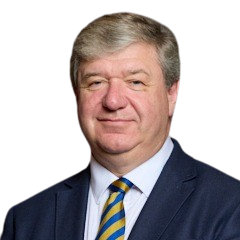
Alistair Carmichael is the Liberal Democrat MP for Orkney and Shetland, and was first elected at the 2001 general election.
In the 2024 general election, Carmichael received 11,392 votes in Orkney and Shetland, representing 55.1% of the vote share. The Scottish National Party (SNP) Candidate, Robert Leslie, came second with 3,585 votes (17.3%) and Alex Armitage of the Scottish Green Party came third with 2,046 votes (9.9%). Carmichael was duly elected with a majority of 7,807.
The Orkney and Shetland constituency covers the two northern archipelagos of Scotland and is the most northerly constituency in the United Kingdom. The seat has been held continuously by the Liberal Party and its successor, the Liberal Democrats, since 1950. Notable previous MPs include former Liberal Party leader Jo Grimond.
Political Career
Carmichael currently serves as chair of the environment, food and rural affairs select committee (since September 2024). The committee is responsible for scrutinising the work of the Department for Environment, Food and Rural Affairs (Defra). It looks at issues from farming to the water sector to a circular economy.
By virtue of this role, Carmichael sits on the liaison committee – the so-called “super committee” composed of the cross-party chairs of all the other commons select committees. It has a broad oversight role, but is best known for its questioning of the prime minister in sessions that take place two or three times a year.
As chair of the Efra committee, Carmichael called on the government to delay changes to inheritance tax rules affecting family farms, announced at the 2024 autumn budget, until 2027.
Following the publication of a report on the issue by his committee, Carmichael stated: “The government, however, seems to be dismissing farmers’ concerns and ignoring the strength of feeling evidenced in the months of protests that saw tractors converge on Westminster and up and down the country.”
During the Conservative-Liberal Democrat coalition government, Carmichael served as comptroller of the household (deputy chief whip) from 2010 to 2013. As the deputy chief whip, Carmichael was responsible for ensuring support for the controversial tuition fees policy among his party (2010).
Commenting later on his appointment as the leading Lib Dem whip, Carmichael told the Hansard Society: “When [party leader and deputy prime minister] Nick Clegg asked me to be chief whip, he said, look, you understand parliament, you have some good emotional intelligence, and sometimes, when it matters, you can be a bit of a thug.
“As a job description, I guess that’s probably going to be as good as you get.”
Carmichael joined the cabinet in October 2013 as secretary of state for Scotland, serving until the end of the coalition government in May 2015. He became the Liberal Democrat chief whip again in 2017, holding the post at various points until 2020.
Following Nick Clegg’s resignation as Lib Dem leader, Carmichael took temporary charge of the party in the House of Commons. He declined to stand to replace Clegg as leader.
In May 2015, he told the Scotland on Sunday newspaper that he was “flattered” by the number of people who had asked him to run. However, he added: “[The Lib Dems] have a big rebuilding task ahead of us and I want to play my part in that but I don’t think I’m the right man to lead the party.”
In recent times, Carmichael has held Liberal Democrat spokesperson roles covering justice (2022-2024), home affairs (2020-2024), Northern Ireland (2017-2024), Brexit and foreign affairs (2020), and environment, food and rural affairs (2019). He served again as chief whip of the Lib Dems from 2017 to 2020.
During the 2015 general election campaign, Carmichael was reported to have authorised the leaking of a memo concerning comments allegedly made by Nicola Sturgeon to the French ambassador. At the time of the leak, he denied all knowledge of leaking the memo, but he later admitted responsibility.
Sturgeon and the French diplomat involved in the conversation have both made clear that the memo was inaccurate. The memo claimed Sturgeon had privately stated she would “rather see David Cameron remain as PM”. The then-Scottish first minister called the leaked memo, published by the Daily Telegraph on 3 April 2015, a “blatant election dirty trick”.
In an interview with Channel 4 News, broadcast the day after the story was initially published, Carmichael said: “The first I became aware of this, and this is already on the public record, was when I received a phone call on Friday afternoon from a journalist making me aware of it.”
After the election, following a Cabinet Office inquiry, Carmichael admitted he authorised his special adviser to release the memo. He apologised, saying it was an error of judgement and that he accepted “the details of the account were not correct”. He also acknowledged that, were he still a government minister, the matter would have “required my resignation”.
Carmichael subsequently survived a legal challenge attempting to unseat him under the Representation of the People Act 1983. The Act states that a person who, during an election or for the purpose of affecting the return of a candidate, “makes or publishes any false statement of fact in relation to the candidate’s personal character or conduct shall be guilty of an illegal practice”.
Before the 2010 coalition government, Carmichael held frontbench roles as spokesperson for Scotland (2007-2010) and home affairs (2006).
According to a Times report, published August 2006, Carmichael privately called on Lib Dem leader Charles Kennedy to stand down from his post. Earlier that year, on 4 January 2006, Carmichael publicly called on Kennedy to force a confidence vote of Lib Dem MPs and peers to confirm his position or remove him. Kennedy resigned days later.
Carmichael has served on several House of Commons committees during his time in parliament. He was a member of the energy and climate change committee (2015-2016), the public accounts committee (2005-2006), the Scottish affairs committee (2001-2005 and 2008-2010), and the international development committee (2001-2002).
Carmichael is listed as a chair of the all-party parliamentary groups (APPGs) for fisheries, Jordan, marine energy and Syria.
Carmichael delivered his maiden speech on 26 June 2001. In it, he stated: “It is my privilege to represent in the House a constituency that is independently minded and deeply self-reliant. I have not been sent here to ask for any special favours, and I am not here to beg for any handouts.
“I am here merely to ask that my constituents be allowed the same opportunities to develop the potential of their communities that are given to other honourable members and their constituents in the rest of the country. It is a case that is based on simple fairness and equality of opportunity. It is my devout hope that any case so based will always be well received.”
Carmichael unsuccessfully contested the Paisley South seat for the Liberal Democrats in the 1987 general election but was beaten by the Labour candidate.
Political Views
Carmichael was a founding member of the centre-left Beveridge Group within the Liberal Democrats – which sought to respond to a perceived rightward shift in the party’s positioning. Established in 2001, the group was named after the economist, pioneering social reformer and Liberal politician, William Beveridge, whose work helped shape the formation and development of the welfare state.
In 2003, Carmichael wrote an article which questioned the claim in the Liberal Democrat policy paper Setting Business Free, which said the party should “start with a bias in favour of market solutions”.
He argued: “Should the party of Beveridge and [John Maynard] Keynes approach issues with a prejudice in favour of the free market system? Should we enter every policy debate with an underlying belief that private is always better than public? I certainly do not think so.”
Carmichael added: “That was the approach which led the Conservatives to undertake the disastrous privatisation of British Rail in the mid 1990s.”
In later years, the Beveridge Group was seen as an ideological and political counterweight to the rise of Orange Book liberalism, typified by thinking of Nick Clegg, a market liberal, as leader. During the Conservative-Lib Dem coalition government, the Orange Booker or market liberal wing of the party was considered to be in the ascendancy – signified by the prominence of sympathetic figures around the cabinet table. Clegg, Ed Davey, David Laws and Vince Cable all penned chapters in the Orange Book, published September 2004, which called for party policy that emphasised greater personal choice and market solutions.
Generally, Lib Dem politicians sympathetic to the Beveridge Group were considered to be more sceptical of the coalition government. Carmichael, however, served in that government across a series of posts, including as a cabinet minister.
As Lib Dem chief whip, Carmichael remained neutral during the 2020 and 2019 party leadership contests.
He endorsed Nick Clegg in the 2007 leadership contest.
Electoral reform
Fair elections APPG: Carmichael is listed as a member of the all-party parliamentary group (APPG) for fair elections – a cross-party group of MPs and peers that campaigns for electoral reform. The group’s stated aims include replacing the first past the post (FPTP) voting system with a form of proportional representation, eliminating “dark money” and “undemocratic influence” from politics, and countering disinformation.
Proportional representation bill: In December 2024, Carmichael voted in favour of the Elections (Proportional Representation) Bill – introduced by Liberal Democrat frontbencher Sarah Olney under the 10-minute rule procedure. The bill sought to “introduce a system of proportional representation for parliamentary elections and for local government elections in England”.
A total of 138 MPs supported the bill – with 136 opposed. Notably, 59 Labour MPs backed Olney’s bill.
Introducing the bill, Olney told the House: “First past the post is a broken and unfair system. This summer, the Labour party won a landslide election victory, securing 63% of seats in the House of Commons in return for just 34% of the vote.
“The system leaves millions of voices unheard and creates a divisive, adversarial political climate where collaboration is discouraged and accountability is often sidestepped.”
Brexit and Europe
Brexit referendum: Carmichael campaigned to remain in the 2016 referendum on Britain’s membership of the European Union (EU), and therefore agreed with a majority of constituents, 59.7% of whom also voted to remain.
Article 50: In February 2017, Carmichael voted against the European Union (Notification of Withdrawal) Bill. The legislation empowered the prime minister to notify the Council of the European Union of the UK’s intention to withdraw, formally triggering the process set out in Article 50 of the Treaty on European Union. MPs supported the bill by 498 votes to 114 at second reading.
In an article for the Herald newspaper, published January 2019, Carmichael wrote: “Let me be clear. I believe that a people’s vote is the only way for our country now to go forward. In itself it is not an answer to all the problems that caused Brexit and which come with it.
“Would it heal the divide within our country? No but it would at least allow the healing to start. If [prime minister] Theresa May and [Labour leader] Jeremy Corbyn are to continue to block it then they make themselves part of the problem so one way or another they must be removed.”
During the 2019 general election, Carmichael stood on a manifesto that pledged to revoke Article 50 and cancel Brexit.
Customs union vote (2025): In December 2025, Carmichael voted in favour of the UK-EU Customs Union (Duty to Negotiate) Bill. The bill, introduced under the ten-minute rule procedure by Liberal Democrat Europe spokesperson Al Pinkerton, sought to mandate the government to enter into negotiations with the European Union to establish a bespoke customs union.
Assisted dying
Carmichael voted in favour of the Terminally Ill Adults (End of Life) Bill, better known as the assisted dying bill, at second reading (November 2024) and third reading (June 2025).
In a statement setting out his position, issued November 2024, Carmichael commented: “Over the years I have had to vote on many difficult decisions in the House of Commons, including over the invasion of Iraq and leaving the European Union.
“This bill far exceeds any of those other votes and I will not take my responsibilities lightly. I know this to be true for every other MP with whom I have discussed it.”
He added: “My starting point in reaching this view is that we have already effectively decriminalised assisted dying for those who have the means and determination to go overseas to do it.
“For that reason I feel that the current debate is necessary. I think it is wrong for the United Kingdom to ‘offshore’ an issue that is as morally and ethically important as this.”
Social values and conscience issues
Same-sex marriage (2013): In February 2013, Carmichael voted in favour of the Marriage (Same Sex Couples) Bill at its second reading. The landmark piece of legislation, which received its second reading by 400 votes to 175, legalised marriage for same-sex couples in England and Wales.
Foreign policy and security
IPAC: Carmichael is a member of the Inter-Parliamentary Alliance on China (IPAC) – an international, cross-party network of legislators from democratic countries focused on relations with the People’s Republic of China. The alliance, established on 4 June 2020, the anniversary of the 1989 Tiananmen Square protests and massacre, was formed to unite “lawmakers worldwide, promoting democracy and addressing threats to the rules-based and human rights systems posed by the rise of China.”
Sanctioned (Russia): In April 2025, Carmichael was among the group of MPs placed on a sanctions list by the Russian government. The measure barred them from entering Russia and was presented by Moscow as a retaliatory response to the UK’s stance on the invasion of Ukraine.
Trident renewal (2016): Carmichael voted against a government motion calling for the renewal of the Trident nuclear deterrent system in July 2016. The motion, which was passed by 472 votes to 117, committed the UK to constructing a new fleet of submarines to carry the nation’s nuclear weapons. Labour was split over the issue with 140 of its 230 MPs going against leader Jeremy Corbyn and backing the motion.
Syria airstrikes (2015): Carmichael voted in favour of a government motion to extend UK airstrikes against Isis from Iraq into Syria in December 2015. The motion, which was passed by 397 votes to 223 after a 10-hour debate in the House of Commons, authorised the RAF to conduct strikes against Isis targets in Syria.
Syria airstrikes (2013): Carmichael voted in favour of the government’s motion on the principle of military intervention in Syria in August 2013. The government motion was defeated by 285 votes to 272, a move which effectively ruled out UK participation in any US-led military strikes.
Iraq War authorisation vote (2003): In March 2003, Carmichael voted against the government motion authorising military action against Iraq. The vote, one of the most contentious in recent parliamentary history, gave the prime minister, Tony Blair, the authority to join the US-led invasion.
Palestine
Palestinian recognition letter (July 2025): In July 2025, Carmichael was among the over 254 MPs to sign a cross-party letter calling for the government to immediately recognise the state of Palestine. The letter called on the prime minister and foreign secretary to recognise Palestine at the UN Conference then taking place in New York.
https://x.com/SarahChampionMP/status/1949769513123094568
Ceasefire vote (November 2023): Carmichael voted for a Scottish National Party (SNP) amendment to the king’s speech in the House of Commons calling for an “immediate ceasefire” in the Israel-Hamas war. Labour had tabled a rival motion, making a more moderate appeal for a “humanitarian pause” in the conflict.
Civil liberties
Covid passes campaign (2021): Carmichael was one of over 70 MPs and peers who launched a cross-party campaign against the “divisive and discriminatory use” of Covid passes in April 2021. The campaign was triggered by government reviews into “vaccine passports”, which signatories argued would create a two-tier society and infringe upon fundamental civil liberties.
Covid passes vote (2021): Carmichael was one of 126 MPs to vote against Covid passes in England in December 2021. The measure, introduced by Boris Johnson’s government, was carried by 369 votes to 126.
Before Politics
Alexander Morrison “Alistair” Carmichael was born on 15 July 1965 in Islay, in the Inner Hebrides. He grew up on a farm and attended Port Ellen Primary School and Islay High School.
He studied for two years at the University of Glasgow, alongside working as a hotel manager, before leaving the university. He eventually returned to education, studying Law at the University of Aberdeen, gaining an LLB in 1992.
After graduating, he qualified as a solicitor, working first as a Procurator Fiscal Depute from 1993 to 1996, and then as a solicitor in private practice in Aberdeenshire from 1996 until his election in 2001.
Personal Life
Carmichael is married to Kathryn, who works as a veterinary surgeon. The couple have two sons.
He is an elder of the Church of Scotland.
Trivia
Carmichael enjoys amateur dramatics and music. He speaks both French and German.
He is one the longest continuously serving Liberal Democrat MP.
Carmichael was the only Scottish MP representing the Liberal Democrats in the House of Commons during the 2015-2017 parliament.


Alistair Carmichael: ‘The government must rethink its tax hikes on the Scotch whisky industry — not double down’
31 October 2023