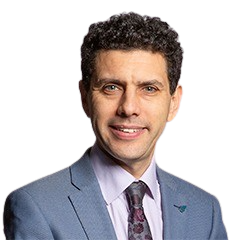
Alex Sobel is the Labour and Co-operative MP for Leeds Central and Headingley, having first been elected to parliament for the predecessor seat of Leeds North West at the 2017 general election.
In the 2024 general election, Sobel received 15,853 votes, representing 50.2% of the vote share. The Green Party candidate, Chris Foren, received 7,431 votes (23.5%), while the Liberal Democrat candidate, Chris Howley, secured 2,611 votes (8.3%). Sobel was duly re-elected with a majority of 8,422 votes.
The Leeds Central and Headingley constituency covers the city centre of Leeds and inner-city areas including Headingley, Hyde Park, Woodhouse, Kirkstall and Little London. It contains the main campus of the University of Leeds and has a very large student population.
It is a new constituency created for the 2024 general election, formed from parts of the abolished Leeds North West and Leeds Central constituencies. Leeds Central had been safe Labour territory, while Leeds North West was a Labour gain from the Liberal Democrats in 2017, having previously been held by the Conservatives before 1997.
Political Career
Sobel currently serves as chair of the all-party parliamentary group (APPG) for fair elections – a cross-party group of MPs and peers that campaigns for electoral reform. The group’s stated aims include replacing the first past the post (FPTP) voting system with a form of proportional representation, eliminating “dark money” and “undemocratic influence” from politics, and countering disinformation.
In September 2025, the APPG for fair elections published a “ready to go” blueprint for an independent review of the FPTP electoral system. Sobel described the proposal as “a ready to go plan to independently review how parliament is elected, promote a national conversation, and build consensus on a way forward”.
In May 2026, Sobel tabled an amendment to the Representation of the People Bill – signed by over 70 Labour MPs – calling on the government to establish a “national commission on electoral reform”. At the time, Sobel described FPTP as “one of the biggest examples of a broken status quo in UK politics.” He invited colleagues to join this “common sense call to take a fresh look at how parliament is elected in modern Britain.”
Sobel serves as a trade envoy to Ukraine (since January 2025). Appointed by the trade secretary, envoys are tasked with boosting British exports and attracting foreign investment. An envoy’s duties typically involve leading trade delegations, lobbying host governments on market access issues, and building relationships with overseas businesses.
Prior to the 2024 general election, which saw Labour returned to power after 14 years in opposition, Sobel served as shadow minister for nature recovery and the domestic environment from December 2021 to September 2023. Before that, he was shadow minister for tourism and heritage from April 2020 to December 2021.
Sobel was a member of the House of Commons culture, media and sport committee (2024), the environmental audit committee (2017-2021), and the backbench business committee (2017-2019).
Sobel is listed as a member of the all-party parliamentary groups for music, net zero, students, Ukraine and West Papua.
Sobel delivered his maiden speech on 12 July 2017 during a debate on the Grenfell Tower Inquiry.
In it, he said: “My constituency starts in inner-city Hyde Park, where we have a vibrant cultural and music scene including the legendary Brudenell Social Club, where only a few weeks ago my right honourable friend [Jeremy Corbyn] gave a speech to 5,000 people – people who climbed trees and stood on rooftops to feel part of our movement.
“We then move on to Headlingley, with its world-renowned sporting pedigree.”
He added: “My own history in Leeds North West started, like that of so many of my fellow constituents, as a student in one of the city’s fine universities.
“It was at university that my interest in fighting for justice and equality began, as staff-student representative for the School of Computing at the University of Leeds, first advocating for my fellow students, before going on to campaign on issues such as student funding and against racism on campus.”
Before entering parliament, Sobel was a Labour councillor for the Moortown ward on Leeds City Council from 2012 to 2018. He stood unsuccessfully for parliament in Beaconsfield and Leeds North West at the 2005 and 2015 general election respectively.
Political Views
Leadership elections and loyalty
Starmer stand down: In May 2026, Sobel publicly called for Keir Starmer, the prime minister, to step down/set out a timetable for his departure. The move followed the 2026 local elections and devolved elections to the Scottish Parliament and Senedd Cymru.
Labour leadership 2020: Sobel was one of 22 Labour who nominated Emily Thornberry for the party’s leadership in early 2020. The election was triggered by the resignation of Jeremy Corbyn following the party’s defeat in the 2019 general election, which resulted in Labour’s fewest seats in the House of Commons since 1935.
Thornberry, then the shadow foreign secretary, was one of five candidates to reach the second stage of the contest. However, she was eliminated from the race on 15 February 2020 after failing to secure the required 33 nominations from Constituency Labour Parties (CLPs) or three affiliated groups. This left Keir Starmer, Rebecca Long-Bailey, and Lisa Nandy as the three candidates on the final membership ballot.
Factional identity and party tradition
Sobel is associated with the “soft left” of the Labour Party, having co-founded the Open Labour activist group in 2015.
In 2015, Sobel signed an open letter that called for a new “forum bringing together activists to build a Labour left which is committed to a better quality of debate and political culture within Labour, while focusing on the question of how to win power.”
The letter added: “The need for a renewed democratic left within the party is clear. This debate cannot be reduced to how ‘left’ or ‘right’ Labour is. It is about how we tie our opposition to austerity and concentrations of power to a strategy where we persuade those who haven’t yet felt the confidence to vote for us.
“Open Labour is a grassroots-powered organisation and will stay that way. It will argue for and practise a new style of left politics which is tolerant, forward-looking and seeks power for a purpose. We urge anyone who sees truth in this letter to visit openlabour.org and join us.”
Mainstream: Sobel is a member of Mainstream, a centre-left network within the Labour Party. The group was launched in September 2025 by the think tank Compass and Open Labour. It describes itself as a home for “Labour’s radical realists” and aims to influence the direction of the Labour government. It has called on the government to offer a “popular, principled and practical left politics for meaningful change.”
Compass has described the group as “an independent vehicle with the sole task of saving the Labour Party from its clear drift to the right and the unintended paving of the way to a Reform government.”
The group is backed by a number of senior Labour figures, including the mayor of Greater Manchester, Andy Burnham, and includes MPs and peers from various traditions within the party – from the left, soft left and the more progressive elements of New Labour.
SERA: Sobel has been listed as a member of the Socialist Environment and Resources Association (SERA) – a socialist society affiliated with the Labour Party. Founded in 1973, SERA is the party’s official environmental campaign group. The organisation campaigns on a wide range of issues, including renewable energy, biodiversity, air quality and the transition to a green economy. SERA describes its member MPs as “champions for the environment”.
Labour ‘reset’: In March 2026, Sobel was among dozens of Labour parliamentarians to co-sign a statement calling for a “reset” in the party’s internal culture and political direction. The statement, supported by an alliance of MPs from both the Mainstream (“soft-left”) and Momentum (left) wings of the party, condemned what it saw as the “insular, centralising approach” of the leadership. It called on Labour to rebuild “basic democracy, pluralism and fair process within our party.”
The intervention followed a series of by-election results in Gorton and Denton, Runcorn and Helsby and Caerphilly.
The statement said: “We stand against the insular, centralising approach of the current leadership that refuses to draw on the energy, talent and ideas of our whole movement, the continued underfunding of public services and local government, and the pandering to the talking points of the far right.”
It added: “We, the undersigned members from every section of the Labour Party – parliamentarians, councillors, internal election candidates, members and trade unionists, pledge to reset the Labour Party.”
Brexit and Europe
Brexit referendum: Sobel supported Remain in the 2016 Brexit referendum, and therefore agreed with a majority of constituents, 64.6% of whom voted to Remain.
Remain pledge: During the 2019 general election campaign, Sobel was one of 193 Labour candidates to sign the anti-Brexit “Remain pledge”, drawn up by the campaign group Remain Labour.
It stated: “Labour is committed to a confirmatory referendum, to give you the final say on Brexit. If elected as your Labour MP, I pledge to campaign to Remain in the EU.”
Electoral reform
Proportional representation bill: In December 2024, Sobel voted in favour of the Elections (Proportional Representation) Bill – introduced by Liberal Democrat frontbencher Sarah Olney under the 10-minute rule procedure. The bill sought to “introduce a system of proportional representation for parliamentary elections and for local government elections in England”.
A total of 138 MPs supported the bill – with 136 opposed. Notably, 59 Labour MPs backed Olney’s bill.
Introducing the bill, Olney told the House: “First past the post is a broken and unfair system. This summer, the Labour party won a landslide election victory, securing 63% of seats in the House of Commons in return for just 34% of the vote.
“The system leaves millions of voices unheard and creates a divisive, adversarial political climate where collaboration is discouraged and accountability is often sidestepped.”
Welfare
Welfare ‘reasoned amendment’ (June 2025): Sobel was one of the over 120 Labour MPs to sign the reasoned amendment to the government’s flagship welfare bill which aimed to reject the proposed legislation.
The amendment, in the name of senior Labour MP Dame Meg Hillier, objected to the fact that the bill had not been subject to a “formal consultation with disabled people” and that “250,000 people will be pushed into poverty” as a result of it, according to a government impact assessment.
The motion also called on the government to wait for the publication of the review into the Personal Independence Payment (Pip), helmed by minister Sir Stephen Timms, and the independent review, conducted by Sir Charlie Mayfield, into how the employment of disabled people could be boosted.
Welfare vote (July 2025): Sobel went on to abstain over the bill at second reading. The vote came after ministers agreed to significant concessions to avoid defeat via a mass rebellion of Labour MPs on 1 July 2025.
Assisted dying
On the second reading of the Terminally Ill Adults (End of Life) Bill, better known as the assisted dying bill, in November 2024, Sobel did not record a vote. Sobel also did not record a vote at the bill’s third reading/
Social values and conscience issues
Trans rights: Sobel attended a rally organised by Labour for Trans Rights, a pressure group within the Labour party, during the party’s annual conference in September 2025. The event was described as a “Trans Solidarity Rally” and was intended to affirm the place of transgender people and their allies within the Labour movement.
X letter: In November 2025, Sobel was one of 34 cross-party MPs and peers who signed a letter to Ofcom demanding an investigation into the social media platform X (formerly Twitter). The letter, led by Joani Reid, chair of the all-party parliamentary group (APPG) on antisemitism, called on the regulator to determine whether the platform was in breach of its legal duties under the Online Safety Act following a reported surge in antisemitic content and calls for violence against Jews on X.
Foreign policy and security
IPAC: Sobel is a member of the Inter-Parliamentary Alliance on China (IPAC) – an international, cross-party network of legislators from democratic countries focused on relations with the People’s Republic of China. The alliance, established on 4 June 2020, the anniversary of the 1989 Tiananmen Square protests and massacre, was formed to unite “lawmakers worldwide, promoting democracy and addressing threats to the rules-based and human rights systems posed by the rise of China.”
Sanctioned (Russia): In April 2022, Sobel was among the group of MPs placed on a sanctions list by the Russian government. The measure barred them from entering Russia and was presented by Moscow as a retaliatory response to the UK’s stance on the invasion of Ukraine.
Palestine
Palestinian recognition letter (July 2025): In July 2025, Sobel was among the over 254 MPs to sign a cross-party letter calling for the government to immediately recognise the state of Palestine. The letter called on the prime minister and foreign secretary to recognise Palestine at the UN Conference then taking place in New York.
Ceasefire vote (November 2023): Sobel was among 56 Labour MPs to vote in favour of a Scottish National Party (SNP) amendment to the King’s Speech in the House of Commons calling for an “immediate ceasefire” in Gaza – defying the instruction set out by the party’s frontbench. Labour had tabled its own motion, making a more moderate appeal for a “humanitarian pause” in the conflict and ordered its representatives to support that stance.
Before Politics
Alexander David Sobel was born on 26 April 1975, he grew up in Beaconsfield. His parents had emigrated from Israel in 1971.
He attended Holtspur Middle School and John Hampden Grammar School in High Wycombe.
He studied information systems at the University of Leeds, graduating in 1997.
After university, Sobel worked with social enterprises and led Social Enterprise Yorkshire and the Humber from 2009 until his election to parliament in 2017.
Personal Life
Sobel is married. He has two children.
He is Jewish and a member of the Jewish Labour Movement (JLM).
On Holocaust Memorial Day in 2023, Sobel told the story of his great-grandfather, David, who was murdered at the Belzec extermination camp.
He wrote in an article for LabourList: “My family lived through the Holocaust in Ukraine. My family were ordinary people who lived and died in extraordinary, terrible times. Hearing their stories growing up means I recall the names of various towns and cities in Ukraine. Places like Lviv, Dnipro, Makeyevka and Kryvyi Rih.”
Trivia
Sobel enjoys indie gigs, video games, cycling and running.
He joined the Labour Party in 1997.
Alex Sobel has not written for Politics.co.uk.