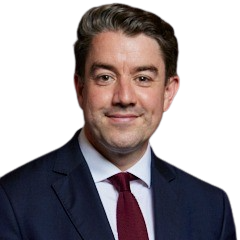
Alan Strickland is the Labour MP for Newton Aycliffe and Spennymoor, having first been elected to parliament at the 2024 general election.
In the 2024 general election, Strickland won 18,394 votes, representing 46.2% of the vote. The Reform UK candidate, John Grant, received 9,555 votes (24.0%), while the Conservative candidate, Paul Howell, secured 8,195 votes (20.6%). Strickland was duly elected with a majority of 8,839.
The Newton Aycliffe and Spennymoor constituency, newly created ahead of the 2024 general election, is located in County Durham, North East England. The seat was formed primarily from the former Sedgefield constituency (previously held by Conservative Paul Howell, and most famously by Labour’s Tony Blair) and parts of Bishop Auckland and City of Durham (both Labour-held).
Political Career
Strickland served as a parliamentary private secretary (PPS) in the Department for Education from July 2024 to July 2026. A PPS acts as an unpaid parliamentary assistant, providing a link between the senior frontbencher and backbench MPs.
Strickland left government as part of the July 2026 reshuffle conducted by Andy Burnham upon his appointment as prime minister.
In May 2026, Strickland was among the over 100 Labour MPs who signed a joint statement insisting it was “no time for a leadership contest.” The letter was an intervention in the political crisis engulfing Keir Starmer’s premiership, after Labour suffered heavy losses in the 2026 local elections and devolved elections to the Scottish Parliament and Senedd Cymru. It was organised as a counterweight to a mounting rebellion that had seen high-profile figures, including some ministers, call for Starmer’s resignation.
The statement read: “Last week we had a devastatingly tough set of election results. It shows we have a hard job ahead to win back trust from the electorate.
“That job needs to start today – with all of us working together to deliver the change the country needs.
“We must focus on that. This is no time for a leadership contest.”
Strickland is a patron of LGBT+ Labour – a socialist society formally affiliated with the Labour Party.
Strickland delivered his maiden speech on 22 July 2024 during a debate on the economy, welfare and public services. In it, he said: “My own family’s story is testament to this spirit of aspiration that has long defined the working people of our country.
“Several generations ago, both sides of my family were drawn from mining villages across England to the Durham coalfields because of their reputation for good wages and reliable work. In turn, my grandparents moved from pit villages to Aycliffe new town, home for two years to the late Lord Beveridge, in search of modern housing and better jobs for their children.
“My parents’ generation then worked hard to give us the opportunities that they never had, including higher education, the chance to work across the country and across the world, and personal freedoms to flourish.
“This ethos – that each generation raises the next, that background be no barrier, and that opportunity be distributed as widely as talent – is the driving force in families in my constituency and a lodestar for this government.”
Before entering parliament, Strickland served as a Labour councillor on Haringey London Borough Council from 2010 until 2018.
Political views
Leadership elections
Labour deputy leadership 2025: Strickland was one of 175 Labour MPs who nominated Bridget Phillipson for the party’s deputy leadership in September 2025. The election followed the resignation of Angela Rayner, who stepped down as deputy prime minister and deputy party leader after an investigation into her tax affairs. It marked the first time since 2007 that Labour had held a deputy leadership contest while in government.
Phillipson, the serving education secretary, was widely viewed as the candidate favoured by Downing Street and the party leadership. She secured 175 nominations from the Parliamentary Labour Party (PLP), comfortably exceeding the 80 required to reach the final ballot. She was ultimately defeated by Lucy Powell.
Welfare
Welfare vote (July 2025): Strickland voted in favour of the government’s flagship welfare bill at second reading. The vote came after ministers agreed to significant concessions to avoid defeat via a mass rebellion of Labour MPs on 1 July 2025.
Assisted dying
Strickland voted against the Terminally Ill Adults (End of Life) Bill, better known as the assisted dying bill, at both second reading (November 2024) and third reading (June 2025).
In a statement issued at the time of the bill’s second reading, he said: “While I don’t feel the current laws around assisted dying are satisfactory, this was not a vote on the principle of assisted dying as a whole – this was a vote on the details of the particular bill that was put before us in parliament.
“This is a profound issue of fundamental constitutional importance. It deals with the way that our society views life and indeed death. I’ve therefore been concerned that the bill doesn’t deal adequately with the legal, ethical, medical and societal complexities that inevitably come with this deeply sensitive issue.”
Social values and conscience issues
Abortion decriminalisation (2025): Strickland voted in favour of a backbench amendment to the Crime and Policing Bill that sought to decriminalise abortion in England and Wales in June 2025. The amendment, which was passed by a majority of 242 votes, removed women from the threat of prosecution for ending a pregnancy at any stage. As an issue of conscience, MPs were allowed to vote according to their personal beliefs.
Before Politics
Alan David Strickland grew up in Newton Aycliffe, County Durham.
He studied at Merton College, Oxford. During this time, he served as president of the Oxford University Student Union (OUSU).
Strickland’s career before entering frontline politics centred on roles in the voluntary sector, where he worked for national charities.
Personal Life
In 2024, PinkNews listed Strickland among a number of out LGBTQ+ parliamentarians.
Trivia
Strickland served as president of the Oxford University Student Union (OUSU).
Alan Strickland has not written for Politics.co.uk.