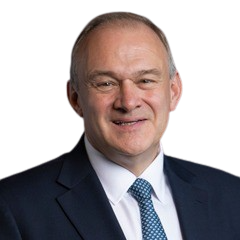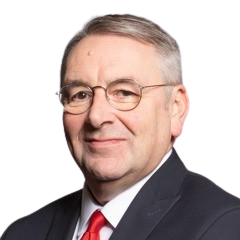
Sir Alan Campbell is the Labour Party MP for Tynemouth, and was first elected at the 1997 general election.
In the 2024 general election, Campbell received 24,491 votes in Tynemouth, representing 50.6% of the vote share. The Conservative candidate, Lewis Bartoli, received 9,036 votes (18.7%), while the Reform UK candidate, Rosie Elliott, secured 7,392 votes (15.3%). Sir Alan was duly elected with a majority of 15,455.
The Tynemouth constituency sits on the coast of North Tyneside, east of Newcastle upon Tyne. It includes coastal towns like Whitley Bay, Tynemouth, and Cullercoats. Historically, the seat was held by the Conservative Party from 1950 until 1997. Campbell gained the seat for Labour in 1997 and has held it since.
Political Career
Campbell was appointed to the post of lord president of the council and leader of the House of Commons in the September 2025 ministerial reshuffle. He succeeded Lucy Powell and was retained in this role following the July 2026 cabinet reshuffle conducted by Andy Burnham upon his appointment as prime minister.
By virtue of this position, Campbell serves on the House of Commons modernisation committee. The modernisation committee is a cross-party committee of MPs that considers reforms to House of Commons procedures, standards and working practices.
After Labour’s victory in the July 2024 general election, Campbell was appointed government chief whip (parliamentary secretary to the Treasury). As chief whip, he oversaw the suspensions of several Labour MPs under Keir Starmer’s leadership, both in opposition and in government.
Seven Labour MPs, namely Zarah Sultana, John McDonnell, Apsana Begum, Richard Burgon, Ian Byrne, Imran Hussain and Rebecca Long-Bailey, were suspended after they voted for a Scottish National Party (SNP) amendment to the king’s speech calling on the government to scrap the two-child benefit cap in July 2024.
https://x.com/Peston/status/1815829379886506493
In February 2025, the whip was restored to four of those suspended MPs – Burgon, Byrne, Hussain and Long-Bailey. However, Begum, Sultana and McDonnell remained as independent MPs because they had continued to be critical of the government, according to reports.
In June/July 2025, Campbell was at the centre of the debate conducted within the Parliamentary Labour Party (PLP) over the government’s flagship welfare bill. Over 120 Labour MPs, including senior figures and select committee chairs, signed a “reasoned amendment” to the bill which aimed to reject the proposed legislation. After significant concessions were granted to the rebels, the bill ultimately passed its second reading on 1 July 2025. However, 47 MPs went on to vote against the legislation.
On 16 July, it was reported that four Labour MPs involved in the rebellion, namely Rachael Maskell, Chris Hinchliff, Brian Leishman and Neil Duncan-Jordan, would be suspended from the party. All four rebels voted against the welfare reforms.
Campbell has extensive experience in the whips’ office for the Labour Party, both in government and opposition. He began as an assistant government whip, and was promoted to full whip in 2006. He served as vice-chamberlain of the household (government whip) from 2006 to 2008.
Between 2008 and 2010, under prime minister Gordon Brown, he served as parliamentary under-secretary of state at the Home Office. His responsibilities included crime reduction, policing, and security.
Following the 2010 general election, Campbell became Labour’s deputy chief whip, a role he held for over a decade until May 2021. He was then appointed opposition chief whip by Keir Starmer, attending shadow cabinet. Campbell served as opposition chief whip from 2021 to 2024.
After the 2001 general election, Campbell was appointed as parliamentary private secretary (PPS) to the minister of state at the Cabinet Office, Gus Macdonald. In 2003, he became the PPS to Adam Ingram at the Ministry of Defence. A PPS acts as an unpaid assistant to a minister, providing a link between the senior frontbencher and backbench MPs.
Campbell served on the public accounts committee from 1997 to 2001.
Campbell delivered his maiden speech on 2 June 1997. In it he said: “Raising standards is the key to a successful future. Earlier governments may have accepted 42nd place in the international education league and may have allowed half our 11-year-olds to fail to reach acceptable standards of literacy.
“This government must not, and perhaps the best start that we can make is to bring down class sizes.”
Political Views
Leadership elections and loyalty
Labour leadership 2020: Campbell was one of 82 Labour MPs who nominated Keir Starmer for the party’s leadership in early 2020. The election was triggered by the resignation of Jeremy Corbyn following the party’s defeat in the 2019 general election, which resulted in Labour’s fewest seats in the House of Commons since 1935.
Starmer’s 82 nominations were the highest of any candidate. The shadow Brexit secretary won a decisive victory in the first round with 56.2% of the vote, defeating Rebecca Long-Bailey and Lisa Nandy.
Labour leadership 2015: Campbell was one of 26 Labour MPs who did not nominate any candidate for the party’s leadership in June 2015. The election was triggered by the resignation of Ed Miliband following the 2015 general election defeat and was the first to be conducted under the “one member, one vote” system. The contest eventually saw Jeremy Corbyn, a veteran backbencher, win a landslide victory in the first round with 59.5% of the vote, defeating Andy Burnham, Yvette Cooper and Liz Kendall.
In March 2016, Campbell was labelled as “hostile group” by the Corbyn leadership in a leaked list which categorised Labour MPs by their perceived loyalty. This label suggested the Corbyn leadership viewed Campbell as actively and openly antagonistic.
Labour leadership 2010: Campbell was one of 81 Labour MPs who nominated David Miliband for the party’s leadership in May 2010. The election followed the resignation of Gordon Brown, who stepped down as prime minister and Labour leader after the 2010 general election.
Miliband, the former foreign secretary, was seen as closely aligned with the New Labour project – a Blairite figure. He secured 81 nominations from the Parliamentary Labour Party (PLP), comfortably exceeding the 33 required to reach the final ballot, but was narrowly defeated by his brother, Ed Miliband, in the final round by 50.7% to 49.3%.
Brexit and Europe
Brexit referendum: Campbell supported the remain campaign in the 2016 referendum on Britain’s membership of the European Union (EU), and therefore agreed with a majority of constituents, 52.4% of whom voted to remain.
Article 50: In February 2017, Campbell voted in favour of the European Union (Notification of Withdrawal) Bill. The legislation empowered the prime minister to notify the Council of the European Union of the UK’s intention to withdraw, formally triggering the process set out in Article 50 of the Treaty on European Union. MPs supported the bill by 498 votes to 114 at second reading.
Welfare
Welfare vote (July 2025): Campbell voted in favour of the government’s flagship welfare bill at second reading. The vote came after ministers agreed to significant concessions to avoid defeat via a mass rebellion of Labour MPs on 1 July 2025.
Assisted dying
Campbell voted in favour of the Terminally Ill Adults (End of Life) Bill, better known as the assisted dying bill, at second reading (November 2024) and third reading (June 2025).
He voted in favour of the Terminally Ill Adults (End of Life) Bill, better known as the assisted dying bill, at both second reading (November 2024) and third reading (June 2025). In an email to constituents, reported by LabourList, Campbell said that it was “vital that [the bill] also includes strong and proper safeguards.”
He added: “Furthermore, people must have choice as they near the end of their life and that means the best possible end of life care. People deserve dignity in dying, and each person nearing the end of their life should feel reassured and safe in the knowledge they will receive the very best care possible.”
Social values and conscience issues
Same-sex marriage (2013): In February 2013, Campbell voted in favour of the Marriage (Same Sex Couples) Bill at its second reading. The landmark piece of legislation, which received its second reading by 400 votes to 175, legalised marriage for same-sex couples in England and Wales.
Foreign policy and security
Sanctioned (Russia): In April 2022, Campbell was among the group of MPs placed on a sanctions list by the Russian government. The measure barred them from entering Russia and was presented by Moscow as a retaliatory response to the UK’s stance on the invasion of Ukraine.
Trident renewal (2016): Campbell voted in favour of a government motion calling for the renewal of the Trident nuclear deterrent system in July 2016. The motion, which was passed by 472 votes to 117, committed the UK to constructing a new fleet of submarines to carry the nation’s nuclear weapons. Labour was split over the issue with 140 of its 230 MPs going against leader Jeremy Corbyn and backing the motion.
Syria airstrikes (2015): Campbell voted in favour of a government motion to extend UK airstrikes against Isis from Iraq into Syria in December 2015. The motion, which was passed by 397 votes to 223 after a 10-hour debate in the House of Commons, authorised the RAF to conduct strikes against Isis targets in Syria.
Syria airstrikes (2013): Campbell voted against the government’s motion on the principle of military intervention in Syria in August 2013. The government motion was defeated by 285 votes to 272, a move which effectively ruled out UK participation in any US-led military strikes.
Iraq War authorisation vote (2003): In March 2003, Campbell voted in favour of the government motion authorising military action against Iraq. The vote, one of the most contentious in recent parliamentary history, gave the prime minister, Tony Blair, the authority to join the US-led invasion.
Palestine
Palestinian recognition vote (2014): In October 2014, Campbell was one of 192 Labour MPs who voted in favour of recognising Palestine as a state. The motion, passed by 274 votes to 12, called on the government to “recognise the state of Palestine alongside the state of Israel as a contribution to securing a negotiated two-state solution”.
Before Politics
Born in Consett, County Durham, in 1957, Campbell attended Blackfyne Comprehensive School (formerly Blackfyne Grammar School). He studied politics at the University of Lancaster. He subsequently gained a postgraduate certificate in education (PGCE) from the University of Leeds and a master’s degree in history from Newcastle Polytechnic (now Northumbria University).
Before entering parliament, Campbell was a history teacher. He first taught at Whitley Bay High School for eight years, when he moved to Hirst High School in Ashington, Northumbria, where he became head of sixth form and later head of history.
“We’re not going in because we’re teachers”, Campbell said at the time of the 1997 election. “We’re going in because we want to change the country for the better. It’s the party’s decision to make education the passion of the next government.”
He added: “The one thing I resent about the Tories is that they have under-valued learning, the whole principle of education. Children should have respect for themselves, and for what they’re doing.”
Personal Life
Campbell married his wife, Jayne, in 1991. The couple have two adult children, a son and a daughter.
In 2000, Campbell had a surgery to remove a benign tumour from the top of his spine.
He was appointed knighted as Knight Bachelor in the 2019 New Years Honours List.
Trivia
Campbell is said to be a keen angler and a long-standing season ticket holder at Sunderland Football Club.
In his maiden speech, Campbell quipped “there is a tradition that the people of Tynemouth do not change their [MP] very often, and I am keen to continue that tradition.”
A veteran MP, serving continuously since 1997, Campbell has made good on this promise. In total, Tynemouth has had four MPs (Grace Colman, Labour; Irene Ward, Conservative; Neville Trotter, Conservative; and Campbell, Labour) since 1945.
Alan Campbell has not written for Politics.co.uk.