Ulster Says No: Unionists stage mass Belfast rally against Anglo-Irish Agreement
On 23 November 1985, a massive unionist demonstration took place at Belfast City Hall to protest against the Anglo-Irish Agreement, which had been signed eight days earlier by Margaret Thatcher, the British prime minister, and Garret FitzGerald, the Irish Taoiseach.
The rally drew an estimated crowd of over 100,000 people, making it one of the largest political gatherings in the history of Northern Ireland.
***
Article 1 of the Anglo-Irish Agreement stated: “The two Governments… affirm that any change in the status of Northern Ireland would only come about with the consent of a majority of the people of Northern Ireland.”
The agreement also affirmed that the two governments would support any future wish by the people of Northern Ireland to enter into a united Ireland. It recognised the “present wish of a majority of the people of Northern Ireland” to remain in the union, but declared that “if in the future a majority of the people of Northern Ireland clearly wish for and formally consent to the establishment of a united Ireland, they will introduce and support in the respective parliaments legislation to give effect to that wish.”
Critically, the agreement granted the Republic of Ireland a formal consultative role in the governance of Northern Ireland through a new Anglo-Irish Intergovernmental Conference. The conference would deal with political matters; security and related matters; legal matters, including the administration of justice; and the promotion of cross-border co-operation.
It marked the first time since partition that Dublin had been formally invited into the governance of Northern Ireland.
The conference was denounced by unionists as a concession to nationalist opinion and a step that would undermine the integrity of the United Kingdom.
Following the signing of the agreement at Hillsborough Castle on 15 November 1985, unionist leaders withdrew from advisory boards and threatened to paralyse local government by refusing to set rates.
On 16 November, the Northern Ireland Assembly – established in 1982 according to a scheme of ‘rolling devolution’ – voted by 44 votes to 10 for a motion calling for a referendum to be held on the agreement.
Tom King, the Northern Ireland secretary, was attacked by loyalists in Belfast on 20 November.
Ian Gow, a Treasury minister and one of Thatcher’s closest personal allies, resigned in opposition to the agreement. Addressing the commons on 26 November, he stated that the deal would “prolong and not diminish the agony of Ulster”. Enoch Powell, the Ulster Unionist Party (UUP) MP for South Down, accused Thatcher of “treachery” in the days leading up to the signing.
Powell sought to remind Thatcher that the “penalty for treachery is to fall into public contempt”.
***
The ‘Ulster Says No’ rally formed part of a broader strategy of non-cooperation and civil disobedience orchestrated by the two main unionist parties: the UUP led by James Molyneaux, and the Democratic Unionist Party led by Ian Paisley.
Both Molyneaux and Paisley addressed the sprawling rally.
Molyneaux, considered the quiet man of Ulster politics, said: “Mr King has alleged that we no longer represent your views – he has alleged that in your hearts you really like the Anglo-Irish Agreement, well, do you?”
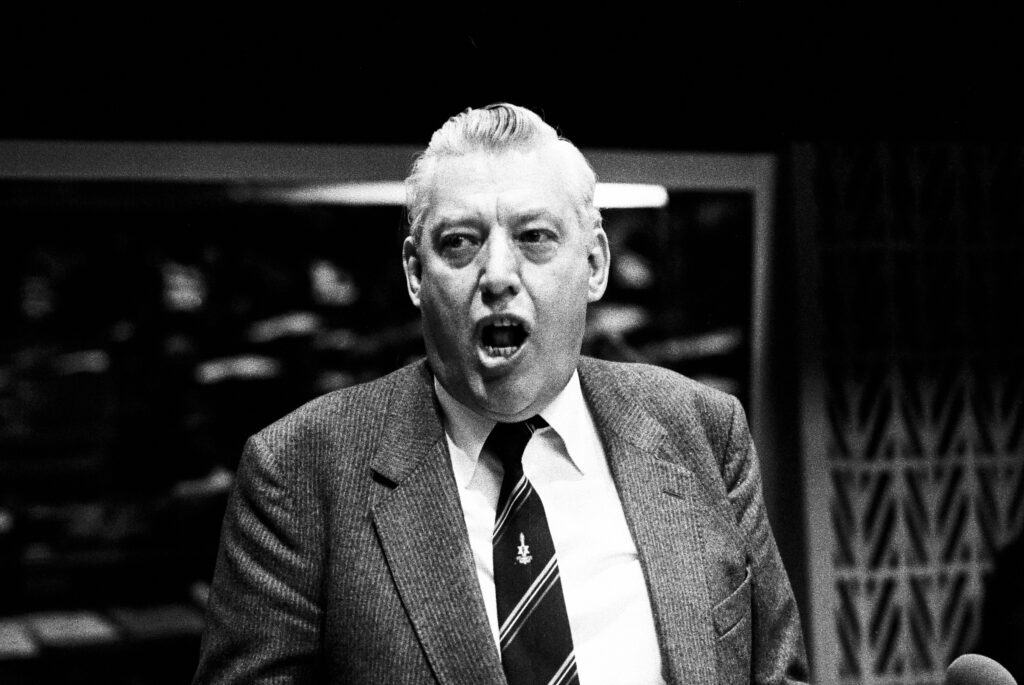
But the event is remembered for Paisley’s contribution, which was typical of his not-an-inch unionism and soaring rhetorical skill.
Standing before Belfast City Hall, Paisley invoked the memory of Unionist leader Edward Carson and the 1912 Ulster covenant. The covenant committed its 471,414 signatories to oppose the establishment of a Dublin-based home rule parliament by “all means which may be found necessary”.
Paisley stated: “[This rally is] bigger than Lord Carson had in 1912, and that crowd had never been excelled.”
In his speech’s most famous passage, the unionist firebrand declared: “I want to ask a question today, and the question is simple.
“Where do the terrorists operate from? From the Irish Republic! That’s where they come from.
“Where do the terrorists return to for sanctuary? To the Irish Republic!
“And yet Mrs Thatcher tells us that that republic must have some say in our province. We say Never! Never! Never! Never!”
Paisley said that unionists were “prepared to lay down our lives rather than surrender”.
He added: “We shall win this battle. God help the men who dare take it [Northern Ireland] from us.”
Paisley and his fellow unionist MPs (with the exception of Powell, who was not in attendance) then signed a pledge to resign by 1 January 1986 if the agreement was approved by the House of Commons the following week.
In the crowd, an effigy of Margaret Thatcher was burned.
***
But the Thatcher government refused to back down.
After a two-day debate, the agreement was approved by the House of Commons on 27 November by 473 votes to 47.
On 17 December 1985, less than a month after the rally, all 15 unionist MPs resigned their seats in the House of Commons simultaneously. This unprecedented move forced a series of by-elections, which the unionists framed as a de facto referendum on the agreement. It came after the UK government rejected unionist calls for a plebiscite on the agreement.
A total of 14 out of 15 Unionist MPs secured re-election.
Unionist resistance to the agreement continued over the following months and years. It featured MPs breaking off contact with ministers, industrial action and unrest, as well as paramilitary violence. The Maryfield Secretariat, the administrative home of the Intergovernmental Conference, became a target for unionist opposition.
On 11 December, unionist workers staged walkouts and marched to Maryfield, where violent clashes between the demonstrators and the Royal Ulster Constabulary (RUC) followed. 38 officers were injured.
On 7 August 1986, Peter Robinson, deputy leader of the DUP, and a loyalist mob invaded the republic, occupying Clontibret in County Monaghan before being dispersed by the Garda Síochána.
A petition against the agreement in Northern Ireland received 400,000 signatures.
***
The Anglo-Irish Agreement is today seen as representing a landmark moment in the Northern Ireland peace process.
It established the principle that the constitutional status of Northern Ireland would not change without representation for the nationalist minority, while acknowledging an Irish or ‘North-South’ dimension would be included in a political solution. It therefore established the principle of consent, as to the governance of Northern Ireland, and ended the prospect of any return to simple majority rule. Crucially, it also signalled to unionists that the British government was willing to face down and repudiate their protests with regard to nationalist representation. It established the principle of consent, as to the governance of Northern Ireland, and ended the prospect of any return to simple majority rule.
John Hume, the leader of the Social Democratic and Labour Party (SDLP), later wrote: “Though no one among us felt it was the final solution, the agreement was a major achievement of democratic politics, and was a significant step forward on the road to lasting peace and stability…
“Everything that has happened in the past few years stems from the agreement.”
The agreement was superseded when the Good Friday Agreement was implemented on 2 December 1999.
In 1992, seven years after the agreement was signed, Paisley privately admitted that the unionist reaction to the accord had been counterproductive. Documents released under the 20 Year Rule in 2017 included Paisley’s insistence that “there was no question of them walking away” from talks.
He added: “They had run away from participation in Westminster and local councils in the past, and that had been a mistake.”
Thatcher, however, later expressed regret over the agreement.
Reviewing a political biography written about Enoch Powell, Thatcher wrote: “I now believe that his assessment [of the agreement] was right, though I wish that on this as on other occasions he had been less inclined to impugn the motives of those who disagreed with him.”

Politics.co.uk Newsletters
DAILY
Politics@Lunch
WEEKLY
Week in Review