Thatcher survives leadership challenge from ‘stalking horse’ MP
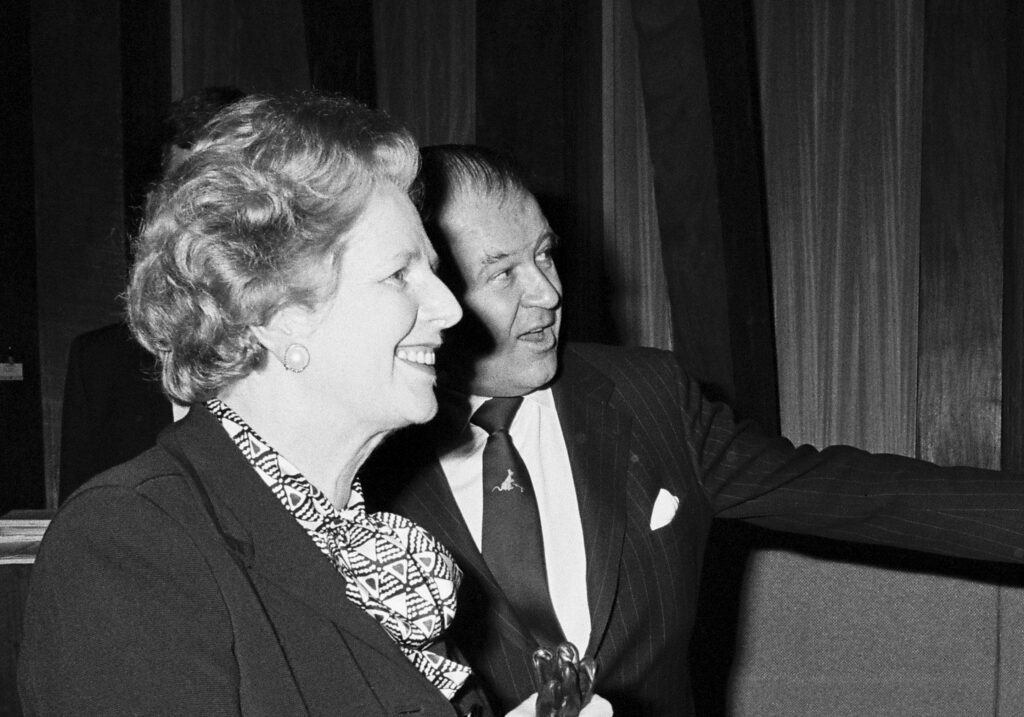
On 5 December 1989, Margaret Thatcher faced the first direct challenge to her leadership of the Conservative Party in 14 years, defeating the backbench MP Sir Anthony Meyer.
Thatcher secured a seemingly decisive victory with 314 votes to Meyer’s 33. But the result exposed significant discontent within her party. A total of 60 MPs – one in six – failed to support her, either by voting for Meyer, spoiling their ballots (24), or abstaining (3).
***
Conservative discontent with Thatcher’s leadership had been simmering since at least the Westland affair (1986), which resulted in the resignation of Michael Heseltine as defence secretary. By late 1989, the government was suffering from the intense unpopularity of the community charge, known universally as the “poll tax”, and internal spits over its policy on European integration.
The Conservatives lost 13 seats in the July 1989 European parliament election – the party’s first national election defeat since October 1974. The campaign was conducted in the shadow of Thatcher’s famous Bruges speech (September 1988) – a trenchant, and divisive, statement of her euroscepticism.
The European Exchange Rate Mechanism (ERM), an economic stability measure, emerged as a flashpoint in 1989. Geoffrey Howe and Nigel Lawson reportedly threatened to resign as foreign secretary and chancellor respectively if Thatcher failed to oversee Britain’s entry into the ERM. Thatcher responded with a reshuffle in July 1989, replacing Howe as foreign secretary with John Major. Howe was made leader of the commons, a post embellished with the title of deputy prime minister. Lawson then resigned in October 1989 following a dispute over the influence of Thatcher’s economic adviser, Sir Alan Walters. Walters opposed Britain’s entry into the ERM.
Under the Conservative Party’s leadership procedures at the time, Thatcher was subject to annual re-elections. But she had been returned to her post unopposed since 1975.
1989 was different.
Meyer, a 69-year-old Europhile backbencher, put himself forward as a candidate, triggering the first Tory leadership election since Thatcher toppled Edward Heath in 1975.
***
Meyer was a long-standing critic of Thatcher’s leadership. In November 1981, he was among the Conservative “gang of 25” who signed a letter threatening to vote against the government’s latest round of monetarist measures delivered at the autumn statement. In the wake of the Westland affair, he argued that the time had come “when we should be thinking in terms of choosing another leader”.
Meyer was also a reluctant candidate, standing in the place of far more senior Thatcher-critics such as Michael Heseltine. He acknowledged that he had no chance of winning, but believed a contest – initiated by a stalking horse candidate – was necessary to test the party’s confidence in its leader.
Meyer declared his candidacy, a self-professed “burnt offering”, on 22 November 1989.
The short 1989 Conservative leadership election featured an intervention from Heath, Thatcher’s predecessor as Conservative leader. The europhile former prime minister described Thatcher as a “narrow little nationalist… unable to move with the movement of history in creating the greater Europe”.
Meyer, meanwhile, was derided by the tabloid press as “Sir Anthony Whats’isname” and a “stalking donkey”. In an open letter to Conservative MPs, he wrote: “On Europe above all, the prime minister stands apart not only from many of her own cabinet.”
One opinion poll, published shortly before voting began in the contest, found two-thirds of voters were unsatisfied with Thatcher’s leadership.
On the day of the election, Thatcher attended the commons for prime minister’s questions.
Labour MP Alice Mahon stated: “Since this might be the last time that the prime minister answers questions at the dispatch box… will she tell us her proudest achievement?
“Is it the number of homeless? Is it the deeply unpopular poll tax or is it the image of a government who resort to seedy bribes to get their privatisation programme through?”
Thatcher responded: “My proudest achievements have been bringing Britain from the decline of socialism to the prosperity of Conservatism.”
The prime minister survived Meyer’s challenge, of course. And she hailed her victory as “splendid” in a statement outside No 10.
She said: “I would like to say how very pleased I am with this result and how very pleased I am to have had the overwhelming support of my colleagues in the House and the people from the party in the country.”
Kenneth Baker, the Conservative chairman, said: “What the Conservative Party has decided today is that they want to be led into the 1990s and the next election by Margaret Thatcher.”
He added: “The leadership question is now settled.”
George Younger, Thatcher’s campaign manager, stated: “It is a marvellous result; 85% of MPs voted for her. It will strengthen her authority for some time to come.”
Norman Tebbitt, the former Conservative chairman, said the result was “very close to an absolute triumph”.
***
Privately, however, Thatcher’s team was alarmed. Younger warned that many MPs had voted for her with “varying degrees of reluctance”. He classified 50 MPs as “reluctant supporters”, who could in time make Thatcher’s position vulnerable.
In a memo, Younger said: “The result is not as good as the figures. Many voted with varying degrees of reluctance for the prime minister. They cannot all be relied upon another time.”
He predicted future danger, noting: “As there are likely to be economic and polls difficulties in a year’s time, another challenge is not improbable.”
He continued: “It is felt that there are personality tensions within cabinet and that these must be resolved if confidence is to be restored. In particular, Geoffrey Howe must be seen and treated as the PM’s right-hand man.”
One of Thatcher’s whips, Tristan Garel-Jones, put it more bluntly when he said: “We are talking about the beginning of the end of the Thatcher era.”
He added: “We have to try and ensure that that is managed in a way that enables her to go to the end of her prime ministership with dignity and honour. The most we can achieve is that she wins the next election.
“I think that is possible, but not certain.”
The 1989 campaign therefore shattered any lingering sense of Thatcher’s political invulnerability. Heseltine was reported to be one of the three MPs who abstained. Heath hinted that he had voted for Meyer.
Meyer was pleased with his showing, saying he received “more votes than I expected to get.”
He added: “I think what I have done is think the unthinkable as it were, raise the very question of the leadership at a time when others weren’t willing to discuss it.
Meyer maintained that the contest was “worth it because it’s raised the whole question of whether Mrs Thatcher’s policies and Mrs Thatcher’s style of leadership are the ones which are most likely to win the next election for the Conservative Party and the ones most suited to British needs at this critical junction in the history of Europe.”
In January 1990, Meyer was deselected by his constituency party in Clwyd North West.
In the year that followed Meyer’s challenge, the issues that inspired his candidacy intensified.
On 1 November 1990, Geoffrey Howe – the last remaining member of Thatcher’s 1979 cabinet – stood down as deputy prime minister. He cited fundamental disagreements with Thatcher’s stance on European integration. It came after Thatcher issued her most strident denunciation of European integration to date with her famous “No. No. No.” declaration on 30 October 1990.
Howe’s famous resignation speech spurred Heseltine to launch a formal leadership challenge the following day, 14 November. He won just enough of the vote on the first ballot to force Thatcher’s resignation.
Meyer went on to join the Pro-Euro Conservative Party (1998-2001) and then the Liberal Democrats from 2001.
Meyer died on 24 December 2004, aged 84.

Politics.co.uk Newsletters
DAILY
Politics@Lunch
WEEKLY
Week in Review
