Poll tax protest in London erupts into major riot
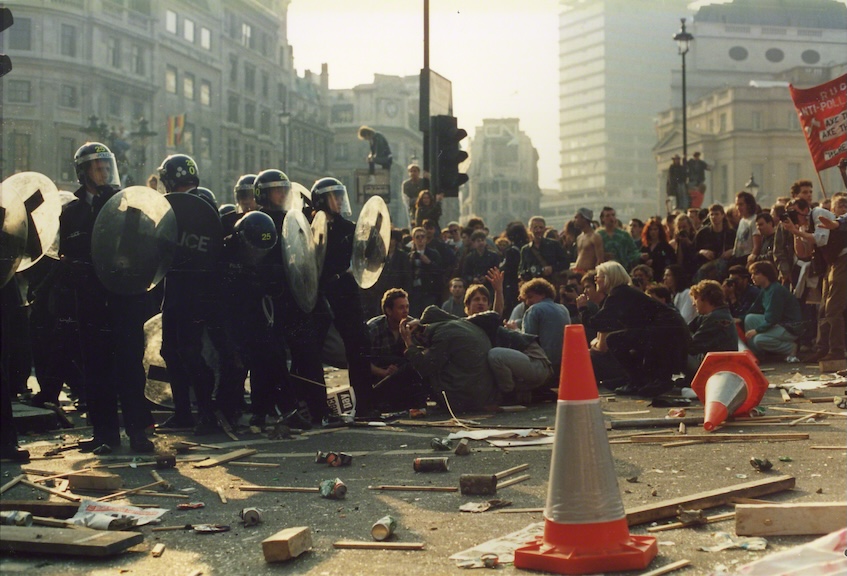
On 31 March 1990, a mass demonstration against the new community charge, or “poll tax”, in central London descended into some of the worst rioting seen in the capital for a century. The event marked the culmination of months of widespread public anger against the deeply unpopular, and politically fatal, poll tax.
The poll tax, introduced under the Local Government Finance Act 1988, was a flat-rate levy on every adult regardless of income. The scheme meant, in the words of Conservative minister Nicholas Ridley, that a “duke [could] pay more than a dustman”.
Thatcher defended her doomed policy on the commons on 1 March 1990. She argued the community charge was a “very much fairer system than domestic rates which preceded it”, whereby “a single person in one house paid the same rates as four or five people in the next-door house.”
***
The march came shortly before 35 million people received their poll tax bills on 1 April. Charges were expected to be much higher than government forecasts.
A total of 200,000 people joined the anti-poll tax protest, far surpassing original estimates which predicted attendance to land in the tens of thousands. The demonstration was organised by the All-Britain Anti-Poll Tax Federation (ABAPTF) on the eve of the tax’s introduction in England and Wales.
The initial march from Kennington Park to Trafalgar Square was largely peaceful, but the situation deteriorated dramatically in the afternoon. Confrontations between police and protesters in the crowded square escalated into a full-scale riot. Missiles were thrown, buildings were set on fire and shops were looted. Police on horseback launched repeated charges to disperse the crowds.
Some 339 people were arrested for public order and other criminal offences. A total of 374 officers of the 2,198 on duty were injured – of whom 58 required hospital treatment.
The clashes have been referred to as the Battle of Trafalgar Square.
Labour MP George Galloway was among those who addressed the crowds, stating his support for the non-payment campaign. “I am one of the one million non-payers [of the poll tax], if the bailiffs come to my house, they’d better bring the SAS and their canine friends”, he declared.
“Some say that there is something wrong with a ‘law-maker’ urging people to break the law. I say that this is an unjust law and there is a proud tradition of opposition to unjust laws.”
Labour MPs Tony Benn, Jeremy Corbyn and Dave Nellist were also in attendance at the rally.
In his famous diaries, Benn said that “before I was due to speak the rally was stopped because of the trouble that had occurred.”
He added: “I got off the platform and began walking back down Whitehall but found the police had thrown a barrier across the road so that people couldn’t get up or down, though they let me through.
“In the crowd I found myself being pressed from behind by riot police and mounted police. People were terribly frightened. I forced my way through until I came to the line of police who didn’t look like police at all.”
***
Police blamed the violence on anarchists and other extremist political groups. David Meynell, the deputy assistant commissioner of the Metropolitan Police, said a peaceful march had been “completely overshadowed by the actions of about 3,500 people in minority groups who launched a ferocious and sustained attack on the police.”
Thatcher, addressing reporters from the prime minister’s country estate, Chequers, expressed her “absolute horror” as to the scale of the violence. “People have a right to demonstrate peacefully”, she said.
“The place to discuss this is in parliament. These people are totally against democracy.”
Neil Kinnock, the leader of the Labour Party, dismissed the rioters as “toy town revolutionaries”.
Kinnock added: “The people who caused it must be treated as criminals. ‘They went to the demonstration to make a riot, and, as a result, caused severe injuries to the police and to innocent people.”
Galloway, who had taken his daughter to hear him speak at the rally, later condemned the violence as “disgraceful”.
The violence was addressed by the home secretary, David Waddington, in a statement to the commons on 2 April 1990.
Waddington said he delivered the statement “with a sense of outrage”, referring to the “acts of criminal violence and viciousness which occurred and which no decent person could fail to condemn”.
He stated: “Several officers were knocked unconscious, others received head injuries, and one officer sustained a fractured jaw and is still in hospital and has either now had or is about to have an operation.”
Waddington relayed that the violence began after 4:40 pm when around “3,000 troublemakers remained behind”.
He told the House: “Scaffolding was dismantled and used as missiles. As police officers cleared demonstrators from the site, the site huts were set alight.
“South Africa house nearby was attacked, a window broken and a small fire started. Officers protecting the front of the embassy came under severe attack.”
The home secretary concluded: “The right of peaceful demonstration is one which I will always defend, but the scenes in our capital city on Saturday had nothing whatsoever to do with peaceful demonstration.”
Roy Hattersley, the shadow home secretary, said that the Labour Party condemns, “without reservation or qualification, the violence which took place in and around Trafalgar square last Saturday. In a democratic society, no cause can justify such conduct. It is literally intolerable.”
Benn argued that the government’s policies had created the conditions for violence.
He called on Waddington to accept that “British history shows that despair and a sense of social injustice have often lain at the roots of civil disturbance”.
Corbyn echoed Benn’s call for a public inquiry.
The Labour MP declared: “I ask the home secretary also to pass on to the prime minister and the cabinet that the basic cause of the large demonstration on Saturday and all the other demonstrations is the manifestly absurd, unjust and mediaeval tax known as the poll tax and that demonstrations – peaceful demonstrations – will continue.
“The issue will not go away until the poll tax is removed.”
Galloway warned that “if the government do not change course on the poll tax, it will be a long hot summer.”
A 1991 police report found “no evidence that the trouble was orchestrated by left-wing anarchist groups”.
***
The botched implementation of the poll tax and the anger the policy sparked contributed to Thatcher’s defenestration as prime minister.
John Major, who entered office as prime minister in November 1990, quickly set about reversing the policy. Major appointed Michael Heseltine, his main opponent in the 1990 Tory leadership contest and longstanding critic of Thatcher, to manage the U-turn.
Major pledged to review the deeply unpopular community charge during the 1990 campaign, endearing himself to some of Thatcher’s critics.
Heseltine outlined the new system in a statement to the House of Commons on 21 March 1991. The new system, he said, would be based on “two essential elements”: property value and the number of adults living in the paying household.
The Labour Party’s manifesto in 1992 argued that, while Thatcher was gone, the “arrogance remains which brought us the poll tax, centralisation in Britain and isolation in Europe.”
Despite such attacks, the Conservative Party and John Major returned to office at the 1992 general election upon winning a surprise majority.
The current council tax system was implemented in 1993.

Politics.co.uk Newsletters
DAILY
Politics@Lunch
WEEKLY
Week in Review
