Thatcher secures historic third term with 102-seat majority
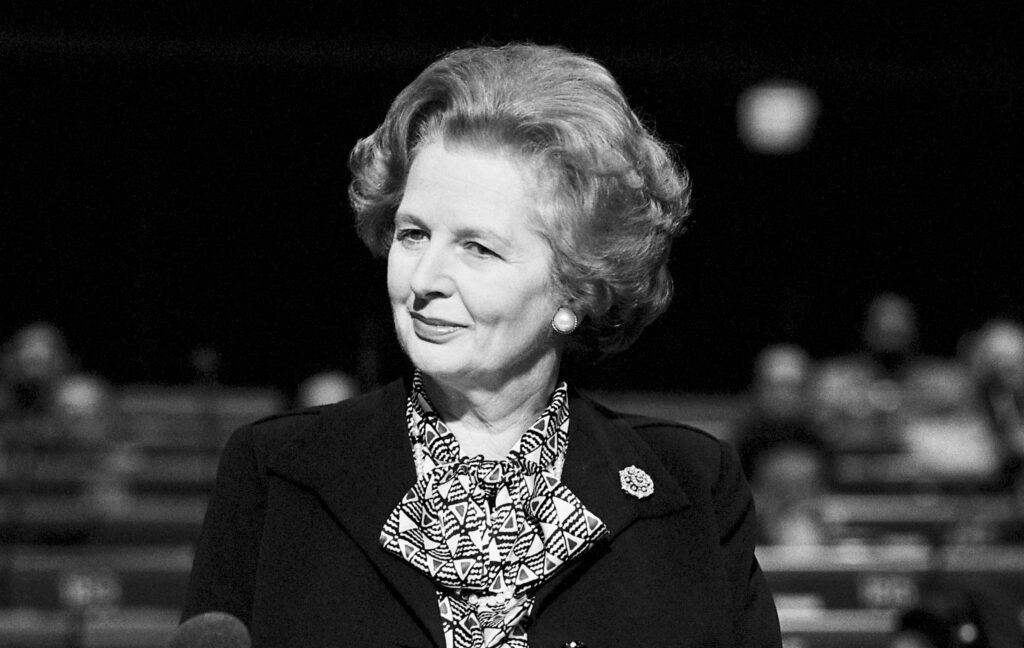
On 11 June 1987, Margaret Thatcher led the Conservative Party to a historic third consecutive general election victory, securing a landslide 102-seat majority. The result made Thatcher the first prime minister to win three successive terms since Lord Liverpool in the early 19th century, and the first since the Great Reform Act of 1832.
***
The Conservatives campaigned on a platform of continued economic reform, tax cuts, and a strong defence policy – capitalising on the beginnings of a period of economic growth known as the ‘Lawson Boom’. However, while Thatcher had emerged strengthened from the 1984-1985 miners’ strike with the government styled as victorious, the resignations of two cabinet ministers – Michael Heseltine and Leon Brittan – over the Westland affair exposed cracks in her political supremacy.
On 4 June, the Conservative campaign was rattled by a rogue Gallup poll for the Daily Telegraph which showed the party’s lead as down to 4 points. At this point, David Young is said to have grabbed his cabinet colleague, Norman Tebbit, by the lapels and declared: “Norman, listen to me, we’re about to lose this f****** election.”
“Wobbly Thursday”, as it became known, prompted Thatcher to back calls for more aggressive messaging. This approach was supported by Young but resisted by Tebbit.
The Conservative message, styled and presented by the advertising agency Saatchi & Saatchi, was simple: “Britain is great again. Don’t let Labour wreck it”.
A memorable Conservative campaign poster depicted a British soldier’s arms raised in surrender with the caption: “Labour’s Policy On Arms”.
Thatcher was also guilty of a series of gaffes during the campaign. In an interview on 11 May, she was asked if the campaign would be her last as Conservative leader.
The prime minister responded: “I would hope not, I would hope not. This is only the third term we are asking for. There is quite a long way to go… Yes, I hope to go on and on, because I believe passionately in our policies.”
The comment was characterised as arrogant and potentially out of step with her party’s position.
Thatcher’s comments on private healthcare are considered in similar terms.
She remarked at a campaign press conference: “I, along with something like 5 million other people, insure to enable me to go into hospital on the day I want; at the time I want, and with a doctor I want. For me, that is absolutely vital.
“I do that along with 5 million others. Like most people, I pay my dues to the National Health Service; I do not add to the queue… I exercise my right as a free citizen to spend my own money in my own way, so that I can go in on the day, at the time, with the doctor I choose and get out fast.”
***
The Labour Party, led by Neil Kinnock, ran a significantly more professional campaign than its attempt in 1983.
The campaign, directed by Bryan Gould and Peter Mandelson, aimed to overhaul the party’s image and that of its leader – including with a celebrated party election broadcast directed by the filmmaker Hugh Hudson (of Chariots of Fire).
The slick broadcast, dubbed “Kinnock: The Movie”, was an attempt to portray the Labour leader as down to earth and understanding. Kinnock’s popularity is said to have jumped markedly in the wake of the broadcast – a factor that contributed to Conservative jitters.
Labour’s manifesto, Britain Will Win with Labour, was also a more moderate document than its unapologetically left-wing predecessor, but the party still struggled to overcome public concerns about its economic policies and its commitment to unilateral nuclear disarmament.
The manifesto read: “We say that it is time to end the nuclear pretence and to ensure a rational conventional defence policy for Britain.”
In an interview on 24 May, Kinnock claimed that Labour’s alternative defence strategy in the event of a Soviet attack would be “using the resources you’ve got to make any occupation totally untenable”.
Thatcher issued a well-refined response. She declared: “Asked this weekend how his non-nuclear defence policy would work, [Kinnock] said, and I quote, ‘You’ve got to make the occupation totally untenable’ – a Soviet occupation, I presume.
“So now we know that Labour’s non-nuclear defence policy is a policy for defeat, surrender, occupation, and finally, prolonged guerilla fighting.”
The Conservative campaign was able to rely on the support of the tabloid press. The Sun ran an article with the headline “Why I’m Backing Kinnock, by Stalin.”
The Alliance, jointly led by David Owen and David Steel, failed to make the electoral breakthrough it had hoped for. The somewhat asymmetric “Two Davids” syndicate struggled with presentation – as the party had done in 1983. Despite winning 22.6% of the popular vote, the Alliance secured only 22 seats, a net loss of one. Leading SDP figures Roy Jenkins, Shirley Williams and Bill Rodgers were defeated.
Owen emerged from the election as the last member of the original “gang of four” standing.
The Alliance’s second successive failure to “break the mould” of British politics prompted a strategic rethink. The Social Democratic and Liberal parties would later merge – fighting the 1992 general election as the Liberal Democrats under the leadership of Paddy Ashdown.
***
The final result saw the Conservatives win 376 seats with 42.2% of the vote, while Labour won 229 seats with 30.8%.
Speaking in the wake of the result, Thatcher said: “It is wonderful to be entrusted with the government of this great country once again.
“The greater the trust, the greater the duty upon us to be worthy of that trust, and we will indeed endeavour to serve the people of these islands in the future as we have in the past.”
She added: “We were told our campaign wasn’t sufficiently slick… We regard that as a compliment. We aren’t the slick party. We are the party that brings sound and secure policies to our country.’”
Kinnock said the election result would lead to “an even greater abyss of division than that which we witnessed previously.”
He added: “Any feeling that we have of depression is outweighed by the feeling of enormous concern about what the consequences of the re-election of a Conservative government will mean”.
Thatcher left office as prime minister in November 1990.
Kinnock led his party to a fourth consecutive defeat at the 1992 general election.

Politics.co.uk Newsletters
DAILY
Politics@Lunch
WEEKLY
Week in Review
