David Owen resigns as SDP leader over proposed Liberal merger
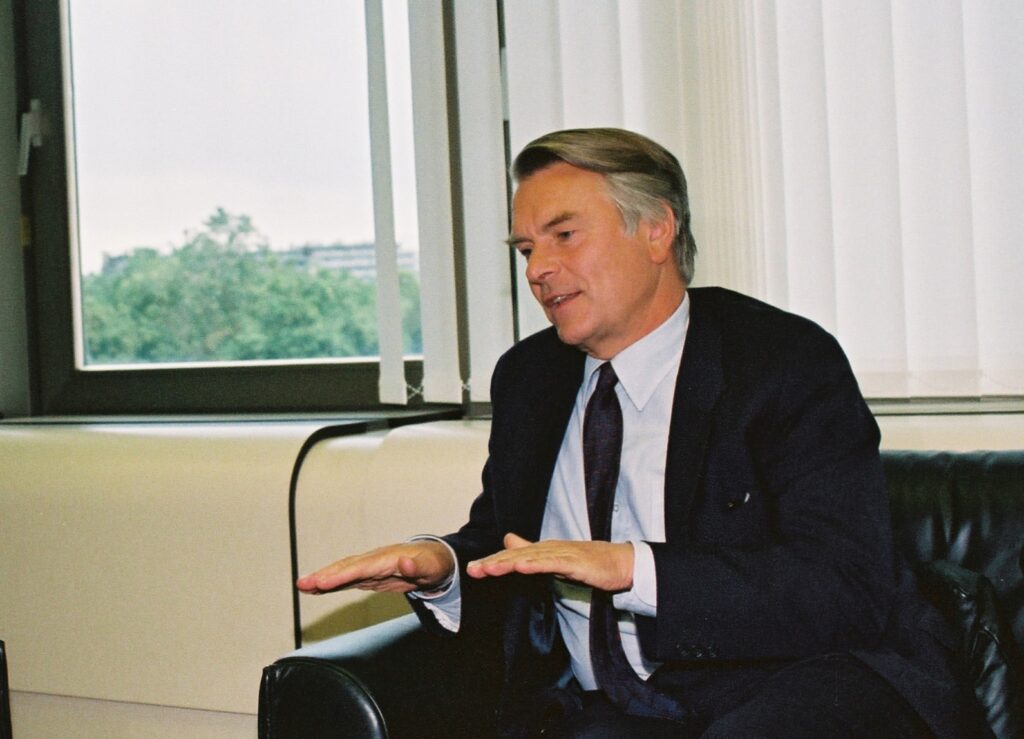
On 6 August 1987, David Owen resigned as leader of the Social Democratic Party (SDP). His departure came after the party membership voted in favour of pursuing a full merger with the Liberal Party – a move Owen vehemently opposed.
The SDP was formed in 1981 by the “Gang of Four” of former Labour figures – Owen, Roy Jenkins, Shirley Williams, and Bill Rodgers – who broke away in protest at the party’s direction under the leadership of Michael Foot. The SDP soon forged an alliance with the Liberal Party, led by David Steel.
The SDP-Liberal alliance secured 25.4% of the popular vote at the 1983 general election – a mere 2.2 points short of Labour. Under the first past the post (FPTP) electoral system, however, this yielded only 23 seats.
In the wake of the election, Owen succeeded Jenkins as leader.
***
Owen initially rejected Steel’s merger overtures, but the underwhelming performance of the SDP-Liberal Alliance in the 1987 contest (winning 22.6% of the vote and losing a seat) intensified pressure for a strategic reevaluation.
Owen’s resignation came after SDP members showed a clear majority favoured opening merger negotiations with the Liberals – by 57.4% to 42.6%. Jenkins, Williams and Rodgers, three of the “Gang of Four” grandees, were also supportive.
Owen dismissed the proposed entity as a “ghastly mess, a disaster and a shambles”.
In his resignation statement on 6 August, he said: “We are now deeply and predictably split.
“The members have decided, as they have every right to do, to seek a merger with the Liberals against my advice. And in the circumstances I do not believe I should continue as their leader during the period of negotiations which will follow.”
He added: “Don’t write me off, or the party, or the SDP, or social democracy.”
Steel, one half of the somewhat asymmetric “Two Davids” syndicate, referred to Owen’s resignation as “logical but not surprising”. The Liberal leader ultimately welcomed the possibility of a merger that could present “a clear and united alternative to Thatcherism and Socialism”. (Steel’s party embraced a formal coalescence by 998 votes to 21 in September 1987, and elected a 17-person team to begin negotiations.)
On 27 August, it was announced that Robert Maclennan would replace Owen as SDP leader and proceeded with merger negotiations with the Liberals.
Some pro-merger SDP MPs opposed Maclennan’s elevation as an effective “caretaker” – not seeing the need for a figurehead as negotiations continued.
Responding to this criticism, Maclennan told the BBC: “I have no doubt that the duty of myself at this time is to be the leader, if the party will have me, because I think we cannot have a vacuum at the top.”
***
The merger negotiations proved immensely acrimonious – characterised by bitter infighting and a series of false dawns.
However, the talks eventually culminated in the formation of the Social and Liberal Democrats (SLD) in March 1988. Neither Maclennan nor Steel, both having endured the strains of the merger negotiations, decided to run for the SLD leadership.
Paddy Ashdown, a former Royal Marine, was elected as the first leader of the Social and Liberal Democrats on 28 July 1988. In his first press conference as leader, Ashdown said his bruised and divided party must “look beyond” internal politics “to the concerns of our nation”. He proposed a “decent, effective and responsible” alternative to Thatcherism.
Owen, meanwhile, simply refused to join the new party.
Instead, he led a small breakaway faction known as the “continuing SDP”.
The project initially showed some promise, capitalising on the tumultuous creation of the Social and Liberal Democrats. It was backed by serving MPs John Cartwright and Rosie Barnes among others.
At the 1989 Richmond by-election, the continuing SDP candidate, Mike Potter, secured second place on 32.2%. The Social and Liberal Democrats won 22.1% of the vote. (Both parties finished behind the Conservative candidate, William Hague.)
But by 1990, the continuing SDP collapsed. It finished seventh out of eight candidates in the Bootle by-election, winning just 155 votes. Owen’s outfit had been outperformed by Screaming Lord Sutch’s Official Monster Raving Loony Party.
Sutch quipped that he would be willing to form an alliance with Owen’s beleaguered party.
The continuing SDP was soon wound up – apparently declining Sutch’s offer.
***
Owen stood down as an MP at the 1992 general election and was soon elevated to the House of Lords – nominated by the then-Conservative prime minister, John Major. Major is said to have considered appointing Owen to his cabinet, even being enthusiastic about the prospect. But the idea was met with internal opposition.
Tony Blair later approached Owen with the promise of a “political future” if he supported New Labour. But the former SDP leader was opposed to Blair’s position on the euro.
In 2007, Owen was reported to be in talks with Gordon Brown. Once more, nothing came of the discussions.
Owen, having correctly predicted a hung parliament ahead of the 2010 general election, donated over £7,500 to the Labour Party during Ed Miliband’s tenure as leader. He later spoke approvingly of Miliband’s “guts”.
The former SDP leader sat as a crossbench peer until 2014 – at which point he began to refer to himself as an “independent social democrat”.
Owen subsequently supported the Leave campaign in the 2016 referendum on Britain’s membership of the European Union (EU). (In 1972, the former minister had quit Harold Wilson’s Labour frontbench cabinet over the party’s refusal to explicitly back British entry to the European Economic Community).
Owen expressed support for Labour’s 2017 general election manifesto, but later became a public critic of Jeremy Corbyn’s leadership.
Owen retired from the Lords on 13 August 2024.
A third SDP continues to exist and contest elections. The party – a rump of a rump of a schism – is a minor socially conservative force.
Politics.co.uk Newsletters
DAILY
Politics@Lunch
WEEKLY
Week in Review