Suffragettes chain themselves to commons mesh in ‘Grille incident’
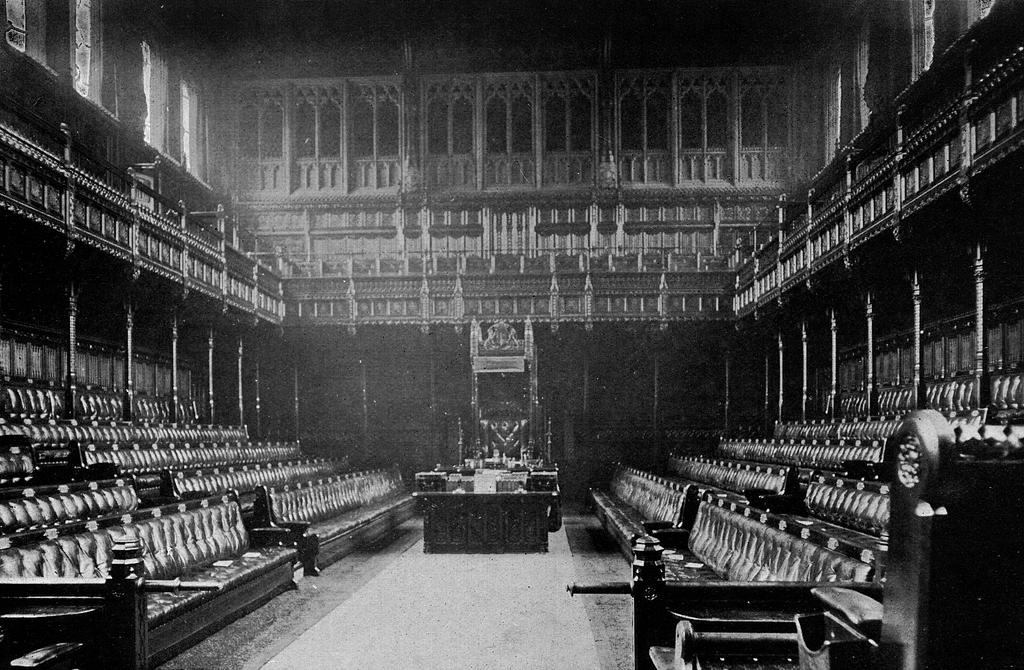
On 28 October 1908, the proceedings in the House of Commons were disrupted as members of the Women’s Freedom League (WFL) conducted a series of protests in and around parliament. It came at the height of the militant struggle to enfranchise women in the United Kingdom.
Most famously, two suffragettes chained themselves to the grille (iron mesh) of the Ladies’ Gallery, while another lowered a banner down the side of the gallery balcony into the House. The ‘Grille Incident’, as it became known, occurred during the debate on the Licensing Bill.
***
The WFL was founded in September 1907, having broken away from the Women’s Social and Political Union (WSPU). The organisation objected to Emmeline Pankhurst’s management of the WSPU.
On the evening of 28 October 1908, several WFL members gained access to the Ladies’ Gallery – a small, caged area from which women could observe the commons proceedings. The gallery was opened alongside the rest of the reconstructed Palace of Westminster following the fire of 1834.
A heavy brass grille stood between the chamber and spectators – a symbolic representation of women’s exclusion from parliament.
At approximately 8:30 pm, Muriel Matters and Helen Fox chained themselves to the grille. A third suffragette, Violet Tillard, forced a WFL proclamation through an iron lattice, before unfurling it into the chamber.
The banner read: “Whereas the Nation depends for its progress and existence upon the work and services of women as well as of men;
“Whereas the State is organised for the mutual protection and co-operation of all its citizens, women as well as men;
“Whereas the Government conducts the national business by means of taxes levied upon women as well as men;
“Whereas the women of the Nation have made clear their need for political rights, and their desire to possess the Parliamentary Vote;
“Whereas working women, and women in the home, are in especial need of the protection of the Vote since legislation is interfering more and more with their interests…
“The Women’s Freedom League demands votes for Women this session”.
The speech delivered by James Remnant, a Conservative MP, was interrupted as Matters and Fox shouted: “We have been behind this insulting grille too long”.
The contribution delivered by Matters has been described as the first speech delivered by a woman in the House of Commons. It was not recorded in the official transcript of commons proceedings, however.
Instead, Hansard noted: “The remainder of [Remnant’s] speech was inaudible in the press gallery on account of a disturbance in the Ladies’ Gallery, where two ladies had chained themselves to the grille and endeavoured to address the House in favour of woman suffrage. Eventually the ladies were removed.”
The serjeant at arms and House attendants were unable to remove Matters and Fox from the grille, forcing them to unscrew the bolts holding the iron mesh. Both Matters and Fox were led away while still attached to large sections of the barrier. They were reported to be “laughing heartily” as a policeman trailed behind, “carrying that portion of the iron work of the grille to which the women were chained”.
A blacksmith was summoned to file off the grille in a nearby committee room, successfully detaching the WFL activists.
In the wake of the incident, commons authorities invested in a set of bolt cutters. They provided for a faster response time when, on 27 April 1909, suffragettes attached themselves to statues standing in central lobby. The contemporary police report to the Serjeant at Arms concluded: “I beg to add that the clippers turned out most valuable in this case as it was only the work of about 7 or 8 minutes from the commencement to the end of the whole proceedings.”
***
Later on the evening of 28 October 1908, as the House divided over an amendment to the Licensing Bill, another disruption occurred.
Hansard’s recording reads: “When the House was being cleared for the division, a man in the Strangers’ Gallery jumped to his feet, threw a bundle of papers on to the floor of the chamber, shouting: ‘Why do not you do justice to women and the unemployed?’ [and] ‘Votes for women’. He was immediately removed.”
Speaking later in the session, the prime minister, H. H. Asquith, described the protest as “disorderly and discreditable” and requested that the speaker take action to protect the “dignity” of the House.
Arthur Balfour, the leader of the opposition, associated himself with Asquith’s request.
The speaker, citing the violation of the “decencies of the House”, ordered the closure of both the Strangers’ Gallery and the Ladies’ Gallery.
The disruption of the chamber formed the centrepiece of wider protests conducted by WFL members on 28 October 1908.
Matters and Tillard, having initially been released, were later arrested for their contributions to the protests around St Stephen’s Hall. Fox evaded capture.
In total, 14 members of the WFL were arrested. Matters and Tillard were among those imprisoned.
A press report said of the incident: “The shrieking sisters who chained and padlocked their bodies to the grille of the ladies’ gallery of the House of Commons, and then uttered shrill cries, which led to their removal by the police, along with a section of that historic screen designed to conceal the presence of women from Britain’s legislators, were clearly the victims of a recognised form of hysteria.
“That they and others like them among the vociferous woman suffragists of Great Britain have reached their hysterical state by deliberately planned action does not alter its pathological significance.”
***
The WFL later attempted to shower King Edward VII and the Palace of Westminster with pamphlets dropped from an airship, emblazoned with the words ‘Votes for Women’, on 16 February 1909. Adverse weather conditions did not stop the so-called ‘Balloon Raid’, which coincided with the state opening of parliament, from attracting significant publicity.
In May 1917, the London Society for Women’s Suffrage (LSWS) sent a petition asking for the removal of the Ladies’ Gallery Grille. The grille was permanently removed from the Ladies’ Gallery on 23 August 1917.
Matters later stood for parliament as a Labour candidate in the constituency of Hastings at the 1924 general election. She received 6,082 votes (28.6%), losing to the incumbent Conservative/Unionist candidate.
In 1939, Matters spoke to the BBC about the Balloon Raid, and briefly referenced the Grille Incident.
She said: “Well, yes, I suppose [my campaigning] was daring if one looks back from the point of view of age and perhaps wisdom. But at the time, I didn’t stop to think what a risky venture it was. I was young…
“I remember when addressing open air meetings, I used to put a Mackintosh on to receive the bad eggs and rotten fish, and that was the sort of thing we were up against.
“Sometimes the chances of success for our cause seemed very small, but we went on. I had already won my spurs by chaining myself to the grille of the Ladies Gallery in the House of Commons. As a result of this, I was entrusted with the aerial demonstration on the day of the opening of parliament.”

Politics.co.uk Newsletters
DAILY
Politics@Lunch
WEEKLY
Week in Review