Starmer appoints Peter Mandelson as US ambassador
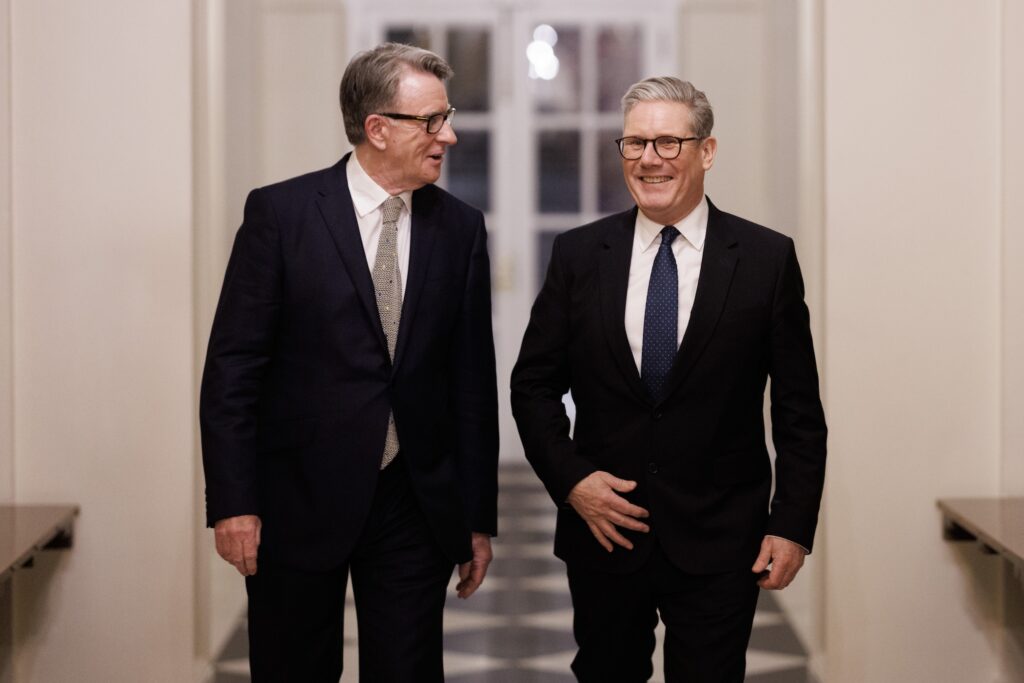
On 20 December 2024, Keir Starmer announced the appointment of Peter Mandelson as the next British ambassador to the United States of America.
Starmer’s decision to dispatch the supposedly diplomatically savvy “prince of darkness” to the states was designed to secure influence with the incoming administration of Donald Trump. Starmer described Mandelson, the former New Labour strategist and European commissioner for trade, as possessing “unrivalled experience”.
However, this decision backfired catastrophically on Starmer and his government. It is widely regarded as one of the defining misjudgements of Starmer’s premiership.
***
From 1997 to 2010, Mandelson held multiple ministerial roles under Tony Blair and Gordon Brown. He was elevated to the peerage in 2008.
The self-described “Third Man” in New Labour was also forced out of Blair’s cabinet on two occasions over politically damaging controversies. Mandelson was not without political baggage, therefore, upon his appointment as British ambassador to the US. But his skills as a seasoned political operator were seen to outweigh his previous shortcomings.
Starmer stated: “The United States is one of our most important allies and as we move into a new chapter in our friendship, Peter will bring unrivalled experience to the role and take our partnership from strength to strength.”
Mandelson, at the age of 71, pledged to land the “big opportunities” offered by the transatlantic alliance.
He declared: “It is a great honour to serve the country in this way. We face challenges in Britain but also big opportunities and it will be a privilege to work with the government to land those opportunities, both for our economy and our nation’s security, and to advance our historic alliance with the United States.”
The appointment was also made despite public criticism regarding Mandelson’s past associations – above all his longstanding friendship with convicted sex offender Jeffrey Epstein. Epstein, a billionaire financier born and raised in New York, was known for socialising with celebrities and politicians.
In February 2025, when asked about his association with Epstein by the Financial Times, Mandelson responded: “It’s an FT obsession and frankly you can all f*** off.”
It later emerged that Mandelson was appointed as US ambassador before a full, in-depth national security vetting process had been concluded.
***
Mandelson assumed office on 10 February 2025 and, initially, the gamble of his appointment appeared to pay off.
In May 2025, Mandelson was praised by Trump in the Oval Office for his role in negotiating trade exemptions after the US administration imposed sweeping “liberation day” tariffs on imports. The US president referred to Mandelson’s “beautiful accent”.
But Mandelson’s ambassadorial honeymoon was ultimately short-lived.
On 8 September, the US House of Representatives oversight committee released a cache of documents from Jeffrey Epstein’s estate. The files revealed a relationship between Mandelson and Epstein that was deeper than had been public knowledge at the time of his appointment. They included a series of messages from a 2003 book compiled by convicted child sex offender Ghislaine Maxwell for Epstein’s birthday.
The so-called “birthday book” contained a glowing 10-page tribute to Epstein from Mandelson. In it, Mandelson referred to Epstein as his “best pal”.
The last part of the lengthy birthday message read: “Happy Birthday Jeffrey, we love you!!”
Later on 8 September, Bloomberg sent a 2,000-word email to the ambassador containing 20 questions about a cache of unearthed correspondence. The Foreign Office (FCDO) became aware of the emails the following day, on 9 September.
On 10 September, Mandelson gave a video interview to the Sun. He spoke of his “very, very deep regret”. He described Jeffrey Epstein as an “albatross around his neck” and hinted at further “very embarrassing” revelations.
Later on 10 September, Starmer defended the US ambassador during a session of prime minister’s questions. Kemi Badenoch, the Conservative leader of the opposition, asked Starmer if he still had confidence in the ambassador.
The prime minister insisted that he did, saying Lord Mandelson was “playing an important role in the UK-US relationship”.
He said: “The relationship between the US and the UK is one of our foremost relationships, and I have confidence in the ambassador in the role he is doing.”
Referring to Epstein, the prime minister added: “He was a despicable criminal who committed the most heinous crimes and destroyed the lives of so many women and girls.
“The ambassador has repeatedly expressed his deep regret for his association with him. He’s right to do so.”
Later that day, the Sun published a news story containing some of the emails Bloomberg had previously asked Mandelson about. The most damaging revelation was an email sent in June 2008, after Epstein had been convicted of soliciting prostitution from a minor.
Mandelson wrote to the disgraced financier: “I think the world of you and I feel hopeless and furious about what has happened.
“I can still barely understand it. It just could not happen in Britain. You have to be incredibly resilient, fight for early release and be philosophical about it as much as you can… everything can be turned into an opportunity and that you will come through it and be stronger for it.
“The whole thing has been years of torture and now you have to show the world how big a person you are, and how strong.
“Your friends stay with you and love you.”
Bloomberg responded by publishing its full cache of Epstein-Mandelson correspondence.
Following the publication of the 2008 emails, Starmer sacked Mandelson on 11 September 2025.
Mandelson’s departure was announced by Foreign Office minister Stephen Doughty, who had been hauled before the commons to answer an urgent question on the “appointment process” the US ambassador underwent.
Doughty said: “In light of additional information in emails written by Peter Mandelson, the prime minister has asked the foreign secretary to withdraw him as ambassador to the United States.
“The emails show that the depth and extent of Lord Mandelson’s relationship with Jeffrey Epstein is materially different from that known at the time of his appointment.
“In particular, Lord Mandelson’s suggestion that Jeffrey Epstein’s first conviction was wrongful and should be challenged is new information. In the light of that and mindful, as we all are, of the victims of Epstein’s appalling crimes, Lord Mandelson has been withdrawn as ambassador with immediate effect.”
The prime minister’s official spokesperson responded that vetting was handled by government departments and “any suggestion that No 10 was involved is untrue”. They also told reporters that Starmer found the emails “reprehensible”.
In his letter to US embassy staff, Mandelson expressed “very, very deep regret”.
He wrote: “The circumstances surrounding the announcement today are ones which I deeply regret. I continue to feel utterly awful about my association with Epstein twenty years ago and the plight of his victims.
“I have no alternative to accepting the prime minister’s decision and will leave a position in which I have been so incredibly honoured to serve.”
James Roscoe was appointed interim ambassador following Mandelson’s removal.
***
On 16 September 2025, the House of Commons held an emergency debate on the dismissal.
Conservative MP David Davis, a former cabinet minister, mocked the government for failing to uncover what “Google could do” with its vetting of Mandelson. He described the former ambassador as a man “easily dazzled by wealth and glamour”.
Davis also expressed sympathy for Doughty, who had once again been sent to defend the government’s handling of the crisis. Davis described Doughty as “the last Spartan at Thermopylae, full of arrows as he stands there trying to defend an impossible position.”
Emily Thornberry, the Labour chair of the foreign affairs committee, contrasted the apparently lax vetting of the political appointee with the hurdles faced by civil servants.
She asked: “Does having significant information in the public domain about a relationship with an internationally prolific child sex offender not raise more red flags than simply being born in Belfast?
“Is a civil servant a greater risk to this country because they are married to somebody who was born in the middle east or because they were close friends with Jeffrey Epstein?
“Did the Foreign Office vetting process miss a glaring national security and reputational risk, or was it told to overlook it?”
She said that, upon Mandelson’s appointment, “red flags were obviously missed or ignored.”
Badenoch accused Starmer of having “shrivelled from leadership”.
Conservative MP Edward Leigh, the father of the House, warned of the diplomatic damage on the eve of Trump’s state visit.
He told the commons: “He [Trump] must think that we in this country are complete plonkers, frankly, for the way that we have handled all this.”
On 18 September, Trump – who was also facing questions over his past closeness to Epstein – denied ever having met Mandelson.
Trump was asked if he sympathised with Mandelson over his sacking at a press conference during his unprecedented second state visit.
He responded: “I don’t know him, actually. I had heard that, and I think maybe the prime minister would be better speaking of that, that was a choice that he made, I don’t know.”
***
In November 2025, six weeks after the scandal first broke, the foreign affairs committee summoned the cabinet secretary, Sir Chris Wormald, and the permanent under-secretary at the FCDO, Sir Oliver Robbins, to give evidence.
Conservative MP John Whittingdale established that the Foreign Office had received the explosive Bloomberg emails before the prime minister stood up at PMQs on 10 September to express “confidence” in Mandelson. Robbins, however, admitted he had not briefed Starmer on the content of the emails before the session.
He cited the need to treat the matter as a “management issue”.
He said: “In the context and tone of this hearing this may sound naive – forgive me for that – but I needed to behave towards Lord Mandelson as an employee to whom I owed a duty of care.
“I was not seeking to involve ministers in the detail.”
Wormald, meanwhile, conceded that the due diligence report sent to the prime minister before Mandelson’s appointment contained “direct extracts from media reporting and notes a general reputational risk”.
The cabinet secretary indicated that the judgment about whether to make the appointment rested with the prime minister.
***
The controversy over Mandelson’s appointment persisted into 2026.
In late January 2026, a release of US Department of Justice files relating to Epstein suggested the paedophile financier made $75,000 (£55,000) in payments to Mandelson in three separate $25,000 transactions in 2003 and 2004. Another email suggested Epstein sent £10,000 to Mandelson’s partner, Reinaldo Avila da Silva, in 2009 to pay for an osteopathy course.
Mandelson responded by resigning his membership of the Labour Party, saying he did not want to “cause further embarrassment”.
The former cabinet minister stated: “Allegations which I believe to be false that he made financial payments to me 20 years ago, and of which I have no record or recollection, need investigating by me…
“I have dedicated my life to the values and success of the Labour party and in taking my decision, I believe I am acting in its best interests.”
The following day, on 2 February, a further tranche of emails were released suggesting Mandelson forwarded internal government information to Epstein in June 2009. At the time, Mandelson was business secretary in Gordon Brown’s government and de facto deputy prime minister. One exchange suggested Mandelson gave Epstein advance notice of a €500 billion bailout by the EU to save the Euro. Another suggested that Mandelson tried to secure changes to a planned tax on bankers’ bonuses following conversations with Epstein.
On 3 February, the Metropolitan Police launched a criminal investigation into Mandelson over allegations of misconduct in public office.
In a statement, the Met commander Ella Marriott said: “Following the further release of millions of court documents in relation to Jeffrey Epstein by the United States Department of Justice, the Met received a number of reports into alleged misconduct in public office, including a referral from the UK government.
“I can confirm that the Metropolitan police has now launched an investigation into a 72-year-old man, a former government minister, for misconduct in public office offences.
“The Met will continue to assess all relevant information brought to our attention as part of this investigation and won’t be commenting any further at this time.”
On 4 February, MPs passed a humble address motion, tabled by the opposition Conservative Party, forcing the government to publicly disclose internal papers, electronic communications and vetting materials relating to the appointment.
The motion called for the release of “all papers relating to Lord Mandelson’s appointment as His Majesty’s Ambassador to the United States of America”. It specifically questioned Starmer’s “assurance to this House on 10 September 2025 that ‘full due process was followed during this appointment’”.
Labour MPs had threatened to vote against a government amendment to the motion, which sought to limit the disclosures, forcing an eleventh-hour concession. Shortly before the division (formal vote), the government whips agreed to hand power over the disclosures to the intelligence and security committee. This compromise was brokered by senior Labour MPs Angela Rayner, the former deputy prime minister, and Meg Hillier, the chair of the Treasury select committee.
***
Four days later on 8 February, Morgan McSweeney, the prime minister’s chief of staff since 2024, resigned over his role in Mandelson’s appointment. McSweeney said he took “full responsibility” for the advice he presented to the prime minister.
He stated: “In public life responsibility must be owned when it matters most, not just when it is most convenient. In the circumstances, the only honourable course is to step aside.”
McSweeney’s departure was treated as symbolically significant and deeply damaging given his pivotal role in Starmer’s rise to power.
In a statement, Starmer said it had been an “honour working with Morgan McSweeney for many years. He turned our party around after one of its worst ever defeats and played a central role running our election campaign. It is largely thanks to his dedication, loyalty and leadership that we won a landslide majority and have the chance to change the country.”
On 23 February, Mandelson was arrested on suspicion of misconduct in public office. He was released on bail in the early hours of the following day. Mandelson’s bail conditions were dropped in March 2026.
Following his release, a Metropolitan Police spokesperson said: “A 72-year-old man arrested on suspicion of misconduct in public office has been released on bail pending further investigation.
“He was arrested at an address in Camden on Monday, 23 February, and was taken to a London police station for interview.”
A statement, issued by a lawyer representing Mandelson, responded: “The arrest was prompted by a baseless suggestion that he was planning to leave the country and take up permanent residence abroad. There is absolutely no truth whatsoever in any such suggestion.”
***
In April 2026, the Guardian exclusively revealed that the government overruled a decision to deny Mandelson security vetting clearance. The newspaper reported that Mandelson failed a developed vetting process in January 2025 – some weeks after the announcement that he would be appointed US ambassador.
Starmer responded to the story by sacking Robbins as permanent under-secretary at the FCDO.
The prime minister insisted that he had no knowledge that security officials advised Mandelson should not be given clearance – a fact he described as “absolutely unforgivable”. Kemi Badenoch, the Conservative leader of the opposition, said that Starmer should resign if he misled the commons over Mandelson’s vetting.
On 21 April, Robbins appeared before the foreign affairs committee to give evidence over his role in Mandelson’s appointment. The former senior civil servant said he had been subjected to “constant pressure” to ensure Mandelson’s swift appointment to the ambassadorial role.
He told MPs: “I walked into a situation in which there was already a very, very strong expectation. And you have seen the papers released already under the humble address that’s coming from No 10 that he needed to be in post and in America as quickly as humanly possible.
“The very first formal communication of this to my predecessor from No 10’s private office being that they wanted all this done at pace and Mandelson in post before [Donald Trump’s] inauguration.”
Robbins was also pressed on whether Downing Street had proposed any other “political appointees” to fill diplomatic roles.
Robbins confirmed that, in March 2025, Downing Street initiated discussions regarding a potential “head of mission” (ambassadorial) role for Matthew Doyle, the former director of communications at Downing Street. Robbins revealed that he had been under “strict instruction” by No 10 not to discuss the proposed appointment with the foreign secretary, which he described as “uncomfortable”.
***
The humble address files were released in batches. The first tranche of material was published on 11 March; the second was released on 1 June.
The material laid bare the criticisms Mandelson and government ministers were making of Starmer, No 10 and Labour MPs. In an exchange with Pat McFadden, then the chancellor of the Duchy of Lancaster, in May 2025, Mandelson wrote that “Keir lacks verve as does the cabinet as a whole.”
McFadden, meanwhile, revealed his annoyance that meetings were dominated by “who can we tax in order to pay benefits”.
The Mandelson scandal contributed to the 2026 Labour leadership crisis.
In the wake of the May 2026 local and devolved parliament elections, Labour MPs lined up to call on Starmer to step down/set out a timetable for his departure.
The coalition calling for Starmer to resign was symbolically broad, including rising stars from the 2024 intake (such as Chris Curtis, Gordon McKee and Yuan Yang), Blue Labour figures (Jonathan Brash, Jonathan Hinder and David Smith), and leading “soft left” MPs (Louise Haigh and Debbie Abrahams).
In total, over 90 MPs called for Starmer to step down as prime minister. This collective expression of disapproval over the direction of the government followed months of mounting pressure on the government.
Several MPs pointed to the government’s appointment of Mandelson and its handling of the ensuing scandal as part of their justification for calling on Starmer to resign.
On 10 May, Rayner issued a 1000-word statement criticising a “toxic culture of cronyism” at the top of the Labour Party.
On 12 May, Alex Davies-Jones resigned as minister for victims and tackling violence against women and girls. She set out the reasons behind her departure in a speech in the House of Commons on 3 June 2026. It came during a debate on the government response to the Mandelson humble address.
Davies Jones told the House: “I sought to use my position in government to advocate for victims, but when we are forced to fight tooth and nail simply to have those voices heard, something is not working as it should. That is why I took the difficult but necessary decision to resign…
“As a survivor, I struggle to understand why prime minister Keir Starmer appointed Peter Mandelson when his association with Jeffrey Epstein had long been publicly known. For survivors, this raises serious questions about whether the lessons of the Epstein scandal have truly been learned.”
Davies Jones said the government “appeared more interested in cultivating relationships with tech elites than listening to the warnings about harms being experienced by women, girls and young people every single day.”
On 22 June 2026, Starmer announced his resignation as prime minister and Labour leader outside 10 Downing Street, becoming the sixth person to leave the office in 10 years. His resignation followed former Greater Manchester mayor Andy Burnham’s victory in the Makerfield by-election – a contest triggered (by the resignation of Josh Simons from parliament) at the height of the May 2026 crisis.
Politics.co.uk Newsletters
DAILY
Politics@Lunch
WEEKLY
Week in Review