‘Speak for England!’: Leo Amery appeals to Labour on the eve of war
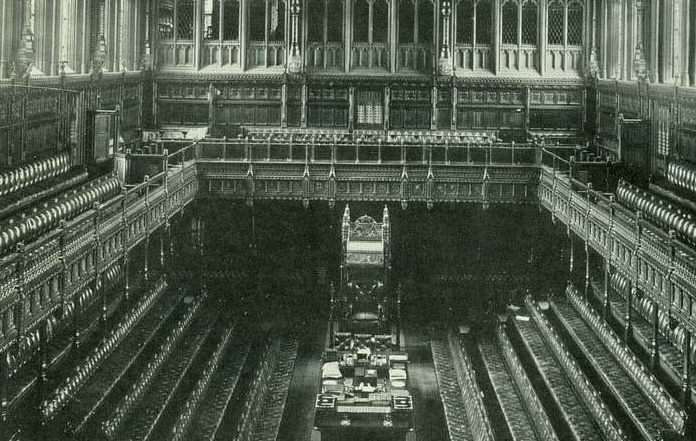
On 2 September 1939, on the eve of war with Nazi Germany, prime minister Neville Chamberlain delivered a hesitant and ambiguous address in the House of Commons. It induced a famous response from Conservative backbencher Leo Amery, who appealed to the stand-in Labour leader to “Speak for England!”
On 1 September, responding to Germany’s invasion of Poland, Chamberlain provided the outline of an ultimatum – but neglected to set a deadline at which point Britain would declare war.
He said that “unless the German government are prepared to give His Majesty’s government satisfactory assurances that the German government have suspended all aggressive action against Poland and are prepared promptly to withdraw their forces from Polish territory, His Majesty’s government in the United Kingdom will without hesitation fulfil their obligations to Poland”.
One MP responded: “Time limit?”
***
Parliament convened at 2:45 pm on 2 September with the continent already in a state of war.
John Simon, the chancellor, had initially been due to deliver a statement. But he received an urgent message not to, as the government wished to consider the possibility of a peace conference proposed by Italy’s Benito Mussolini. Simon then told MPs that “the prime minister will be coming down to the House later in the sitting, and will himself make a statement which cannot be made at this moment.”
At around 18:30 on 2 September, the speaker suspended the session with MPs still waiting to hear an update from Chamberlain. The prime minister, hesitant to make a formal declaration of war unilaterally, is said to have been delayed by discussions with his counterparts in France.
Chamberlain finally rose to address the House at around 19:45.
In a short statement, he confirmed that the government was “in communication with the French government as to the limit of time within which it would be necessary for the British and French governments to know whether the German government were prepared” to withdraw from Poland.
Chamberlain told MPs: “Sir Nevile Henderson [the British ambassador to Germany] was received by Herr von Ribbentrop [German minister of foreign affairs] at 21:30 last night, and he delivered the warning message which was read to the House yesterday.
“Herr von Ribbentrop replied that he must submit the communication to the German chancellor [Adolf Hitler]. Our ambassador declared his readiness to receive the chancellor’s reply. Up to the present no reply has been received.”
Chamberlain said the delay “may be” caused “by consideration of a proposal which… had been put forward by the Italian government”.
He explained that the Italian government had proposed a five-power conference to resolve the crisis.
But he added: “While appreciating the efforts of the Italian government, His Majesty’s government, for their part, would find it impossible to take part in a conference while Poland is being subjected to invasion, her towns are under bombardment and Danzig is being made the subject of a unilateral settlement by force.”
He said: “If the German government should agree to withdraw their forces, then His Majesty’s government would be willing to regard the position as being the same as it was before the German forces crossed the Polish frontier.
“That is to say, the way would be open to discussion between the German and Polish governments on the matters at issue.”
Chamberlain went on to refer to the status if Danzig, which the German Reichstag had voted to annex on 1 September.
He said: “The international status of Danzig as a free city is established by a treaty of which His Majesty’s government are a signatory, and the free city was placed under the protection of the League of Nations…
“His Majesty’s government do not, therefore, recognise either the validity of the grounds on which the action of the Danzig authorities was based, the validity of this action itself, or of the effect given to it by the German government.”
Some 38 hours after the German invasion of Poland, MPs had expected a declaration. But Chamberlain delivered more delay and promises of hypothetical negotiations.
***
For Amery, the contribution raised the prospect of “another Munich” – a reference to the 1938 conference that handed the Sudetenland to Germany.
Arthur Greenwood rose to address the House on behalf of the Labour Party; he was deputising for Clement Attlee, who was in hospital for prostate surgery.
But before Greenwood could begin his speech, Amery interjected from the government benches: “Speak for England, Arthur!”
Chamberlain, Amery savagely insinuated, had not.
Greenwood’s speech captured the mood of the House. He argued that the “incessant strain must end sooner or later – and, in a sense, the sooner the better”.
The Labour deputy leader told MPs: “I believe the whole House is perturbed by the [prime minister’s] statement… An act of aggression took place 38 hours ago. The moment that act of aggression took place one of the most important treaties of modern times automatically came into operation…
“I wonder how long we are prepared to vacillate at a time when Britain, and all that Britain stands for, and human civilisation are in peril.”
He characterised continued delay as strategically “dangerous” and a sign of weakness.
“Every minute’s delay now means the loss of life, imperilling our national interests”, he said. “The moment we look like weakening, at that moment dictatorship knows we are beaten. We are not beaten. We shall not be beaten. We cannot be beaten; but delay is dangerous.”
He concluded: “I cannot see Herr Hitler, in honesty, making any deal which he will not be prepared to betray. Therefore, thinking very hurriedly in these few moments, I believe that the die is cast”.
Chamberlain rose again to insist that the delay did not reflect a “weakening” of his resolve. He stated that the French cabinet was currently in session, and that he would soon be informed of its position.
The prime minister heavily suggested that, in a further update the following day, war would be declared. “I anticipate that there is only one answer I shall be able to give to the House tomorrow”, Chamberlain said.
But as Amery later wrote, the PM “failed to correct the impression left by his original statement, and the House broke up in confusion and dismay.”
John Wardlaw-Milne, a Conservative MP, told Chamberlain that it was 38 hours “since this war began” and “something like 24 hours… since the prime minister’s message was delivered in Germany.”
He said that “the whole country is nervous about this continual delay in carrying out our pledges”.
David Margesson, the chief whip, privately told Chamberlain that he believed the government would fall if war was not soon declared.
***
On the evening of 2 September, when the cabinet met to adopt an agreed position, several ministers were in a state of revolt.
The following day, at 12:25 am and again at 5:00 am the Foreign Office sent telegrams to Henderson, the UK’s ambassador, instructing him to seek a meeting with Ribbentrop. He was told that unless the government received assurances by 11:00 am that Germany would withdraw from Poland, Britain would declare war.
At 11:00 am, the deadline expired and Chamberlain addressed the nation in a radio broadcast.
***
On 3 September, MPs gathered in parliament for a Sunday session. Chamberlain read out the final ultimatum delivered to the German government that morning (below).
He added: “That was the final note. No such undertaking was received by the time stipulated, and, consequently, this country is at war with Germany..
“This is a sad day for all of us, and to none is it sadder than to me. Everything that I have worked for, everything that I have hoped for, everything that I have believed in during my public life, has crashed into ruins.
“There is only one thing left for me to do; that is, to devote what strength and powers I have to forwarding the victory of the cause for which we have to sacrifice so much. I cannot tell what part I may be allowed to play myself; I trust I may live to see the day when Hitlerism has been destroyed and a liberated Europe has been reestablished.”
Chamberlain would remain in office until 10 May 1940.
His downfall was punctuated by another famous intervention from Amery.
The Conservative MP, channelling Oliver Cromwell, told Chamberlain: “You have sat too long for any good you have been doing lately.
“Depart, I say, and let us have done with you. In the name of God, go!”

Politics.co.uk Newsletters
DAILY
Politics@Lunch
WEEKLY
Week in Review
