Second Reform Act extends vote to urban working men
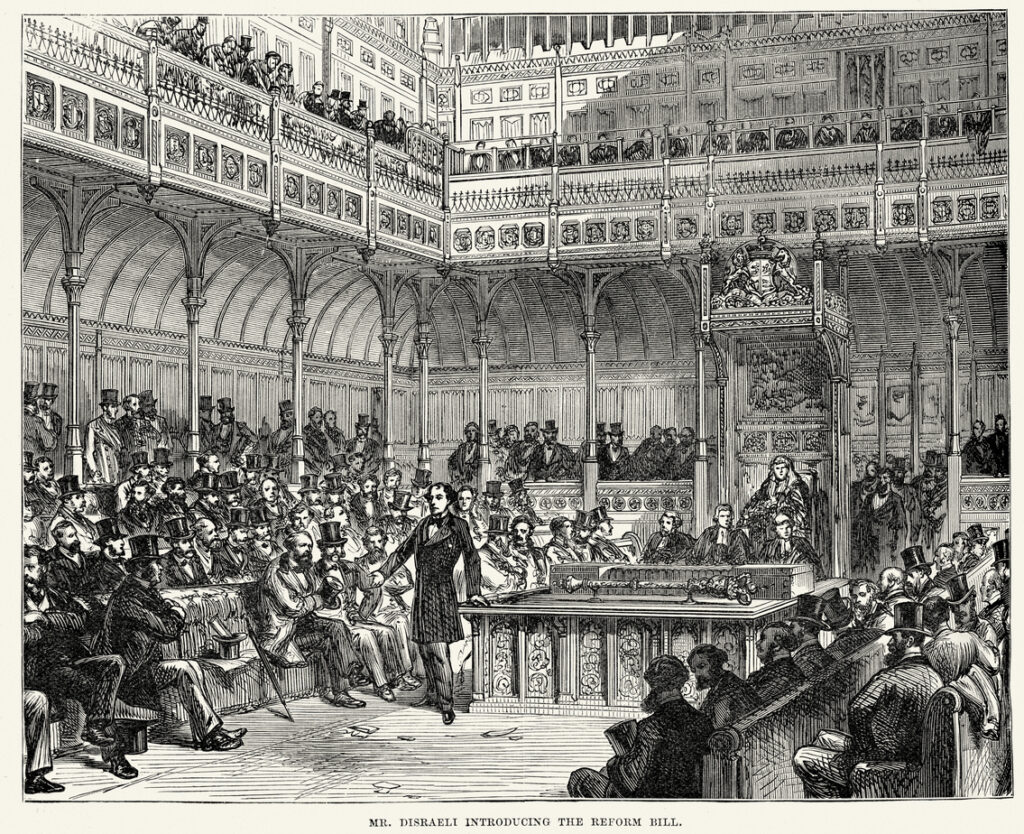
On 15 August 1867, the Representation of the People Act, commonly known as the Second Reform Act, received royal assent. It marked a major step in the democratisation of Britain, significantly expanding the parliamentary franchise to large numbers of working-class men.
The act, which built on the limited gains of the 1832 Great Reform Act, followed a period of sustained popular and parliamentary pressure. The legislative package went some of the way to realising the Chartist demand for universal manhood suffrage, which arose from the disillusionment that followed the 1832 reforms. But by the 1860s, Chartism had given way to more targeted movements for franchise reform – notably John Bright’s Reform Union (founded 1864) and the Reform League, established in 1865 to the delight of contemporary Karl Marx.
***
Lord Palmerston, the dominant Liberal prime minister from 1855, was an intractable opponent of reform. His death in office in 1865 released an immediate wave of pent-up, pro-reform agitation in his party.
Earl (John) Russell, Palmerston’s successor as prime minister, drafted the 1832 Reform Act and helped steer it through parliament. His Liberal government, led in the commons by William Gladstone, introduced a cautious reform bill.
Gladstone announced his conversion to the cause of moderate franchise reform in May 1864. In a speech that provoked the ire of Palmerston, he told the House of Commons that “every man who is not presumably incapacitated by some consideration of personal unfitness or of political danger is morally entitled to come within the pale of the constitution.”
He added: “I do not recede from the protest I have previously made against sudden, or violent, or excessive, or intoxicating change; but I apply it with confidence to this effect, that fitness for the franchise… is not repelled on sufficient grounds from the portals of the constitution by the allegation that things are well as they are.”
The 1866 bill failed to make it through the commons. Benjamin Disraeli corralled opposition sentiment as a collective comprising Conservatives, anti-reform Liberals known as the ‘Adullamites’ under Robert Lowe and pro-reform radicals combined to bring about its defeat.
In March 1866, during a debate on the ill-fated bill, Lowe referred to working class men as “impulsive, unreflecting, and violent people”.
Lowe told the commons: “Is it not certain that in a few years from this the working men will be in a majority?…
“If you want venality, if you want ignorance, if you want drunkenness, and facility for being intimidated; or if, on the other hand, you want impulsive, unreflecting, and violent people, where do you look for them in the constituencies? Do you go to the top or to the bottom?”
The bill’s failure and Lowe’s comments provoked popular outrage.
The radical Reform League, led by members of Marx’s International Workmen’s Association, responded with a series of demonstrations throughout the nation. The group’s action culminated in a giant meeting held at Hyde Park on 23 July 1866. The home secretary, Spencer Walpole declared it to be illegal on the grounds it would cause “riotous or disorderly conduct”. But the 1600 constables deployed to guard Hyde Park were no match for the estimated 200,000 people who invaded the park once the railings were successfully weaned from their supports. A three-day occupation followed.
The ‘Hyde Park Railings Affair’ was a considerable embarrassment for the government and for Walpole in particular. The journal Punch subsequently spoke of a “Hyde Park Rail-Way” to reform.
The bill’s defeat also precipitated the collapse of the Liberal government under Russell.
In June, the Earl of Derby was appointed prime minister for a third time, forming a minority Conservative administration with Disraeli serving as chancellor of the exchequer and commons leader.
**
In 1859, Disraeli had introduced a bill that would have resulted in a modest increase to the franchise. Some eight years later, with the Liberals divided and parliament lacking clear leadership, he sensed a political opportunity.
Disraeli’s embrace of reform was greeted with suspicion and downright opposition within his party. Refusing to be bounced into franchise expansion, Viscount Cranborne (later the 3rd Marquess of Salisbury) resigned as secretary of state for India in protest at Disraeli’s proposals. He was joined by the Earl of Carnarvon, the secretary of state for the colonies, and Jonathan Peel, the secretary of state for war.
The Conservatives, after all, had opposed Gladstone’s Reform Bill only the previous year.
But Disraeli had resolved on a strategy to outflank the Liberals, hoping to win the gratitude of the newly enfranchised and regain the political initiative for his Conservative Party. This approach was famously described by Derby, the prime minister, as a “leap in the dark”.
At a speech delivered at Mansion House in early August 1867, Disraeli described his proposed reforms as a challenge to Liberal dominance over questions of political reform. The leading Conservative asserted that he had “attempted to disturb” the supposed Liberal “hereditary right to deal with the question of reform”.
Disraeli said that “he had in his time seen many monopolies broken up, and recently he had seen the termination of the monopoly of Liberalism.”
He argued that Liberal resentment at the loss of this supposed “hereditary right” to renovate Britain’s political institutions was to be expected, referencing a certain displeasure that “other persons should presume to interfere with those changes which I hope in the spirit of true patriotism they believed the requirements of the state rendered necessary.”
But Disraeli added: “For what is the Tory party unless it represents national feeling? If it do not represent national feeling, Toryism is nothing. It does not depend upon hereditary coteries of exclusive nobles; it does not attempt power by attracting to itself the spurious force which may accidentally arise from advocating cosmopolitan principles or talking cosmopolitan jargon.”
This strategic logic was arguably distilled in a speech to the House of Lords, delivered by senior Liberal peer Earl Granville on 22 July 1867.
Granville recounted the likely apocryphal story of how Disraeli had sought to persuade a Tory sceptic of his bill’s merits by declaring: “Don’t you see how it has dished the Whigs?”
Lord Granville later recounted in the House of Lords how Derby, when challenged by a friend on the revolutionary nature of the Bill, defended it with the simple argument: “Don’t you see how it has dished the Whigs?”
In this same debate, the Reform Bill’s second reading in the Lords, Derby delivered his own defence of the measure.
He argued that the party, under his leadership, had been relegated to opposition twice before and that it would not now be a “mere stop-gap until it should suit the convenience of the Liberal Party to forget their dissensions.”
Derby declared it his duty “to undertake this difficult task – a task which, as I thought, it was all but impossible to fulfil; and, despite of any taunts of inconsistency, despite of any opposition, to endeavour towards the close of my political career to settle one great and important question of vital importance to the interests of the country.”
Derby maintained that the Conservatives had never opposed the principle of Reform, but rather the “imperious dictation” of Gladstone.
Ultimately, Disraeli’s daring strategy to “dish the Whigs,” together with the bill’s safeguards, extra-parliamentary pressure, and the fear of a sudden general election helped assuage sceptical Conservative MPs.
***
Disraeli introduced his Reform Bill, initially a more cautious set of measures than those championed by Gladstone, on 18 March 1867. Addressing the commons, he couched his argument in conservative language, framing the legislation as a “constitutional” measure born of “principle” rather than “democracy”.
He stated: “We do not… live – and I trust it will never be the fate of this country to live – under a democracy. The proposition which I am going to make tonight certainly have no tendency in that direction.”
Franchise reform should be conducted, he said, “in the spirit of our existing institutions, and with a due deference to the traditions of an ancient state.”
Moreover, he referred to the franchise as not an individual right, but a “public right” that must be earned with “public duty” – specifically, the payment of local rates (taxes). Only a man responsible enough to personally pay his rates to the parish, Disraeli maintained, could be trusted with the vote.
He told MPs: “If you are going to invest men with the exercise of public rights, let that great trust be accompanied with the exercise of public duty.”
Disraeli also noted the “very great sacrifices… chagrin and great mortification” that had come with his advocacy of the bill, a reference to recent cabinet resignations.
Addressing the radical-Liberal opponents of the bill, he declared: “I am told that in this measure there are checks and counterpoises, and that it assumes in this country the existence of classes.
“If there are checks and counterpoises in our scheme, we live under a constitution of which we boast that it is a constitution of checks and counterpoises. If the measure bears some reference to existing classes… why should we conceal from ourselves, or omit from our discussions, the fact that this country is a country of classes, and a country of classes it will ever remain.”
A series of classic clashes between Disraeli and Gladstone, his parliamentary nemesis, followed.
The Liberal leader took specific aim at Disraeli’s chosen safeguards. Speaking in the 18 March debate, Gladstone specifically condemned the “fancy franchises” and “dual vote” measures. These “checks and counterpoises” introduced a set of alternative qualifications to privilege the position of ‘respectable’ citizens – defined as men with a university degree, those with £50 in funds or savings banks, and householders in the boroughs who paid direct taxes of 20 shillings.
This was the basis of the “dual vote” proposal. A working-class man who was a householder and rate-payer would get one vote; a middle-class or wealthy man who paid his rates and 20 shillings in direct taxes would get two votes.
Disraeli proposed that a person “who pays 20 shillings direct taxation, and who enjoys the franchise which depends upon the payment of direct taxation, if he is also a householder and pays his rates, may exercise his suffrage in respect of both qualifications.”
Gladstone condemned this measure as a “gigantic engine of fraud” and a “proclamation of a war of classes.”
He added: “The British constitution rests, and has rested from time immemorial, on the mutual goodwill, respect, and good feeling of the people…
“The day you place in the hands of the rich man… this weapon to use against his poorer fellow countrymen – that day you seal the doom of the old British constitution… that day you light up a flame the most dangerous and formidable that ever menaced the safety of a state.”
The Reform League also declared its opposition to Disraeli’s measures. It called for another mass demonstration at Hyde Park. Walpole, the home secretary, once again declared that attendance at the meeting would be illegal. The demonstrators defied Walpole’s declaration and gathered in Hyde Park. The government backed down and Walpole, seen to have mishandled the event, resigned.
The public show of pressure convinced Disraeli to strengthen his Reform Bill.
***
During the bill’s committee stage, in his capacity as commons leader, Disraeli accepted a series of amendments proposed by Liberal and radical MPs. The amendments successively strengthened the bill in the eyes of reformers, and it soon ballooned beyond the scope of Disraeli’s initial intentions. On its way to the statute book, the initially mild Reform Bill mutated into something more radical.
The proposed legislation ended its parliamentary journey as a significantly more “democratic” package than when it started.
In a debate on 17 May, Disraeli accepted an amendment from Liberal backbencher Grosvenor Hodgkinson which sought, in a round about way, to enfranchise every eligible householder.
Hodgkinson said the bill should address the widespread issue of “compounding”, a mechanism that enabled landlords to pay the rates for their tenants often in bulk, at a discount. Under the bill’s original scheme, “compound householders” would be denied the vote. But Hodgkinson proposed to abolish the system of compounding in parliamentary boroughs altogether.
Hodgkinson argued that “a system which depended upon personal payment of rates… and a system of compounding for rates” were “so antagonistic that they could scarcely coexist.”
Disraeli, without consulting the cabinet or indeed the prime minister, agreed to the amendment. Speaking to a sparsely populated chamber, he argued the amendment was not “opposed to the principles” of the bill, saying it “would enforce the policy which we recommend” and “give completeness to the measure.”
He also dismissed Hodgkinson’s reports of a “very agitated dangerous state of the country” as “monstrous exaggeration.”
But he added, mockingly: “I have no doubt there are individuals [Gladstone] who, having long tried with what I may call blundering hands to settle this question, may be exceedingly annoyed that those who have been their rivals in the enterprise have been more successful.”
It is not entirely inconceivable that Disraeli might have radicalised his bill, at least in part, to spite his arch-rival. Of course, the leading Tory conspicuously refused to accept any of Gladstone’s amendments.
Having accepted Hodgkinson’s scheme, Liberal MP Ralph Bernal Osborne responded by praising Disraeli as “the greatest radical in the House”.
He added: “He has achieved what no other man in the country could have done. As I have said before, he has lugged up that great omnibus full of stupid, heavy country gentlemen… He has converted these Conservatives into radical reformers.”
Osborne, having defended “stupid” as “a perfectly parliamentary word”, referred to Disraeli as “the ministry by himself” and his cabinet colleagues as mere “respectable pawns on the board, their opinion not being worth a snap of the fingers”.
Osborne joked that if Conservative MPs “behind [Disraeli] are discontented – if they are not ‘obsolete’ Conservatives, let them come over here, and we will walk over to the other side of the House and sit behind the right honourable gentleman. A fair exchange is no robbery.”
In a more straightforward contribution, John Stuart Mill, the Liberal MP and seminal philosopher, said the acceptance of Hodgkinson’s amendment was a “great and splendid concession”.
The amendment alone is said to have enfranchised approximately half a million men.
Gladstone confided to his diary: “Never have I undergone a stranger emotion of surprise than when, as I was entering the House, our whip met me and stated that Disraeli was about to support Hodgkinson’s motion. But so it was, and the proposition was adopted without disturbance, as if it had been an affair of trivial importance…
“I do not suppose that in the whole history of the ‘mystery-man’ [Disraeli], this proceeding can be surpassed. The Tories, having been brought to accept household suffrage on the faith of the limitation imposed by personal payment of the rates, found at a moment’s notice that that limitation had been thrown overboard, and that their leader had given them a bill virtually far larger than any that Mr. Bright had sought to impose upon them.”
During the bill’s committee stage, Disraeli summarily surrendered on the dual vote, reduced the residence requirement to one year (from two) for borough householders, enfranchised lodgers who paid rent of £10, abolished compounding by householders, reduced the county occupation franchise from £15 to £12, and dropped his “fancy franchises” proposal.
***
Naturally, Lowe and Cranbourne’s opposition only grew throughout this period.
Cranborne spoke in opposition to the bill on 15 July ahead of its third reading. He noted “how enormously the bill has changed since it passed its second reading. In no sense is it the same bill.”
He said the bill originally “bristled with precautions and guarantees and securities”, all of which have now “disappeared.”
The future prime minister declared: “If it be a Conservative triumph to have adopted the principles of your most determined adversary… to have introduced a Bill guarded with precautions and securities, and to have abandoned every one of those precautions and securities at the bidding of your opponents, then… the Conservative party has won no triumph so signal as this.”
He singled out Disraeli’s calculated manoeuvres, recalling his opposition to the 1866 reform bill and his second reading speech denouncing “democracy”. He argued that Disraeli had used opposition to reform to gain power, then abandoned those principles to maintain it.
He concluded by accusing Disraeli of “betrayal”.
Cranborne told the house: “The Conservative Party, whose opinions have had my most sincere approval, have, to my mind, dealt themselves a fatal blow by the course which they have adopted…
“I should, above all things, regret that this great gift to the people – if gift you think it – should have been purchased at the cost of a political betrayal which has no parallel in our parliamentary annals, which strikes at the root of all that mutual confidence which is the very soul of our party government, and on which only the strength and freedom of our representative institutions can be sustained.”
Speaking in the same debate, Lowe congratulated the Conservative Party for leading England to “a shameful victory over herself”.
He condemned the bill as founded on the “principle of a right existing in the individual as opposed to general expediency.”
He said: “It is the principle of numbers as against wealth and intellect. It is the principle, in short, which is contended for, and always will be contended for, by those who devote themselves to the advocacy of popular rights – the principle of equality.”
Lowe argued that in basing the bill on the principle of equality but failing to apply it universally, it sowed “the seeds of a discontent and agitation which will not terminate.”
He compared the bill’s passage to the Battle of Chæronea, which marked the effective loss of Greek liberty. He called for a poet or historian “who might set forth in words that could not die, the shame, the rage, the scorn, the indignation, and the despair with which this measure is viewed by every cultivated Englishman who is not a slave to the trammels of party”.
Disraeli dismissed the “frantic attacks” of his opponents, rejecting the accusation that the government had betrayed its principles or “obsequiously” surrendered to the “imperious dictation” of Gladstone. He argued that the “great fault” of the 1832 Great Reform Act was its failure to “give a due share of the representation to the working classes”.
He mocked Lowe’s self-comparison to a fallen Greek hero, remarking that the victims at Battle of Chaeronea “died for their country.”
Disraeli added: “But this victim of Chæronea takes the earliest opportunity, not of expressing his glory in his achievements and his sacrifice, but of absolutely announcing the conditions on which he is ready to join with those who have brought upon him so disgraceful a discomfiture.”
The jibe alluded to Lowe’s newly-stated support for state intervention in education. Having accepted defeat in his speech, the Liberal MP declared that it was “absolutely necessary that you should prevail on our future masters to learn their letters.”
Disraeli returned the merits of his bill and its philosophical justification in his peroration.
He told MPs: “I think England is safe in the race of men who inhabit her; that she is safe in something much more precious than her accumulated capital – her accumulated experience; she is safe in her national character, in her fame, in the tradition of a thousand years, and in that glorious future which I believe awaits her.”
The bill passed its third reading without a division.
Derby then steered it through the Conservative-controlled House of Lords without revising the recently revealed spirit of the legislation. (One Lords amendment ended the automatic dissolution of parliament when the sovereign died).
***
Disraeli’s measures and concessions produced an act that granted the vote to all male householders who paid rates, as well as to male lodgers paying £10 or more in annual rent. In the counties, the franchise was extended to occupiers of property valued at £12 per year and owners of land worth £5 per year. The act also provided for a modest redistribution of 53 parliamentary seats, removing representation from some small boroughs and granting extra seats to larger industrial towns and populous counties.
The act doubled the size of the electorate, from around 1.36 million to almost 2.48 million voters. The bulk of the newly enfranchised were working-class men in urban areas.
Disraeli formed his first ministry in February 1868 upon the resignation of Derby on the grounds of ill health. “I have climbed to the top of the greasy pole”, the new prime minister reputedly asserted.
But Disraeli’s “leap in the dark” did not initially land him on safe ground. The Conservatives lost the 1868 general election, the first held according to the new franchise. The Liberals under Gladstone won 387 seats – a net gain of 18. The party was therefore restored to power with a stable majority. In other words, the Whigs were not “dished”. But well over one million votes were cast – nearly three times the number of people who voted in the 1865 election.
Disraeli left office in favour of Gladstone, who formed his first ministry in December 1868.
The Representation of the People Act 1867 markedly changed the substance and conduct of British politics, forcing parties to develop mass organisations and popular messaging to appeal to the expanded electorate. In this regard, it is seen as one of the most significant reforms in British political history.
The process of passing the act also had a long-standing effect on the Conservative Party. Disraeli’s patronage of reform changed his party. It was a political gamble, but in many ways a classically conservative one: the deliverance of change in the pursuit of preservation. It was an empirical, paternalistic response to the irresistible facts of industrialisation and radicalism – an attempt to show that traditional institutions could be a force for social good. All the while, the act mostly maintained the dominance of the landed classes.
The Representation of the People Act 1867 was also notable for the intervention of John Stuart Mill. On 20 May, during the legislation’s commons committee stage, he proposed an amendment to replace the word “man” with “person”. Mill’s speech and amendment marked the first time the substantive case for women’s suffrage had been made in the UK parliament.
In addition, the act helped to establish political reform as a continuous process. The 1832 Great Reform Act had been styled as a permanent settlement; Disraeli’s conversion and his approach at committee stage, together with the positions adopted by Liberal MPs, underlined that reform was fundamentally fluid.
Disraeli responded shortly after with the Boundary Act 1868, which adjusted the electoral map for the newly expanded franchise.
Gladstone’s first ministry framed the Ballot Act 1872, which introduced the secret ballot for parliamentary and municipal elections, as securing the democracy promised by the Second Reform Act.
***
Disraeli’s 1867 act was a milestone for its malleability, helping to pave the way for the further extension of the franchise in 1884 under Gladstone’s second ministry.
The debate over reform in this period is also responsible for a series of memorable phrases.
John Bright, the veteran reformer and agitator statesman, generated at least two enduring expressions.
In January 1865, Bright referred to England as the “Mother of parliaments” – a phrase that has been misquoted many times since. Some two years later, Bright conceded that attempting to rouse parliament from its apathy on reform would be like trying to “flog a dead horse” to make it pull a load.

Politics.co.uk Newsletters
DAILY
Politics@Lunch
WEEKLY
Week in Review
