Roy Jenkins resigns as Labour deputy leader over Europe referendum
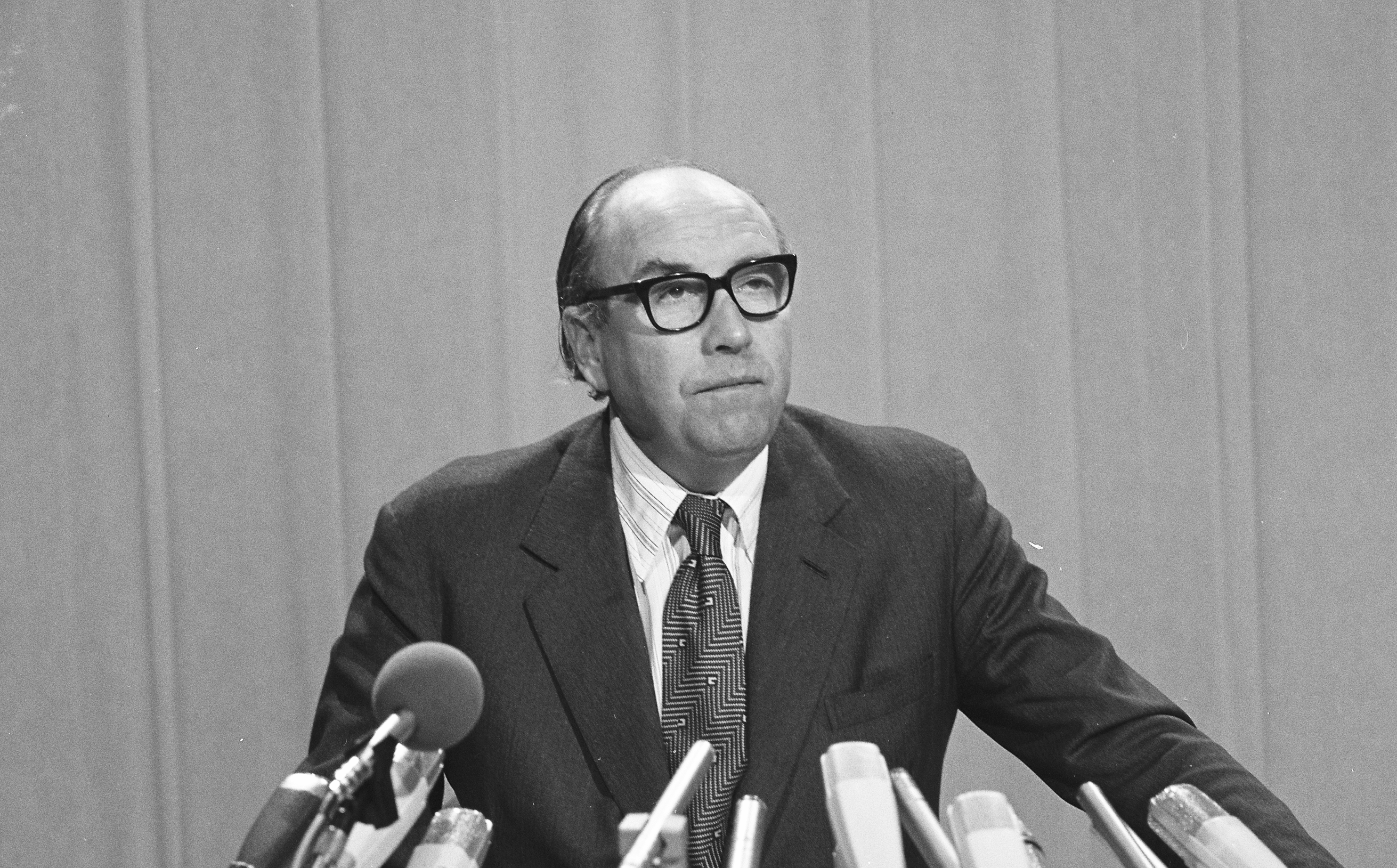
On 10 April 1972, Roy Jenkins resigned as deputy leader of the Labour Party and from Harold Wilson’s shadow cabinet in a major split over the party’s policy on Europe. The resignation was an act of opposition to the leadership’s decision to support a referendum on the United Kingdom’s membership of the European Economic Community (EEC).
Jenkins, a former chancellor and home secretary, was the most prominent europhile in British politics. In October 1971, he led 69 Labour MPs in defying a three-line whip to vote with Edward Heath’s Conservative government in favour of joining the EEC.
At the second reading of the European Communities Bill in February 1972, Jenkins voted against the European Communities Bill at second reading, choosing to toe the party line. He had committed to supporting the party’s position during the 1971 Labour deputy leadership contest.
But Jenkins viewed the leadership’s subsequent shift to backing a referendum during the bill’s committee stage as a concession to his party’s anti-EEC, eurosceptic wing. The decisive moment came when the Labour leadership voted to support an amendment proposed by anti-EEC Conservative MP Neil Marten calling for a referendum on British entry.
***
On 10 April, Jenkins was joined in his resignation by two further senior shadow ministers, George Thomson and Harold Lever. Thomson, who held a defence brief, had served as minister for Europe and common market negotiator in the previous Labour government.
Explaining his decision to resign, Lever said: “We think we will now be more effective in calling a halt to the drift in our party outside the leadership than if we were to remain members of a captive minority.”
On 11 April, David Owen joined the exodus in resigning his shadow defence brief, as did Dick Taverne and Lord Chalfont. Shirley Williams, the shadow home secretary, also wrote to Wilson threatening to resign if the party refused to adopt a “more constructive” approach to joining the EEC.
In his resignation letter to Harold Wilson, Jenkins opposed what he called “government born out of opportunism.”
He declared: “I want to see that future Labour governments have a clear sense of direction. This constant shifting of the ground, I cannot accept. Save in the very short term, it will be far more damaging to the Labour Party than to the present government.”
Jenkins wrote that the “official majority position of the party, which was only one of opposition to the terms of entry to the European Economic Community, has increasingly become one of opposition in principle.”
He added: “When I was re‐elected deputy leader in the autumn [I] realised that this would involve the acceptance by me of some difficult votes with which would not agree.
“But I did not envisage that, in a relentless and shortsighted search for tactical advantage, issues on which I thought the party had a settled mind would be reopened and that I would be required to vote for Conservative amendments directly contrary to positions which we have all long since taken up, and which, incidentally, are contrary also to the decision of the Labour party conference.”
The former chancellor continued: “What is more likely [if there were a referendum]… is that party loyalties would be strongly mobilised and that in order to frustrate the government of the day the opposition would form a temporary coalition of those who, whatever their political views, were against the proposed action.”
His resignation letter thereby set out his opposition to the use of referendums on a point of principle.
Jenkins stated: “By this means we would have forged a more powerful continuing weapon against progressive legislation than anything we have known in this country since the curbing of the absolute powers of the old House of Lords.
“Apart from the obvious example of capital punishment, I would not in these circumstances fancy the chances, to take a few random but important examples, of many measures to improve race relations, or to extend public ownership, or to advance the right of individual dissent, or to introduce the planning restraints which will become increasingly necessary if our society is to avoid strangling itself.”
Heath also opposed the referendum proposal on the grounds that it was not in the British tradition. He argued that Britain has a “fully effective and representative parliamentary system”. On 18 April, Neil Marten’s amendment was rejected by 284 votes to 235. The European Communities Act received royal assent on 17 October 1972.
Jenkins, considered by some to be Wilson’s heir apparent, badly damaged his chances of emerging as Labour leader with his resignation.
Edward Short prevailed in the deputy leadership contest that followed, defeating Michael Foot and Anthony Crosland. Short was seen as the race’s unity candidate.
Jenkins later returned to the Labour frontbench as shadow home secretary and then home secretary following the February 1974 general election. But he retained concerns over the party’s leadership. His appointment as shadow home secretary came after he placed fifth in the November 1973 shadow cabinet election.
***
During the 1975 referendum on Britain’s membership of the EEC, Jenkins was a leading voice in the successful ‘Yes’ campaign.
He stood for the Labour leadership in April 1976 following Wilson’s resignation as prime minister. He placed third behind James Callaghan and Michael Foot.
Jenkins, who had previously defeated Foot in the 1970 and 1971 deputy leadership contests, responded by stepping back from British politics. He resigned from the House of Commons on 3 January 1977 to take up a new post as president of the European Commission.
But Jenkins soon returned to the British political frontline.
His stand in 1972 arguably prefigured his eventual break from Labour to co-found the Social Democratic Party (SDP). The formation of the SDP, signaled by the Limehouse Declaration of 25 January 1981, was a direct response to the Labour Party’s pronounced shift to the left under the leadership of Foot, the white-haired socialist elder statesman. Foot defeated Dennis Healey, seen as a standard-bearer of the party’s social democratic tradition, in the 1980 Labour leadership contest.
Shirley Williams and David Owen famously joined Jenkins in founding the SDP as three of the so-called ‘Gang of Four’. (The fourth SDP co-founder, Bill Rodgers, had been sacked from a junior ministerial post over his role in the October 1971 rebellion.)
Roy Hattersley, seen as a Jenkins ally at the time of his resignation, later reflected on the events of 10 April 1972.
Hattersley argued: “That was not the day on which the Social Democrats were born. It was not even the morning when they were conceived. But it was the moment when the old Labour coalition began to collapse. I did not realise it at the time, but once the envelope landed on the chief whip’s desk, the creation of a new centre party was inevitable… the Labour Party was never the same again.”

Politics.co.uk Newsletters
DAILY
Politics@Lunch
WEEKLY
Week in Review