Heath celebrates as Britain joins EEC after decade of debate
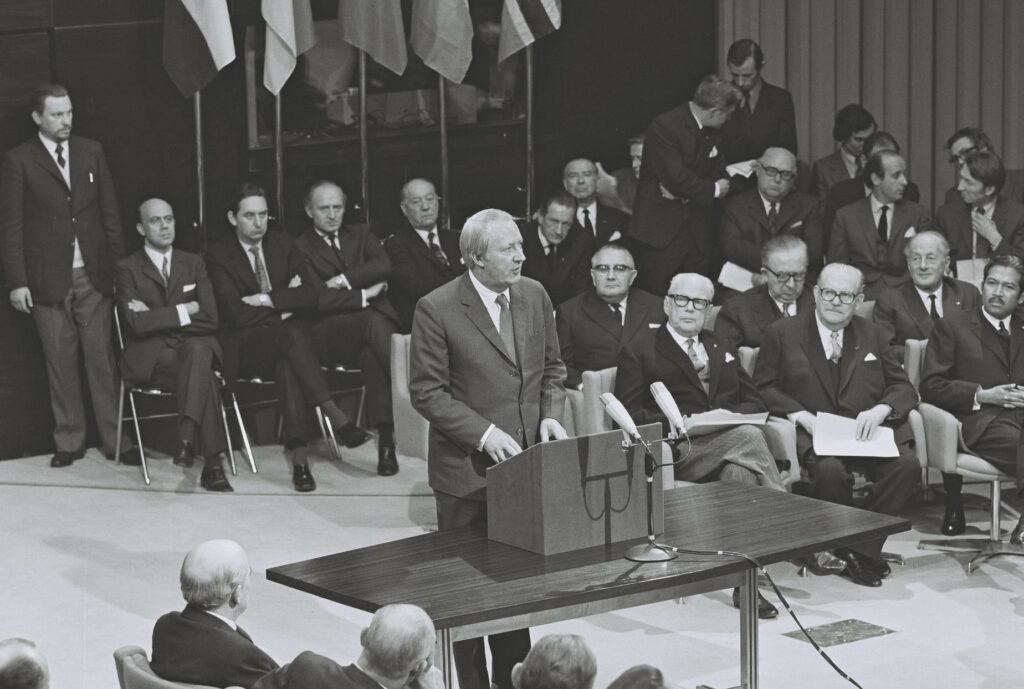
Britain joined the European Economic Community (EEC) on 1 January 1973, marking the culmination of more than a decade of political negotiation and debate.
Britain’s accession was the signature achievement of Edward Heath during his tenure as prime minister. Speaking on 1 January, the Conservative prime minister looked forward to “great cross-fertilisation of knowledge and information” between the United Kingdom and Europe.
Heath said: “It is going to be a gradual development and obviously things are not going to happen overnight. But from the point of view of our everyday lives we will find there is a great cross-fertilisation of knowledge and information, not only in business but in every other sphere.
“And this will enable us to be more efficient and more competitive in gaining more markets not only in Europe but in the rest of the world.”
Heath had committed his party to supporting Britain’s accession in the 1966 Conservative election manifesto, Action not Words. During that campaign, Labour leader Harold Wilson accused Heath of “rolling on his back” and submitting to the common market.
Wilson said: “One word from the French government and the Conservative leader rolls over on his back like a spaniel.”
Heath, having lost the 1966 general election, won a resounding victory four years later.
The 1970 Conservative election manifesto stated: “If we can negotiate the right terms, we believe that it would be in the long-term interest of the British people for Britain to join the European Economic Community, and that it would make a major contribution to both the prosperity and the security of our country.
“The opportunities are immense. Economic growth and a higher standard of living would result from having a larger market.”
***
For Britain and Heath’s European ambitions, the 1973 accession was a case of third time lucky. Previous attempts to secure entry into the EEC in 1961 and 1967 were vetoed by the French president, Charles de Gaulle. The UK launched its third bid to join the EEC, established by the 1957 Treaty of Rome, in 1969, shortly after de Gaulle’s resignation.
A meeting lasting 12 hours between Heath and de Gaulle’s successor as French president, George Pompidou, in May 1971 paved the way for Britain’s accession. Speaking after the summit, Heath said: “We both agree that it is not only desirable but possible for our negotiators to find solutions during June. The way is now open for them to do so.”
On 24 May, Heath told the commons that the “French president wants to see Britain in the European Economic Community.”
The prime minister said he was “confident that the divisions and suspicions which have so hampered relations between Britain and France in recent years have now been removed.”
The House of Commons endorsed the principle of EEC accession on 28 October 1971, following a week-long debate. The motion, proposed by foreign secretary Alec Douglas-Home, read: “That this House approves Her Majesty’s Government’s decision of principle to join the European Communities on the basis of the arrangements which have been negotiated.”
Addressing MPs, Heath argued that EEC membership would see Britain “work with partners whose interests are the same as ours.”
In a historic appeal, he urged MPs to back Britain’s accession after “10 years of negotiation… and after 10 years of debate”.
He declared: “The moment of decision for parliament has come…
“Tonight, the world is similarly watching Westminster, waiting to see whether we are going to decide that Western Europe should now move along the path to real unity – or whether the British parliament, now given the choice, not for the first time but probably for the last time for many years to come, will reject the chance of creating a united Europe”.
Heath added: “Surely we must consider the consequences of staying out. We cannot delude ourselves that an early chance would be given us to take the decision again. We should be denying ourselves and succeeding generations the opportunities which are available to us in so many spheres; opportunities which we ourselves in this country have to seize…
“But tonight when this House endorses this motion many millions of people right across the world will rejoice that we have taken our rightful place in a truly United Europe.”
MPs voted for Britain’s accession by 356 votes to 244 – a majority of 112.
39 Conservatives voted against entry, and 69 Labour MPs in favour.
***
On 22 January 1972, in the Egmont Palace in Brussels, Heath signed the treaty of accession.
Addressing the accession ceremony, Heath celebrated the conclusion of “arduous negotiations over more than 10 years”. He called for a Europe that is “strong and confident within itself.”
He declared: “Thus this ceremony marks an end and a beginning. An end to divisions which have stricken Europe for centuries. A beginning of another stage in the construction of a new and greater Europe.
“This is the task for our generation in Europe.”
The parliamentary debates over the European Communities Act 1972, which made legal provision for Britain’s accession, were marked by a deep political divide that defied party affiliation. Staunch Conservative eurosceptics, such as Enoch Powell, remained bitterly opposed to Britain’s accession. The legislation was subjected to some 300 hours of debate.
Harold Wilson’s Labour Party was also divided over the issue.
In April 1972, Roy Jenkins, Labour’s most prominent europhile figure, resigned from the shadow cabinet over his party’s demand for a referendum on Europe. He viewed the leadership’s shift to backing a referendum, which came during the debate over the European Communities Act, as a concession to his party’s eurosceptic wing.
In March, Labour had moved to support an amendment proposed by Conservative MP Neil Marten calling for a consultative referendum on British entry. It came after Pompidou proposed his own referendum on the enlargement of EEC. (The proposals were ultimately approved by 68.3% of French voters, on a turnout of 60.2%).
In his resignation letter to Wilson, Jenkins opposed what he called “government born out of opportunism.”
He declared: “I want to see that future Labour governments have a clear sense of direction. This constant shifting of the ground, I cannot accept. Save in the very short term, it will be far more damaging to the Labour Party than to the present government.”
Jenkins stated that the “official majority position of the party, which was only one of opposition to the terms of entry to the European Economic Community, has increasingly become one of opposition in principle.”
He added: “It may be argued… that the EEC referendum would be a once-for-all operation. The device would never be used again. Who can possibly say that?
“Once the principle of the referendum has been introduced into British politics, it will not rest with any one party to put a convenient limit to its use. And most history shows, as [Clement] Attlee pointed out with terse force in 1945, that it is a splendid weapon for demagogues and dictators.”
The passage of the European Communities Act (by eight votes at second reading) was effectively ensured by a small group of pro-European Labour MPs, who defied their own party’s whip to vote by abstaining. A total of five Labour MPs abstained.
After all, Jenkins voted against the bill at second reading, choosing to toe the party line on this occasion. He resolved that this course of action was the only way he could stay in the Labour Party and make the case for a pro-European policy.
A rebellion of 15 Conservative MPs voted with the opposition against the bill. Four chose to abstain.
After the result was announced, Heath declared: “Her Majesty’s government will now continue with their consistent policy with the same determination as they have shown in the past.”
The European Communities Act 1972 received royal assent in October 1972, formally completing the ratification of the accession treaty.
***
To celebrate Britain’s accession in 1973, alongside Ireland and Denmark, Heath launched a two-week “Fanfare for Europe” gala. The festivities involved an investment of £350,000 of public money.
Speaking at the EEC ‘celebration banquet’, Heath stated: “We’ve been accustomed during these years and all these arguments to hear the community described as the common market. I hope that this is a habit which we can now abandon.
“Certainly, the unified market is a matter of enormous significance, but it is only the first step which will carry us well beyond the questions of tariffs and trade – for what we are building is a community, a community, whose scope will gradually extend until it covers virtually the whole field of collective human endeavour.”
On 5 June 1975, the United Kingdom voted decisively to remain a member of the EEC in the country’s first-ever nationwide referendum. A resounding 67.23% voted in favour of staying in, versus 32.77% who supported withdrawal.
The referendum was called by Wilson as prime minister, largely to resolve his party’s deep internal divisions over Europe.
Labour’s February 1974 and October 1974 general election manifestos promised to renegotiate the terms of membership, and to put the outcome to a vote. The 1975 referendum campaign saw the normal rules of party politics suspended. The government was officially in favour of remaining in, but Wilson granted his ministers a rare ‘agreement to differ’, summarily suspending collective responsibility.
Responding to the result, Jenkins said: “It puts the uncertainty behind us. It commits Britain to Europe; it commits us to playing an active, constructive and enthusiastic role in it.”
Heath responded: “I’ve worked for this for 25 years, I was the prime minister who led Britain into the community and I’m naturally delighted that the referendum is working out as it is.”

Politics.co.uk Newsletters
DAILY
Politics@Lunch
WEEKLY
Week in Review
