Plaid Cymru founded at National Eisteddfod
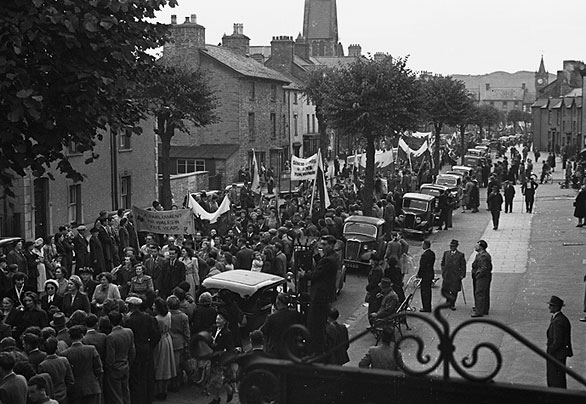
On 5 August 1925, during the National Eisteddfod week in Pwllheli, Gwynedd, a group of six Welsh nationalists met to formally establish Plaid Genedlaethol Cymru (The National Party of Wales), later known as Plaid Cymru.
***
The party emerged from the fusion of two existing nationalist groups: Byddin Ymreolwyr Cymru (Army of Welsh Home Rulers) and Y Mudiad Cymreig (The Welsh Movement). Key figures at the founding meeting included the writer and academic Saunders Lewis, H. R. Jones, Ambrose Bebb, Lewis Valentine, and D. J. Williams.
Valentine was elected as the party’s first president, holding the post until 1926. Lewis served as president from 1926 to 1939.
Plaid Genedlaethol Cymru was unafraid to assert a distinct Welsh cultural and political identity. The setting of the National Eisteddfod, Wales’ premier cultural festival, reflected the party’s initial emphasis on cultural nationalism. The party adopted Welsh as its working language, and aimed to restore Welsh as the primary language of the nation.
In its early years, the party functioned more as a cultural and social pressure group than a conventional electoral machine. Its initial electoral impact was minimal; in the 1929 general election, its candidate in Caernarvonshire, Valentine, polled just 609 votes (1.6%).
Ideologically, the party was a broad church, attracting members from the left, right and centre, as well as both monarchists and republicans. Saunders Lewis, for example, was avowedly anti-socialist.
By the 1930s, the party had adopted the goal of securing self-government for Wales, or ‘dominion status’, akin to that achieved by the Irish Free State in 1922.
A defining moment for the party arrived in 1936 with the Tân yn Llŷn (Fire in Llŷn) incident. The British government, led by Stanley Baldwin, decided to build an RAF air base on the Llŷn Peninsula despite widespread protests. On 8 September 1936, Lewis, Valentine and Williams claimed responsibility for setting fire to the site. They were sentenced to nine months in prison.
The episode became a cause célèbre, heightening the party’s profile.
Speaking in court, Lewis defended the collective’s actions as “forced upon us… in obedience to conscience and to the moral law”.
He said his primary motive was the preservation of the Llŷn peninsula as “an essential focus of this Welsh culture.”
Lewis likened the “English government’s behaviour” to that of “the behaviour of this new anti-Christ throughout Europe”.
He declared: “If you find us guilty the world will understand that here also in Wales an English government may destroy the moral person of a nation, may shatter the spiritual basis of that nation’s life, may refuse to consider or give heed to any appeal even from the united religious leaders of the whole country, and then may use the law to punish with imprisonment the men who put those monstrous claims of anti-Christ to the test.”
Plaid Cymru officially adopted a neutral stance during the Second World War – partly on account of its pacifistic elements, partly due to its opposition to the British state.
However, while the party was associated with conscientious objection, several members – including leading figures like Bebb – were outspoken in their support for the war.
Lewis’ antisemitism and apparent praise for Hitler became targets for the party’s opponents.
The British state is said to have monitored Plaid Cymru’s activities during the war.
***
In 1943, Lewis contested the University of Wales parliamentary seat at a by-election. He won 1,330 votes, or 22%. Gwenan Jones, the first woman to stand for Plaid Cymru in a general election, won 1,696 votes in the same University of Wales constituency two years later.
Plaid Cymru’s first parliamentary breakthrough came in 1966, when Gwynfor Evans, the party’s president since 1945, won the Carmarthen by-election.
The July 1966 by-election produced a political earthquake. Evans secured 16,179 votes (39.0%), defeating Labour’s Gwilym Davies (13,743 votes, 33.1%) with a majority of 2,436. The swing from Labour to Plaid Cymru was a significant 12.0 points.
Evans’s victory was a watershed moment for Plaid Cymru. It marked the arrival of Welsh nationalism as a significant electoral force, and provided a major boost for the Welsh language movement.
Plaid Cymru’s Carmarthen breakthrough in 1966 was viewed in conjunction with the electoral advance of the Scottish National Party (SNP), which won a similarly symbolic by-election victory in Hamilton the following year.
The new nationalist members were greeted with significant hostility, but their victories were watched closely by Harold Wilson’s Labour government. The prime minister responded with the announcement of a royal commission in 1969, with a remit to consider Britain’s constitutional framework and devolution.
Reporting in 1973, the ‘Kilbrandon commission’ recommended legislative devolution for Scotland and Wales in the form of elected assemblies. The findings led directly to the 1978 Scotland and Wales Acts, and the failed referendums that followed.

Politics.co.uk Newsletters
DAILY
Politics@Lunch
WEEKLY
Week in Review