Equal Franchise Act grants women vote on same terms as men
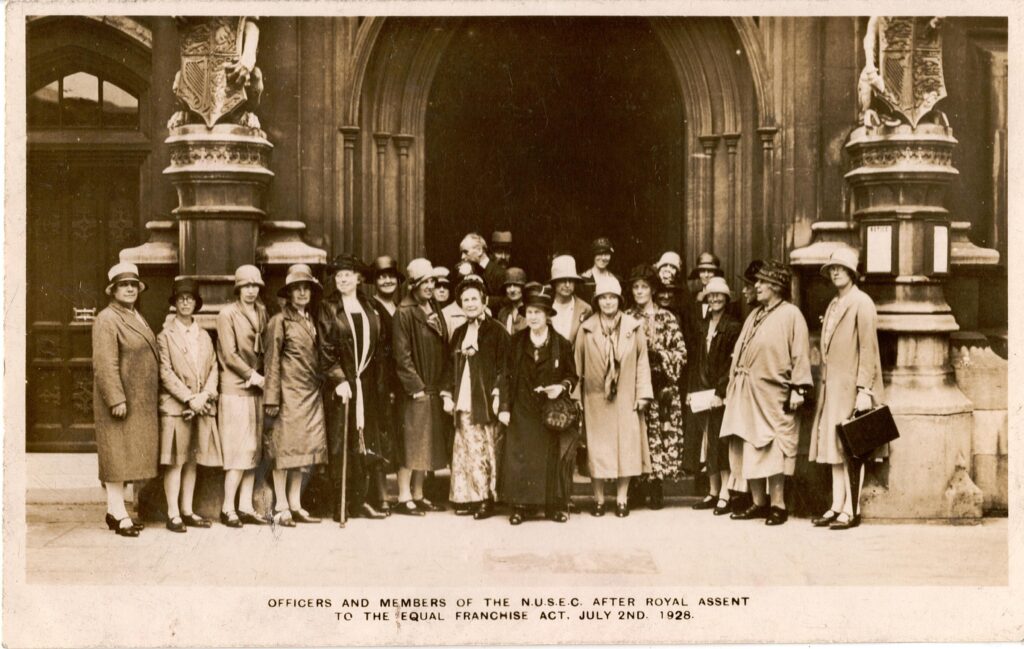
The Representation of the People (Equal Franchise) Act received Royal Assent on 2 July 1928. The act granted the vote to all women over the age of 21, on the same terms as men, and in doing so established universal adult suffrage in the United Kingdom for the first time.
The legislation, passed by Stanley Baldwin’s Conservative government, rectified the anomalies of the previous 1918 Representation of the People Act. The earlier act had been a landmark, enfranchising women for the first time – but it had created a two-tier electoral system, granting the vote only to women over the age of 30 who met a property qualification.
***
The Parliament (Qualification of Women) Act 1918 had given women over 21 the right to stand for election as an MP – but not the right to vote.
The Conservative Party won a landslide 209-seat majority at the 1924 general election, in which it had campaigned for “equal political rights for men and women”.
An election communication read: “The Unionist party is in favour of equal political rights for men and women, and desires that the question of an extension of the franchise should, if possible, be settled by agreement. With this view they would, if returned to power, propose that the matter be referred to a [speaker’s] conference of all political parties on the lines of the Ullswater Committee [a previous commission on London government].”
In the end, the Conservative government legislated without deferring first to a cross-party speaker’s conference – a processual point that offended some MPs during the bill’s passage.
The February 1928 king’s speech promised parliamentarians that proposals would “be brought before you for amending the law relating to the parliamentary and local government franchise.”
After the violent and bitter struggles of the pre-war period, the bill’s passage through parliament was surprisingly smooth. However, Winston Churchill, the chancellor of the exchequer, vehemently opposed the bill.
As a young man, Churchill had argued: “I shall unswervingly oppose this ridiculous movement (to give women the vote)… Once you give votes to the vast numbers of women who form the majority of the community, all power passes to their hands.”
But Churchill was in the minority in cabinet and, it turned out, in parliament.
Speaking at the bill’s second reading debate, the home secretary, Sir William Joynson-Hicks, argued the proposals were the “logical conclusion of a series of reform bills, beginning with that of [Great Reform Act] 1832.”
He added: “Although it is quite true that the Conservative Party, prior to 1832, opposed the extension of parliamentary reform, since 1832 it has joined with the other parties in the various extensions of the franchise which have been put before parliament.”
Addressing possible objections, Joynson-Hicks acknowledged the bill would create a female majority of around two million, but argued the “experiment” of women’s suffrage since 1918 had been “amply justified.”
He added: “A woman under 30 may enter the civil service, she may be a doctor, she may be a barrister: she is compelled to serve, if called on, as a juror. We have decided that, after 21, she is fit to hold the power of life and death in a criminal case in our courts of law.
“Are we to say to-day, nine years after that Act was passed, that she is not entitled, and she has not justified her claim, to vote for a Member of this House?”
The bill passed its second reading in the House of Commons by 387 votes to just 10.
For the veteran campaigners, it was a moment of profound triumph.
The suffragist leader Millicent Fawcett wrote in her diary on the day of the Act’s passage: “It is almost exactly 61 years ago since I heard John Stuart Mill introduce his suffrage amendment to the Reform Bill on 20 May 1867.
“So I have had extraordinary good luck in having seen the struggle from the beginning.”
***
The 1928 act added a further five million women to the electoral roll and made women a majority (52.7%) of the electorate for the subsequent general election. There were 14 million women eligible to vote compared with 11.25 million men.
The general election of May 1929 was often referred to as the ‘Flapper election’ due to the large numbers of newly enfranchised young women. The Daily Mail newspaper had previously ran a prominent campaign against the so-called “flapper vote”.
The 1929 election returned 287 Labour MPs (up 136) and 260 Conservative MPs (down 152).

Politics.co.uk Newsletters
DAILY
Politics@Lunch
WEEKLY
Week in Review
