Boris Johnson questioned by privileges committee over ‘Partygate’
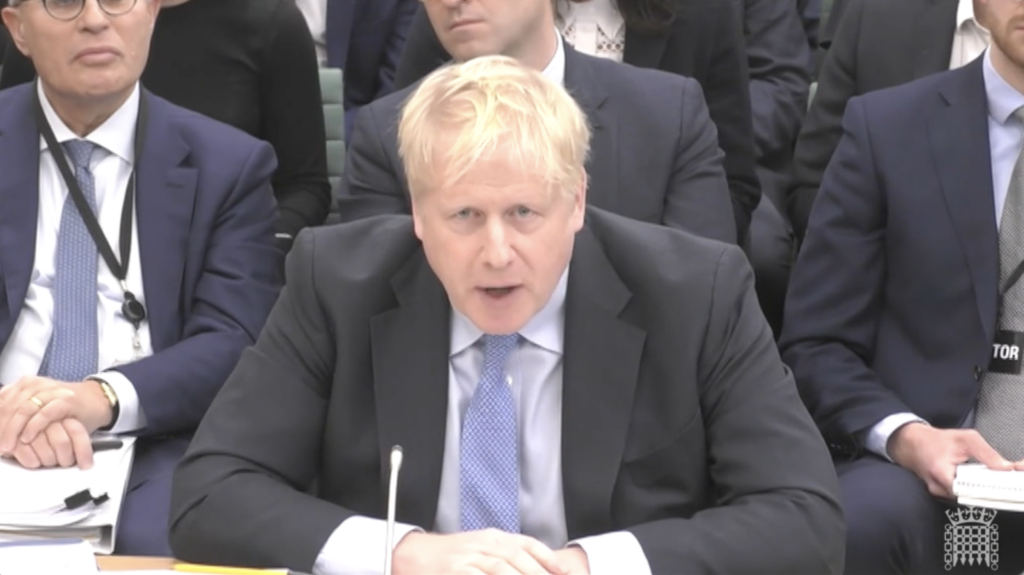
On 22 March 2023, the former prime minister, Boris Johnson, appeared before the House of Commons committee of privileges to face more than three hours of questioning over whether he had knowingly misled parliament about gatherings held in Downing Street during Covid-19 lockdowns.
The committee’s inquiry centred on statements Johnson had made to the commons in which he assured MPs that all pandemic rules and guidance had been followed in Downing Street.
Johnson first addressed the emerging Partygate scandal in the commons on 1 December 2021. It came after the Daily Mirror’s political editor, Pippa Crerar, reported that Johnson had broken rules with a series of Downing Street gatherings during the 2020 festive period.
But the prime minister insisted that no rules had been broken. He told MPs “that all guidance was followed completely in No 10”.
***
At the start of business on 19 April 2022, the speaker of the House of Commons, Lindsay Hoyle, announced that he would allow a debate to be held on a motion referring Johnson, then the prime minister, to the privileges committee. The speaker confirmed he had received letters from a number of MPs calling for this course of action, including the Labour leader of the opposition, Keir Starmer.
The matter, Hoyle said, concerned “the prime minister’s statements to the House regarding gatherings held at Downing Street and Whitehall during lockdown.”
Hoyle told the House: “I want to be clear about my role. First, as members will appreciate, it is not for me to police the ministerial code… My role is to decide whether there is an arguable case to be examined.
“Having considered the issue, and having taken advice from the clerks of the House, I have decided that this is a matter that I should allow the precedence accorded to issues of privilege.”
Hoyle’s actions were consistent with the rules of the House, which require that a matter of privilege must first be raised with the commons speaker. It is the speaker who has discretion to decide whether the matter should have the precedence accorded to matters of privilege – i.e. that the issue should be given priority over other business set down for debate. MPs then vote on a motion to refer the matter specifically to the committee of privileges for a full inquiry.
The commons subsequently debated a motion tabled by Starmer as leader of the opposition, calling for an investigation on 21 April 2022.
The motion noted “the issue of fixed penalty notices by the police in relation to events in 10 Downing Street and the Cabinet Office” and the prime minister’s assertions on the floor of the House, including that “all guidance was followed in No 10”.
It ordered that “this matter be referred to the committee of privileges to consider whether the right honourable member’s conduct amounted to a contempt of the House”.
The motion was passed without a division.
***
As part of its investigation, the privileges committee focused on six gatherings between May 2020 and January 2021, and statements Johnson made to parliament about them: a gathering in the No 10 garden on 20 May 2020; Johnson’s birthday gathering on 19 June 2020; leaving celebrations on 13 November 2020, 27 November 2020 and 14 January 2021, and “cheese and wine” Friday night press office gatherings.
The privileges committee, unlike many other select committees, has the power “to order the attendance of any member before the committee and to require that specific documents or records in the possession of a member relating to its inquiries be laid before the committee or any sub-committee”.
Under these rules, Johnson was called before the cross-party MPs to deliver evidence under oath.
The televised evidence session in March 2023, some months after Johnson’s resignation as prime minister, provided a moment of unprecedented political drama.
In a combative and unapologetic performance, Johnson defended his statements, arguing that he had made them in good faith based on the advice he had been given by his officials. Having previously accepted that he delivered misleading comments in the commons, he insisted any such statements were delivered unintentionally or inadvertently.
In his opening statement, Johnson told the committee: “I am here to say to you, hand on heart, that I did not lie to the House. When those statements were made, they were made in good faith, and on the basis of what I honestly knew and believed at the time.
“When this inquiry was set up, I was completely confident that you would find nothing to show I knew or believed anything else, as indeed you have not. I was confident not because there has been some kind of cover-up; I was confident because I knew that is what I believed, and that is why I said it.”
He denied having “knowingly or recklessly” deceived the House in December 2021, arguing that he spoke “in good faith, based on what I honestly knew and reasonably believed at the time.”
The former prime minister also questioned the integrity of the committee, including its chair, senior Labour MP Harriet Harman. Harman was standing in for Labour MP Chris Bryant, who had recused himself due to his well-publicised criticisms of Johnson.
Johnson declared: “I have the utmost respect for you, the chair, but you have said some things about this matter before reading the evidence which are plainly and wrongly prejudicial, or prejudge, the very issue on which you are adjudicating.
“I am going to put your earlier remarks down to the general cut and thrust of politics, and trust in what you have stressed at the outset: the impartiality that the Committee insists upon in your report.”
The Conservative-majority committee repeatedly challenged Johnson’s defence.
***
On 9 June 2023, Johnson announced his resignation as an MP after receiving a draft of the committee’s final report. In a statement, the former prime minister Johnson branded the committee a “kangaroo court” and claimed its year-long inquiry had delivered “what is intended to be the final knife-thrust in a protracted political assassination”.
The 106-page final report of the privileges committee, published a week later on 15 June 2023, found that Johnson committed “repeated contempts of parliament”.
The report also accused Johnson of having “breached the confidence” of the privileges committee by discussing its draft findings prior to their publication. The former prime minister was accused of being complicit in a “campaign of abuse and intimidation of the committee.”
The committee’s report stated that had Johnson remained an MP, it would have recommended that he be suspended from the House of Commons for 90 days. This proposal, subject to approval by a vote of the commons, would have triggered a recall petition in Johnson’s Uxbridge and South Ruislip constituency under the Recall of MPs Act 2015, and possibly a by-election.
On 19 June, the House of Commons endorsed the report by 354 votes to 7, with a large number of abstentions. Rishi Sunak, the serving prime minister, was among those who abstained. The then-PM maintained that he had other commitments.
The Conservative MPs who voted against the report were Desmond Swayne, Bill Cash, Nick Fletcher, Adam Holloway, Karl McCartney, Joy Morrissey and Heather Wheeler.
The committee subsequently published a special report on 29 June, concerning a “co-ordinated campaign of interference” in its work. This report named several Johnson allies, including former ministers Priti Patel, Jacob Rees-Mogg and Nadine Dorries, accusing them of attempting to undermine the committee’s credibility and influence the outcome of the inquiry.
The report stated: “Free speech is at the heart of parliamentary democracy. However, members who, while an inquiry involving individual conduct is in progress, attack the honesty or the integrity of the committee, or attack the process itself in a way clearly aimed at discrediting the committee or steering the committee towards a particular outcome, are interfering in disciplinary proceedings set up by the House in a way that is unacceptable.”
Lord Goldsmith, a longstanding Johnson ally and Foreign Office minister, was also named. Goldsmith had said that “evidence was totally irrelevant” to the committee’s original report.
Labour and the Liberal Democrats called for Goldsmith to be dismissed in light of the special report.
On 30 June, Goldsmith resigned from his ministerial position. He did not refer to the committee’s investigation, instead citing Sunak’s “apathy” over climate change. In his reply, Sunak said the former minister had been asked to apologise for comments he made about the privileges committee.
The prime minister wrote: “You were asked to apologise for your comments about the privileges committee as we felt they were incompatible with your position as a minister of the Crown. You have decided to take a different course.”
Goldsmith denied this.
Politics.co.uk Newsletters
DAILY
Politics@Lunch
WEEKLY
Week in Review