Macmillan purges cabinet in ruthless ‘Night of the Long Knives’ reshuffle
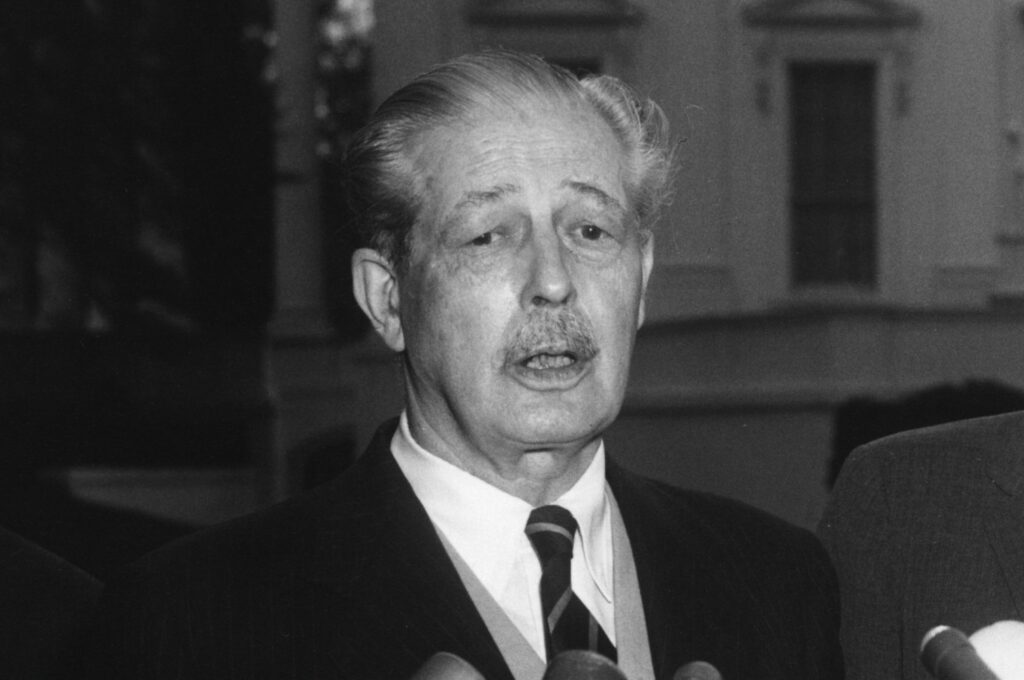
On 13 July 1962, the prime minister, Harold Macmillan, carried out what is often cited as the most brutal cabinet reshuffle in modern British political history, sacking seven senior ministers – a third of his cabinet – in a single day. The purge, which became known as the ‘Night of the Long Knives’, was a gamble to revitalise his increasingly unpopular Conservative government.
By mid-1962, Macmillan’s government, in power since 1957, was facing mounting political difficulties. A series of poor by-election results had culminated in the loss of Leicester North East to Labour on 12 July; the Conservative share of the vote dropped from 48.1% in 1959 to 24.2%, landing the party in third behind Labour and the Liberals.
Macmillan felt radical action was needed to refresh the government’s image ahead of the next general election. His primary target was the chancellor, Selwyn Lloyd, whose unpopular deflationary economic policy – symbolised by the ‘pay pause’ of July 1961 – was widely blamed for the government’s slump. Macmillan intended to replace him with Reginald Maudling, who favoured a more expansionist approach.
***
Macmillan agreed the details of the reshuffle with Rab Butler, the home secretary, and Iain Macleod, commons leader and Conservative Party chairman.
However, the reshuffle was thrown into turmoil after Butler leaked the details of “Mac’s Master Plan” to the Daily Mail. The prime minister felt compelled to press ahead with the ministerial changes, fearful of a conspiracy to undermine his premiership. Lloyd, then in attendance at a Buckingham Palace reception, was summoned and summarily sacked.
Over the course of Friday 13 July, Macmillan summoned the targeted ministers to Admiralty House (Downing Street was under renovation) and dismissed them. Alongside Lloyd, those dismissed from cabinet were the lord chancellor, Viscount Kilmuir; the education minister, Sir David Eccles; the defence minister, Harold Watkinson; the secretary of state for Scotland, John Maclay; and Lord Mills as a minister without portfolio.
The speed and scale of the changes shocked Westminster. Liberal MP Jeremy Thorpe observed that “Greater love hath no man than this, that he lay down his friends for his life”.
Macmillan, nicknamed ‘Supermac’ for his calm demeanour, was now dubbed ‘Mac the Knife’.
The ‘Night of the Long Knives’ title referred to Adolf Hitler’s 1934 purge of his political opponents in Ernst Rohm’s paramilitary SA.
Macleod suggested that the reshuffle was necessary as outgoing ministers had displayed “all the signs of tiredness that are not surprising when we have been in office so long”.
He added: “You may find that some people who were admirable leaders a few years ago have lost much of the zest that must be an essential part of our appeal. I’m sure, too, you will agree that it is only right that you should apply the same standard to yourself and to the other officers of your association.”
But Lloyd was widely viewed to have been treated badly. The former chancellor was cheered upon entering the commons on 17 July, a lowly backbencher in the wake of his sacking.
The prime minister’s reception from Conservative MPs was rather cooler.
In a question referring to nuclear testing, Labour MP Roy Mason asked the prime minister: “Would it not appear that the press also had seismological detectors in Whitehall last week in order to assess the rumblings that were taking place there?”
Notably, several of Macmillan’s ministerial victims were subsequently mollified with peerages. The prime minister offered the outgoing chancellor, Lloyd, a peerage. While Lloyd, the highest profile casualty of the purge, rejected the gong, he was nonetheless appointed as a member of the Order of the Companions of Honour – alongside Harold Watkinson, the outgoing defence minister.
Viscount Kilmuir, who was dismissed as lord chancellor, was elevated in the peerage to an earldom. The education minister, David Eccles, was raised to the peerage as Baron Eccles. Lord Mills, who left his post as a minister without portfolio, was soon created a viscount.
***
The Labour frontbench responded with a motion of censure against Macmillan, which was debated on 26 July.
Hugh Gaitskell, the Labour leader of the opposition, denigrated the reshuffle as a “convincing confession of failure” driven by a series of by-election defeats.
Gaitskell observed that while “in all governments incompetent ministers are from time to time dismissed”, he was not aware of any precedent “for the removal of no fewer than seven ministers, one-third of the whole of the cabinet”.
The Labour leader stated: “How and why did all this happen? As to why, there is really no doubt that this was the act of a desperate man in a desperate situation, and the desperate situation was the steady, remorseless and steep decline of the Conservative Party’s fortunes in by-election after by-election.”
Gaitskell further referred to Macleod’s justification regarding fatigue.
He responded: “If this is the explanation, there is one question which follows: why did the prime minister stop at seven?
“What about the leader of the House himself? He does not always strike us as being flowing over with buoyancy and ebullience… To tell the truth, I must say that the former chancellor of the exchequer looks far more ruddy and healthy and wide awake than any of these ministers.”
Gaitskell concluded: “His government will be remembered not for the leadership they gave the nation, but as a conspiracy to retain power. Men and measures have been equally sacrificed for this purpose.
“That is why we call it a government of gimmicks, an administration of ad-men.”
Macmillan hit back at the “contradictory accusations” made of his premiership, having been blamed for both “excessive loyalty” and, now, for taking “violent action in a moment of panic”.
In his address, the prime minister paid tribute to Lloyd for the “courage, single mindedness and patriotism that he has shown.”
He added: “Last July, with my full support, he embarked upon an operation made necessary by the fierce pressures on sterling which were then being developed. That phase of the battle is over. We have achieved a sound basis for growth and we must confirm that and move to a new phase.
“I have decided that for this new phase there must be some new commanders. These decisions are, as all those who have held this office know, one of the greatest burdens that fall upon a prime minister.”
Gaitskell’s motion of censure was ultimately rejected by 351 votes to 253.
***
In the immediate aftermath of the sweeping reshuffle. Macmillan’s personal approval ratings declined. But his standing, among his party and the public, recovered over time. Indeed, despite the immediate political damage, the reshuffle achieved its core objective. As chancellor, Maudling promptly reversed his predecessor’s austerity measures. The government’s reflationary policy was later linked to the decline in Liberal fortunes – which previously peaked at the 1962 Orpington by-election.
With his reshuffle, Macmillan also constructed a markedly younger, more energetic cabinet.
In the end, Macmillan lasted another 18 months in Downing Street. He resigned in October 1963, following a period of ill-health and the shocking revelations of the Vassal and Profumo scandals.
Lloyd returned to cabinet during Alec Douglas-Home’s tenure as prime minister (1963 to 1964). He was subsequently elected speaker of the House of Commons, serving from 1971 to 1976.
Douglas-Home led the Conservative Party to a narrow defeat at the 1964 general election. Labour, led by Harold Wilson after Gaitskell’s passing, won a slight majority of just four seats.
Some years later, Macmillan said of his infamous reshuffle: “I don’t like the expression sacked. I prefer replaced. But I thought in the new economic situation we wanted a less tired mind. Selwyn [Lloyd] had been a splendid minister for a solid eight years.
“I felt he was not creative any more, therefore I wanted a new man at the Treasury and a younger man.”

Politics.co.uk Newsletters
DAILY
Politics@Lunch
WEEKLY
Week in Review