King John seals Magna Carta at Runnymede
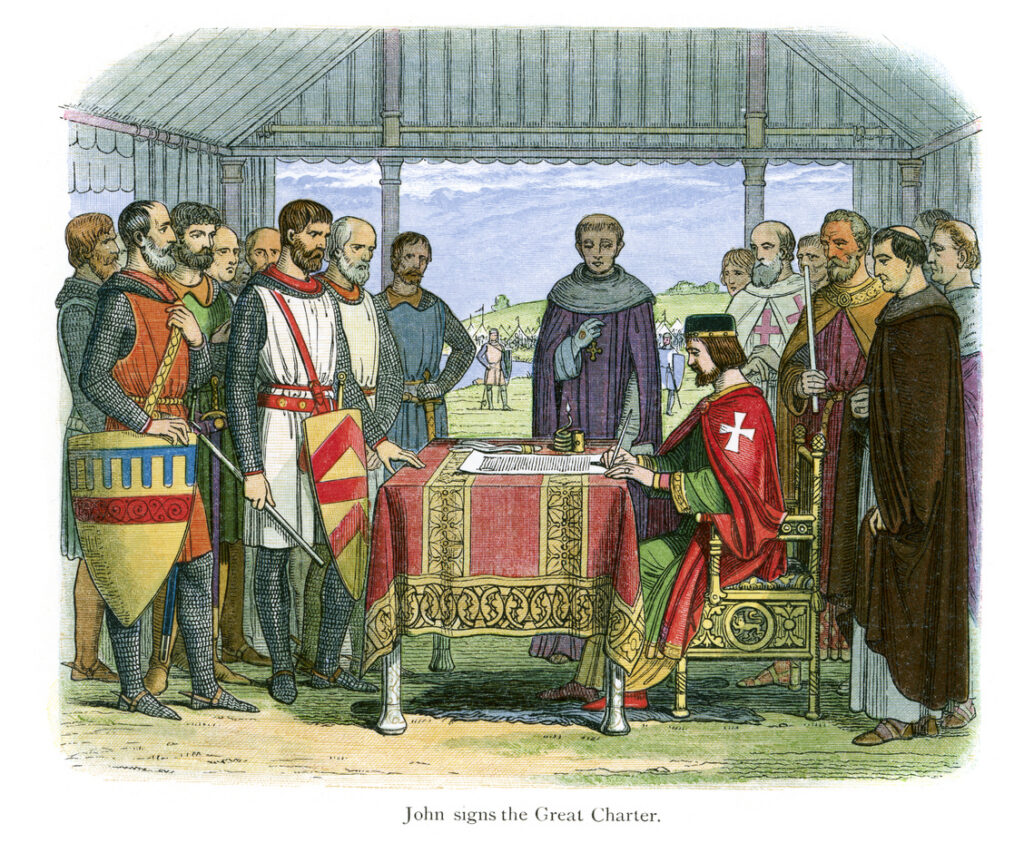
On 15 June 1215, in a meadow at Runnymede on the bank of the River Thames, King John was compelled by his rebellious barons to seal Magna Carta, a peace settlement that placed limits on royal power.
***
King John was a deeply unpopular monarch. His failed attempt to regain lost ancestral lands in France, culminating in his decisive defeat at the Battle of Bouvines in 1214, had been funded by years of high and arbitrary taxation. A 1212 baronial conspiracy to assassinate the king was foiled. But disaffection did not dissipate. Upon returning to England in May 1214, with nothing to show for his campaigns in France, John faced an armed revolt.
The rebel barons appointed Robert Fitzwalter, who had been implicated in the 1212 plot, as their military leader. The agitators captured London in May 1215 and the king was forced to the negotiating table. What followed was a symbolic settlement, by all accounts a peace treaty – but one in which the ruling monarch recognised the rights, privileges and liberties of his noble subjects.
Magna Carta, the product of five days of intensive negotiations at Runnymede, was designed to protect the feudal rights of free men. Its 63 clauses placed restrictions on the king’s ability to levy taxes without baronial consent, protected the church from royal interference, and sought to prevent abuses of justice by the king’s officials.
Clause 39 of the ‘the Charter of Runnymede’ stated that no “freemen shall be taken or imprisoned or disseised or exiled or in any way destroyed, nor will we go upon him nor send upon him, except by the lawful judgment of his peers or by the law of the land.”
Clause 40 declared: “To no one will we sell, to no one will we refuse or delay, right or justice.”
Clause 61, the so-called ‘security clause’, provided for a council of barons a means by which to monitor John’s adherence. It was agreed that the barons would elect 25 of their number “who shall be bound with all their might, to observe and hold, and cause to be observed, the peace and liberties we have granted and confirmed to them by this our present Charter.”
Any infringements on the terms of the charter, if redress was not forthcoming within 40 days, would serve as justification for the council in seizing “castles, lands, possessions, and in any other way they can, until redress has been obtained as they deem fit, saving harmless our own person, and the persons of our queen and children; and when redress has been obtained, they shall resume their old relations towards us.”
This explosive clause legitimised organised resistance to the king, were he found guilty of transgressions, providing a formal, royally-sanctioned formula by which the barons could acquire satisfaction.
***
Upon the sealing of Magna Carta, the barons renewed their previously forsaken oaths of fealty to John.
But the peace treaty was a failure. Within weeks, Pope Innocent III annulled the charter, dismissing it as a “shameful and demeaning” infringement of kingly authority.
Historians have viewed the breakdown of the treaty as inevitable, given the lack of trust and the charter’s strict provisions. The 25 baronial representatives elected to scrutinise the king were some of his most virulent opponents (including Fitzwalter).
England subsequently descended into the First Barons’ War. While John died of dysentery contracted while on campaign in eastern England in late 1216, his son, Henry III, successfully broke the stalemate and suppressed the rebel barons.
***
Magna Carta was a short-lived social contract. But its significance as a symbol of lawful rule is measured in centuries. This nominal peace treaty, in establishing that the sovereign was subject to the rule of law, codified principles that Britons suffering under despotism would cite for centuries to come.
Reformers, radicals and revolutionaries revered the document for having established a tradition of liberty. In particular, it helped inspire collisions with arbitrary governance in the 17th and 18th centuries.
Magna Carta arguably remains relevant in a modern context.
In March 2001, four modern-day barons – the Duke of Rutland, Viscount Masserene and Ferrard, Lord Ashbourne and Lord Hamilton of Dalzell – sought to use the provisions of Magna Carta to persuade the Queen to withhold the royal assent from a bill ratifying the Treaty of Nice.
Asserting their ancient rights, the barons believed that European integration conflicted with Magna Carta’s prescriptions.
The four rebel barons petitioned the monarch of the grievances under Clause 61 of Magna Carta. However, with 40 days having elapsed and with no redress in sight, the barons did not revolt against Queen Elizabeth II’s rule.

Politics.co.uk Newsletters
DAILY
Politics@Lunch
WEEKLY
Week in Review
