Keir Starmer elected Labour leader in decisive victory
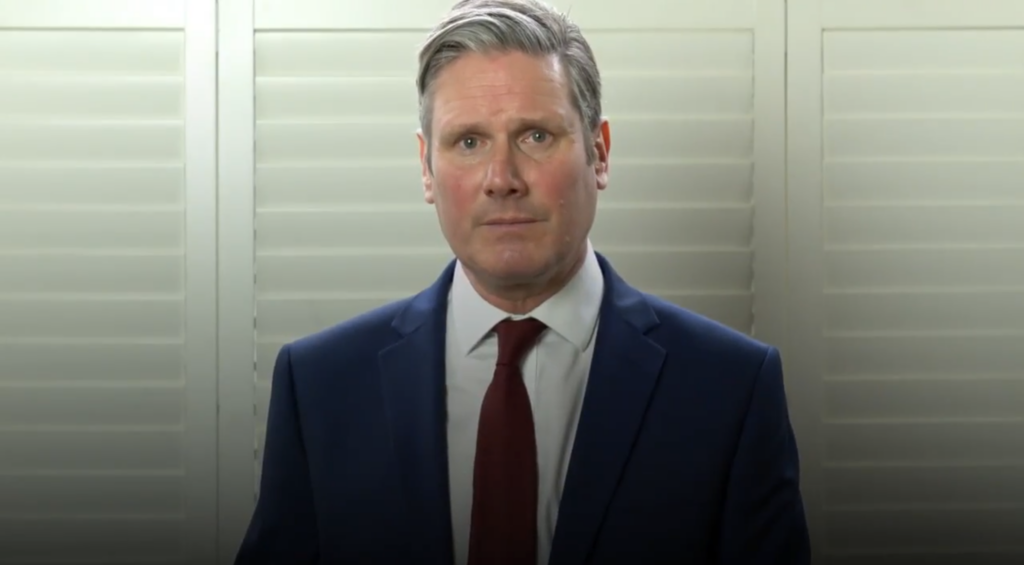
On 4 April 2020, Keir Starmer was elected leader of the Labour Party. The result, announced in a scaled-back virtual event due to the Covid-19 pandemic, saw Starmer defeat his rivals Rebecca Long-Bailey and Lisa Nandy overwhelmingly in the first round of voting.
The leadership contest was triggered by Jeremy Corbyn’s resignation following Labour’s catastrophic defeat at the 2019 general election – the party’s worst since 1935. Labour returned just 202 MPs.
***
Prior to entering politics, Starmer had a distinguished legal career as a human rights barrister and served as Director of Public Prosecutions (DPP) and head of the Crown Prosecution Service (CPS) from 2008 to 2013, for which he was knighted in 2014. He was first elected as the MP for Holborn and St Pancras in 2015.
The process for electing the leader of the Labour Party is set out in the party’s official rule book. (The deputy leader election rules follow the same format.) In the event of a vacancy, candidates (who must be MPs) needed to secure nominations from 10% of Labour MPs and MEPs. (This threshold was increased to 20% following a rule change at the party conference in 2021.)
A candidate also needs nominations from either 5% of Constituency Labour Parties (CLPs) or at least three affiliated organisations (of which at least two must be trade unions) whose combined membership is at least 5% of the total affiliated membership. Candidates who reach the nomination threshold are then subjected to a vote of eligible party members and members of affiliated organisations. Members vote using the instant-runoff preferential voting system.
Starmer, the then shadow Brexit secretary, received the most nominations from MPs and MEPs at 88.
Long-Bailey, the shadow business secretary and widely regarded as the continuity candidate for the party’s left/Corbynite wing, won 33 nominations.
Nandy, a backbench critic of Corbyn, secured 31 nominations. During the campaign, Nandy argued that the party needed a “bridge” to reconnect with traditional working-class voters in northern England.
Emily Thornberry, then the shadow foreign secretary, was one of five candidates to reach the second stage of the contest. However, she was eliminated from the race on 15 February 2020 after failing to secure the required 33 nominations from Constituency Labour Parties (CLPs) or three affiliated groups. This left Starmer, Long-Bailey and Nandy as the three candidates on the final membership ballot.
Jess Phillips, who had been a prominent critic of Corbyn’s leadership of the Labour Party, withdrew from the contest on 21 January 2020, suggesting that she could not “unite all parts of our movement”.
Clive Lewis, the shadow minister for sustainable economics, withdrew from the contest shortly before the nominations deadline, having fallen well short of the 22 threshold required to reach the next stage.
During the election campaign that followed, Starmer claimed that Corbyn was “right” to position Labour as the “party of anti-austerity”. He outlined 10 pledges that collectively comprised a Corbyn-lite platform.
In the end, Starmer secured 275,780 votes (56.2%), running on a platform of unity and competence. Long-Bailey placed second with 135,218 votes (27.6%). Nandy won 79,597 votes (16.2%).
The turnout, from a total of 784,181 eligible voters, was 62.6%.
Angela Rayner was also elected as the new deputy leader, winning the contest with 52.6% of the vote in the third round. Labour MPs Rosena Allin-Khan and Richard Burgon finished second and third respectively.
***
Speaking after the result, Starmer said it was an “honour and the privilege of my life to be elected as leader of the Labour Party.”
He vowed to “engage constructively with the government, not opposition for opposition’s sake” during the Covid crisis.
On 23 March 2020, the prime minister, Boris Johnson, delivered his famous television broadcast, declaring a blanket stay-at-home order. Johnson announced that to stop the “invisible killer” from spreading between households, the British people were required to stay at home, with only four strictly limited exceptions.
Starmer’s victory was therefore conducted in the shadow of the Covid crisis.
The new Labour leader said he would not score political points or make “impossible demands.”
He added: “But we will test the arguments that are put forward. We will shine a torch on critical issues and where we see mistakes or faltering government or things not happening as quickly as they should we’ll challenge that and call that out.”
He thanked “Rebecca and Lisa for running such passionate and powerful campaigns and for their friendship and support along the way.”
Starmer also paid tribute to his predecessor, Corbyn, who he described as a “friend as well as a colleague.”
But the Labour leader vowed to face the “future with honesty”.
He declared: “We’ve just lost four elections in a row. We’re failing in our historic purpose… Be in no doubt I understand the scale of the task, the gravity of the position that we’re in.
“We’ve got a mountain to climb, but we will climb it, and I will do my utmost to reconnect us across the country, to re-engage with our communities and voters, to establish a coalition across our towns and our cities and our regions with all creeds and communities to speak for the whole of the country.
“Where that requires change, we will change. Where that requires us to rethink, we will rethink.”
Starmer concluded: “I will lead this great party into a new era, with confidence and with hope. So that when the time comes, we can serve our country again in government.”
***
The relationship between Starmer and his newly elected deputy leader, Angela Rayner, was initially said to be strained. In 2023, Rayner described her relationship with the Labour leader as an “arranged marriage”.
She said: “I often talk about it as an arranged marriage. We were both elected by the membership differently and independently. We work constructively together.”
In September 2021, Rayner was criticised for reportedly referring to Conservative ministers as a “bunch of scum” at a Labour conference reception. According to the Daily Mirror, she told the event on Saturday night: “We cannot get any worse than a bunch of scum, homophobic, racist, misogynistic, absolute vile… banana republic, vile, nasty, Etonian… piece of scum.”
At first, Rayner defended the comments, saying she was trying to convey in a “passionate way” the “anger and frustration that people feel when you have a prime minister, who has said things and not apologised that are racist, that are misogynistic, that are homophobic, that has given billions of pounds of taxpayers’ money to their mates and literally wasted that money”.
Starmer, however, said that Rayner had deployed “not language that I would use.”
In October, Rayner apologised for the remarks, saying that she had since reflected on “our political debate” and the “abuse that now seems to feature all too often”.
Rayner was criticised for allegedly using similar language in the House of Commons chamber in October 2020. Conservative MP Chris Clarkson said he heard Rayner use the term “scum” after he had accused Labour of “opportunism”.
Dame Eleanor Laing, the commons deputy speaker, told Rayner that she should not deliver “remarks like that – not under any circumstances.” The Labour deputy leader responded in the chamber by calling on Clarkson to withdraw “inaccurate” comments. She later issued a statement, saying: “I apologise for the language that I used in a heated debate in parliament earlier.” The confrontation came after Rayner revealed that her aunt had died from Coronavirus.
Rayner held a series of roles on Starmer’s frontbench during his tenure as leader of the opposition.
Initially, Rayner served as chair of the Labour Party and national campaign co-ordinator from April 2020 to May 2021. Following disappointing local election results for Labour in May 2021, Starmer moved Rayner from these roles in a reshuffle and attempted to demote his deputy.
However, Rayner and her allies resisted attempts to demote her. She eventually secured a host of senior roles, including shadow chancellor of the Duchy of Lancaster and shadow secretary of state for the future of work. She was also retained in the role of shadow first secretary of state (appointed April 2020).
Rayner therefore emerged with a 24-word job title as deputy leader, shadow first secretary of state, shadow chancellor of the Duchy of Lancaster and shadow secretary of state for the future of work. She held this elaborate job-description from May 2021 to September 2023.
In a further reshuffle in September 2023, Rayner was appointed as shadow deputy prime minister and shadow secretary of state for levelling up, housing and communities.
In May 2024, during the general election campaign, Rayner insisted that she and Starmer now “get on really well”, adding: “I think in the early days we were a bit yin and yang.”
She told the Daily Record: “I’m a bit Northern, aren’t I, and loud, and Keir’s from the south and he’s not quite as loud. I would say I am an extrovert and Keir’s an introvert.”
***
Starmer’s election in 2020 ultimately represented an ideological and strategic shift for the party.
From 2020 until his election as prime minister in 2024, Starmer signalled a series of symbolic breaks with Corbyn’s tumultuous tenure. After barring Corbyn from standing as a Labour candidate, he celebrated the “changed” nature of his Labour Party.
Long-Bailey was dismissed as shadow education secretary in June 2020. The stated reason was her sharing, on social media, of an interview with the actor Maxine Peake which contained an alleged antisemitic trope regarding Israeli state actors and US police tactics. Long-Bailey stated she did not endorse all aspects of the article.
In a statement, Long-Bailey said: “Today I retweeted an interview that my constituent and stalwart Labour Party supporter Maxine Peake gave to the Independent. Its main thrust was anger with the Conservative government’s handling of the current emergency and a call for Labour Party unity.”
She added: “In no way was my retweet an intention to endorse every part of that article.
“I wished to acknowledge these concerns and duly issued a clarification of my retweet, with the wording agreed in advance by the Labour Party Leader’s Office, but after posting I was subsequently instructed to take both this agreed clarification and my original retweet down…
“I could not do this in good conscience without the issuing of a press statement of clarification. I had asked to discuss these matters with Keir before agreeing what further action to take, but sadly he had already made his decision.”
Nandy was appointed as shadow foreign secretary in the wake of the 2020 contest, but was soon subjected to successive demotions.
The 2024 general election resulted in a spectacular landslide victory for Starmer’s Labour Party, bringing 14 years of Conservative government to a definitive end. Labour secured 411 seats and a commanding House of Commons majority of 174.
But Labour’s vote was spread widely and thinly throughout the country. The party’s landslide victory came on a vote share of 33.7% – the lowest vote share of any majority government in British history. Labour’s vote only increased by 1.6 points compared to their historic defeat in 2019.
In his first speech as prime minister, Starmer said his government would rebuild hope and opportunity in the UK “brick-by-brick” and would show voters that “politics can be a force for good.”
***
From 2024 to 2026, a series of missteps increased tension in the parliamentary Labour Party and eroded confidence in Starmer’s leadership. The decision to cut the winter fuel payment, which was announced in the weeks following the 2024 general election, provoked a considerable backlash. Starmer’s position was further weakened by the June/July 2025 welfare bill revolt and the Peter Mandelson vetting scandal.
In September 2025, Rayner resigned as deputy prime minister and secretary of state for housing, communities and local government, following an inquiry into her tax affairs related to the purchase of a flat in Hove. The resignation came after the prime minister’s independent adviser on ministerial interests, Sir Laurie Magnus, concluded that she had failed to meet the “highest possible standards of proper conduct”.
The resignation was a significant blow to Starmer. It removed one of Labour’s most high-profile figures from the political frontline, triggering both a cabinet reshuffle and an internal election to fill the vacant deputy leadership post.
On the backbenches, Rayner helped broker a compromise at the height of the Mandelson affair (February 2026) over a humble address motion tabled by the opposition Conservative Party. It came after Labour MPs threatened to vote against a government amendment to the motion, which sought to limit the disclosure of internal papers and vetting materials. In the end, the government committed to hand power over the disclosures to the intelligence and security committee.
Also in February, Rayner publicly supported former mayor of Greater Manchester Andy Burnham’s candidacy ahead of the Gorton and Denton by-election. Burnham was ultimately blocked from standing by an 8-1 vote of the Labour national executive committee (NEC).
The May 2026 local elections and simultaneous elections to the devolved Scottish Parliament and Senedd Cymru sparked an intense political crisis as Labour MPs lined up to call on Starmer to step down/set out a timetable for his departure. In total, over 90 MPs called for Starmer to resign as prime minister.
On 10 May, Angela Rayner, the former deputy prime minister, issued a 1000-word statement criticising a “toxic culture of cronyism” at the top of the Labour Party. She called on the Labour Party to “live up to our name: we must be the party of working people” and for Starmer to “meet the moment and set out the change our country needs.”
Rayner also criticised the decision to block Burnham from standing in the Gorton and Denton by-election as a “mistake.”
On 22 June, Starmer announced his resignation as prime minister and Labour leader outside 10 Downing Street, becoming the sixth person to leave the office in 10 years. Starmer’s resignation as prime minister followed Burnham’s victory in the Makerfield by-election – a contest triggered (by the resignation of Josh Simons from parliament) at the height of the May 2026 crisis.

Politics.co.uk Newsletters
DAILY
Politics@Lunch
WEEKLY
Week in Review