Coronavirus Act grants government sweeping emergency powers
On 25 March 2020, the Coronavirus Act received royal assent, becoming law just days after its introduction to parliament. The act equipped the UK government and devolved administrations with some of the most extensive emergency powers in modern British history to manage the escalating Covid-19 pandemic.
The legislation, which was passed by the House of Commons in a single day, received cross-party support. No division (formal vote) was held during the bill’s rapid journey through parliament.
Its wide-ranging provisions gave ministers the authority to restrict public gatherings, close premises, postpone elections and direct the suspension of transport. It also gave police and public health officials powers to detain individuals deemed infectious.
The legislation duly provided the legal basis for the “lockdown” of citizens and businesses, which was announced on 23 March 2020 – coinciding with the bill’s commons stages. The act also temporarily relaxed some legal duties on local authorities for providing social care, allowed for the emergency registration of retired healthcare staff to support the NHS, and modified legal processes to allow for virtual court hearings.
The Department of Health and Social Care (DHSC) stated that these measures were “temporary, proportionate to the threat we face, will only be used when strictly necessary and be in place for as long as required to respond to the situation”.
However, the act was met with immediate concern from civil liberties groups. Big Brother Watch described the act as containing the “most draconian powers in peace-time Britain”. Amnesty International warned that “emergency powers can sometimes be misused, and this must not give a green light to trample on our basic human rights and liberties”.
***
Introducing the bill to the commons at second reading on 23 March, the health secretary, Matt Hancock, described Coronavirus as “the most serious public health emergency that has faced the world in a century.”
He added: “We are all targets, but the disease reserves its full cruelty for the weakest and the most vulnerable. To defeat it, we are proposing extraordinary measures of a kind never seen before in peacetime.
“Our goal is to protect life and to protect every part of the NHS. This bill, jointly agreed with all four UK governments, gives us the power to fight the virus with everything that we have.”
Hancock argued that the bill’s provisions were “proportionate to the threat we face” and that they would only be activated “on the basis of the best possible scientific evidence.”
He said the bill gave all four UK governments, including the devolved administrations, a “legislative and regulatory toolkit to respond in the right way at the right time by working through the action plan.”
He pointed to “strong powers” the bill gave the government “to restrict or prohibit events and public gatherings and, where necessary, to shut down premises”.
The health secretary added: “This part of the bill also allows us to close educational settings or childcare providers, and to postpone for one year elections that were due to take place in England in May.
“These are not measures anyone would want to take, but they are absolutely necessary in this crisis.”
Hancock concluded: “We ask for these powers as a whole to protect life. We will relinquish them as soon as the threat to life from coronavirus has passed. This bill means that we can do the right thing at the right time, guided by the best possible science.
“That science gets better every day. This disease can isolate us, but it cannot separate us from the ties that bind us together. With patience and resolve, with the painstaking use of data and evidence, and with the whole nation working together as one United Kingdom, we will get through this.”
Jeremy Hunt, the former health secretary, called for a move “to lockdown rules that ban non-essential travel.”
He told MPs: “It is time not just to ask people to do social distancing, but to enforce those social distancing rules – not next week, not this week, but right away.”
Jonathan Ashworth, the shadow health secretary, called on the government “to enforce social distancing and greater social protection as a matter of urgency.” He warned that “many people are not adhering to the type of social distancing that we expect.”
Ashworth also relayed harrowing reports from medical staff regarding shortages of personal protective equipment (PPE). He said he had received messages from doctors “telling us they feel like lambs to the slaughter because of failures in the distribution of protective kit”.
The shadow health secretary pledged his party’s support for the proposed legislation, while warning about the powers it granted ministers.
He told the House: “The bill contains the most draconian powers ever seen in peacetime Britain – powers to detain and test potentially infectious members of the public, including children, in isolation facilities; and powers to shut down gatherings, which could impede the ability to protest against the overall handling of the crisis or against the abuse of the powers themselves.”
Ashworth added: “Those words will chill every liberal and libertarian instinct of members across this House.”
Labour MP Chris Bryant hit out at panic-buying, describing the practice as a “disgrace”.
Bryant stated: “It is born out of selfishness and it must stop… The number of armchair epidemiologists and virologists in this country seems to have grown dramatically without any evidence of qualification.”
The bill was read a second time without a formal vote (division), reflecting unanimous agreement.
***
During the bill’s committee stage, the government introduced new clause 19, which mandated a parliamentary vote every six months to renew the technically temporary provisions.
Government amendment 52, meanwhile, provided legal protection for the deceased of Muslim and Jewish communities, requiring their wishes and faith to be shown “due regard” to prevent cremation. Originally, the bill included a provision simply enabling a local or national authority to direct whether a deceased person must be buried or cremated.
Conservative MP David Davis, a longtime civil liberties campaigner, argued that the bill was “guaranteed to have flaws, even with the best draftsmen in the world”. He spoke to an amendment to reduce the bill’s sunset clause from two years to one year, but ultimately did not press it to a division.
In the lead up to the debate, Davis told the Times that there was nobody who could “scrutinise a 300-page bill in one day.” He called for “an absolute, brick-wall stop on this legislation at 12 months.”
Conservative MP Steve Baker expressed his reluctant support for the bill, but said that it was ushering in a “dystopian society”.
Baker said: “When I look at this Pandora’s box of enlargement, discretion and extensions of power, I can only say what a dreadful, dreadful thing it is to have had to sit here in silence and nod it through because it is the right thing to do…
“Libertarian though I may be, this is the right thing to do but, my goodness, we ought not to allow this situation to endure one moment longer than is absolutely necessary.”
At 10:00 pm, all the bill’s clauses were put to a vote and passed by the committee of the whole House. In the minutes that followed, the bill was reported, read a third time and formally passed by the commons.
Overall, it took just hours for parliament to sign over unprecedented peacetime powers to the executive.
***
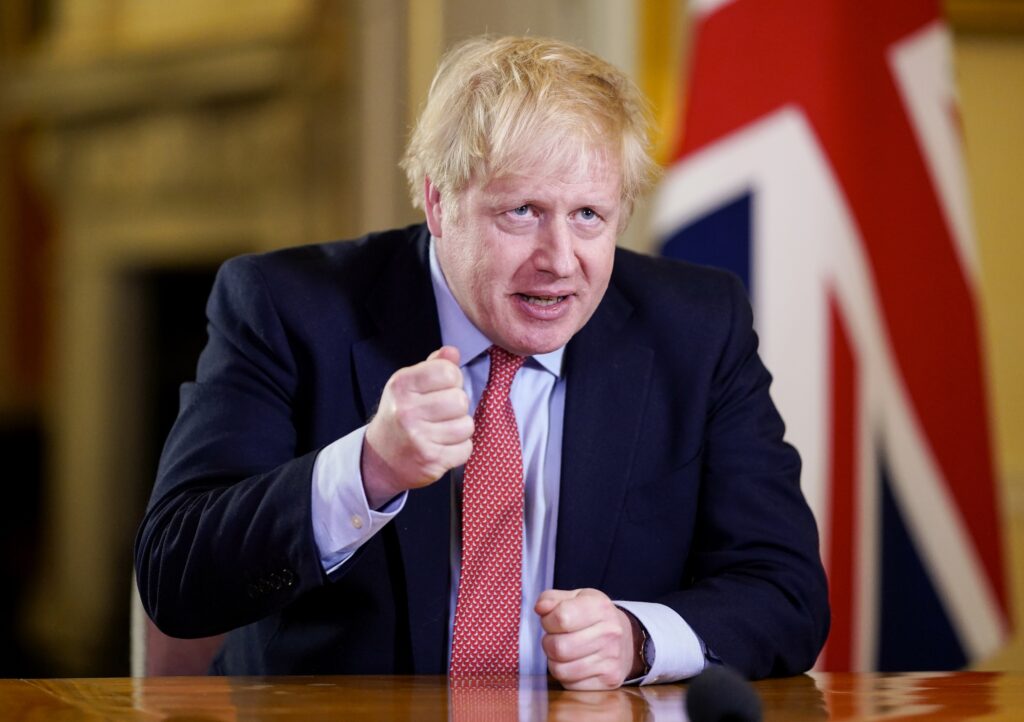
Notably, it was during the bill’s passage on 23 March that Boris Johnson delivered his famous television broadcast, declaring a blanket stay-at-home order. This development beyond the chamber only influenced the latter stages of the debate.
In his broadcast, Johnson announced that to stop the “invisible killer” from spreading between households, the British people were required to stay at home, with only four strictly limited exceptions.
The prime minister stated: “From this evening I must give the British people a very simple instruction – you must stay at home. Because the critical thing we must do is stop the disease spreading between households.”
The four exceptions were for shopping for basic necessities; one form of exercise a day; any medical need, to provide care or to help a vulnerable person; and travelling to and from work, but only where absolutely necessary.
To ensure the “stay at home” order was effective, the government moved to shut down the social and commercial life of the nation, closing all shops selling non-essential goods, stopping all gatherings of more than two people in public, and banning all social events, including weddings, baptisms and other ceremonies, but excluding funerals.
On 25 March 2021, MPs voted by 484 to 76 to extend the operation of the act. A total 36 Conservative MPs rebelled, while 21 Labour MPs also voted against it.
Many of the act’s most stringent powers were later suspended or revoked before it formally expired in 2022.

Politics.co.uk Newsletters
DAILY
Politics@Lunch
WEEKLY
Week in Review
