Heath government scrapes victory in key Common Market vote
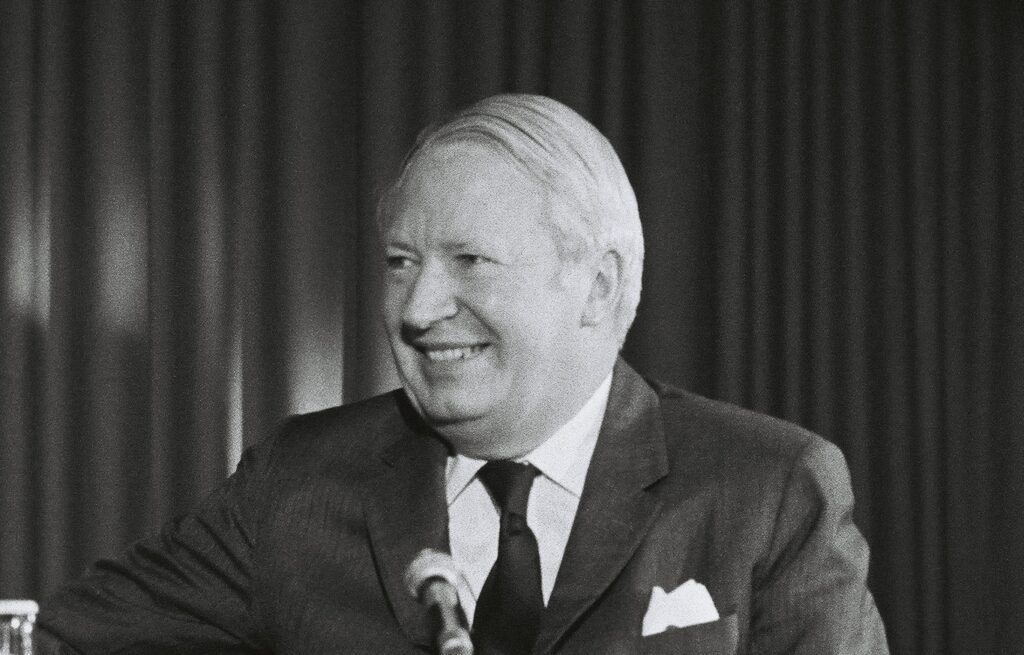
On 17 February 1972, Edward Heath’s Conservative government won a critical vote on the second reading of the European Communities Bill by a majority of just eight, securing its passage at second reading by 309 votes to 301, after three days of intense debate.
The vote marked the most significant parliamentary hurdle to the United Kingdom’s entry into the European Economic Community (EEC).
***
Heath committed his party to supporting Britain’s accession in the 1966 Conservative election manifesto, Action not Words. During that campaign, Labour leader Harold Wilson accused Heath of “rolling on his back” and submitting to the common market. “One word from the French government and the Conservative leader rolls over on his back like a spaniel”, Wilson said.
But it was during Wilson’s tenure that the UK launched its third bid to join the EEC in 1969. It came shortly after Charles de Gaulle’s resignation as French president. De Gaulle had vetoed Britain’s accession on two occasions in 1963 and 1967. De Gaulle’s successor, George Pompidou, was much more amenable to Britain’s entry.
Both parties went into the 1970 general election committed in principle to EEC membership.
The 1970 Conservative manifesto stated: “If we can negotiate the right terms, we believe that it would be in the long-term interest of the British people for Britain to join the European Economic Community, and that it would make a major contribution to both the prosperity and the security of our country.”
The forthcoming negotiations on Britain’s entry, the Labour manifesto outlined, would be “pressed with determination with the purpose of joining an enlarged community provided that British and essential Commonwealth interests can be safeguarded.”
Heath, whose Conservative Party won the 1970 general election, entered into negotiations with Pompidou. A meeting in May 1971 paved the way for Britain’s accession. Speaking after the summit, Heath said: “We both agree that it is not only desirable but possible for our negotiators to find solutions during June. The way is now open for them to do so.”
Wilson and the Labour leadership, seeking to navigate divisions between the party’s europhile and eurosceptic elements, came out in opposition to the “Tory terms” of accession negotiated by Heath. The party therefore opposed the European Communities Bill, while remaining committed to European accession in principle. In an interview in July 1971, Wilson said he regarded the terms as “unsatisfactory, inadequate, and indeed in certain respects, crippling for Britain.”
The Labour leader added: “I saw great advantage in joining the common market on the right terms, economic advantages and political advantages… but the terms must be right. The terms in my view are not right and throughout I made it clear it would depend on the terms.”
***
Heath made the second reading vote on the European Communities Bill a matter of confidence in his government. A defeat in the division lobbies, therefore, would have precipitated the downfall of the Heath government.
In an announcement shortly before the vote, Heath said: “I must tell the House that my colleagues and I are of one mind that the government cannot abdicate their responsibilities in this matter.
“Therefore, if this House will not agree to the second reading of the bill tonight and so refuses to give legislative effect to its own decision of principle, taken by a vast majority less than four months ago, my colleagues and I are unanimous that in these circumstances this parliament cannot sensibly continue.”
The debate exposed divisions over Europe within both major parties.
Among the most forceful opponents of entry was the Conservative MP Enoch Powell. He argued that as an “inherent consequence of accession to the Treaty of Rome” parliament would lose its legislative supremacy.
Powell declared: “It will no longer be true that law in this country is made only by or with the authority of Parliament-which in practice means the authority of this House. The legislative omni-competence of this House, its legislative sovereignty, has to be given up.”
The bill’s passage was secured by a combination of Liberal votes and a small group of pro-European Labour MPs, who defied their own party’s whip to vote by abstaining. A reported total of six Labour MPs abstained.
Labour’s europhile flank was led in spirit by Roy Jenkins, the party’s deputy leader. In October 1971, Jenkins had led 69 Labour MPs in defying a three-line whip to vote with Heath’s government in favour of joining the EEC.
At the second reading of the European Communities Bill, however, Jenkins voted against, choosing to toe the party line. He had committed to supporting the party’s position during the 1971 Labour deputy leadership contest.
Had Labour’s six europhile abstentions voted with Wilson, Heath’s majority would have been down to just two. In total, a rebellion of 15 Conservative MPs, including Powell, voted with the opposition against the bill. Four chose to abstain.
Five members of the Liberal Party also voted for the bill. Had those MPs voted with Labour, the bill and the government would have also fallen. It was reported that some Labour MPs “began pushing and manhandling” Liberal leader Jeremy Thorpe after the vote.
After the result was announced, Heath declared that “Her Majesty’s government will now continue with its consistent policy with the same determination that it has shown in the past.”
In April 1972, during the bill’s committee stage, the Labour leadership voted to support an amendment proposed by anti-EEC Conservative MP Neil Marten calling for a referendum on British entry. This prompted Jenkins to resign as deputy leader of the Labour Party. In his resignation letter, Jenkins opposed what he called “government born out of opportunism.”
Heath also opposed the referendum proposal on the grounds that it was not in the British tradition. He argued that Britain has a “fully effective and representative parliamentary system”.
On 18 April, Marten’s amendment was rejected by 284 votes to 235.
The European Communities Act received royal assent on 17 October 1972.
The legislation, which gave legal force to the Treaty of Accession and legal authority for European law to have effect as national law in the UK, was the central policy of the Heath government. It paved the way for the UK to formally join the EEC on 1 January 1973.
British accession was Heath’s signature achievement during his tenure as prime minister.
***
Heath went on to lose the “Who governs Britain?” election of February 1974, precipitating Wilson’s return as prime minister. Labour’s February 1974 general election manifesto, entitled Let us Work Together: Labour’s Way Out of a Crisis, promised to renegotiate the terms of Britain’s EEC membership and hold a referendum.
Notably, in a speech in Birmingham on 23 February 1974, Powell urged voters to support Labour as a protest against Heath’s europhile policies. He claimed the main issue in the campaign was whether Britain was to “remain a democratic nation… or whether it will become one province in a new Europe super-state”.
Powell said it was people’s “national duty” to oppose those who had deprived parliament of “its sole right to make the laws and impose the taxes of the country.”
Across two summits in 1974 and 1975, Wilson’s government negotiated with the other eight member states the introduction of an EEC regional policy, a budgetary correction mechanism and market access for dairy products from New Zealand. This renegotiation was followed by a referendum.
On 5 June 1975, the United Kingdom voted decisively to remain a member of the EEC in the country’s first-ever nationwide referendum. A resounding 67.23% voted in favour of staying in, versus 32.77% who supported withdrawal.
Responding to that result, Heath said: “I’ve worked for this for 25 years, I was the prime minister who led Britain into the community and I’m naturally delighted that the referendum is working out as it is.”
In the end, the European Communities Act 1972 marked the beginning of a relationship that would last for 47 years – ended by Britain’s withdrawal from the European Union (EU).
The European Communities Act was repealed on 31 January 2020, under the terms of the EU Withdrawal Act 2018.

Politics.co.uk Newsletters
DAILY
Politics@Lunch
WEEKLY
Week in Review
