Expelled MP John Wilkes re-elected unopposed
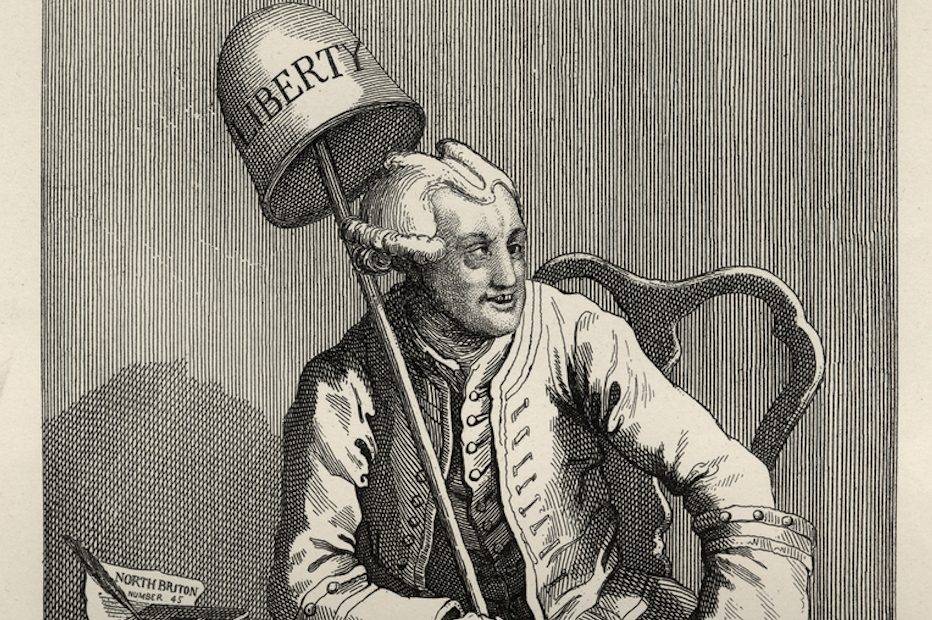
On 16 February 1769, the radical politician John Wilkes was re-elected unopposed as the member of parliament for Middlesex in a direct challenge to the authority of the House of Commons.
The by-election was called after Wilkes, who was in prison at the time for seditious libel, had been expelled from the House on 3 February.
It marked the beginning of an extended constitutional and political crisis known as the “Middlesex election affair”.
***
Wilkes, who was first elected to parliament in 1757, rose to prominence as the proprietor and one of the main authors of the anti-government satirical newspaper, The North Briton.
In an article of issue 45, Wilkes criticised and mocked a speech delivered by King George III. He accused ministers of putting the king’s “sacred name” to a contemptible speech which included “unjustifiable… declarations” and “infamous fallacy”.
The government of Lord Bute viewed the article as a direct attack on the monarch himself. As such, a general warrant was issued for the arrest of the paper’s authors, printers, and publishers. Wilkes was ultimately arrested alongside 49 people on 30 April 1763, facing charges of seditious libel. He faced imprisonment briefly in the Tower of London.
Wilkes’ court appearances were met with public demonstrations, and his defiance gave rise to the popular cry: “Wilkes and Liberty!”. The saga saw the number 45 adopted as a new symbol of free speech and opposition to arbitrary government.
In November 1763, the House of Commons resolved that authors of seditious libels were not entitled to parliamentary privilege. Wilkes, watching the machinations play out in parliament, fled to Paris on Christmas day 1763.
In January 1764, Wilkes was formally expelled from the commons. He was tried, convicted and quickly replaced as MP for Aylesbury.
***
Heavily indebted, Wilkes returned from France in the spring of 1768. Upon landing in Britain, he contested the 1768 general election, standing (unsuccessfully) in the City of London and Middlesex (successfully) on anti-government platforms.
Wilkes subsequently presented himself to the authorities to serve out his sentence. His imprisonment on 10 May 1768 was marked by a protest on St George’s Fields. An estimated 15,000 supporters of the radical MP’s plight, chanting “No liberty, no King”, were fired on by government soldiers after being read the Riot Act. The event is known as the Massacre of St George’s Fields.
In February 1769, parliament deemed Wilkes ineligible to sit in parliament by 219 votes to 137 on the grounds that he had been an outlaw at the time of his initial election.
However, at the subsequent by-election on 16 February 1769, the Middlesex electorate returned Wilkes as their MP without a contest.
The government and its supporters in the commons once more refused to accept the result, resolving that Wilkes, “having been in this session of parliament expelled this House, was and is incapable of sitting in the present parliament.”
But Wilkes was re-elected unopposed, once again, on 16 March. Parliament responded by voiding the result, precipitating a third by-election held on 13 April.
Wilkes was re-elected again, prompting parliament to declare his Tory opponent, Colonel Henry Luttrell, as the victor. In the event, Wilkes had defeated Luttrell by a margin of 1,143 votes to 296. Reports later emerged that Luttrell had been promised the seat sometime before the contest took place.
The commons accepted Luttrell’s election by 197 votes to 143.
Charles James Fox, beginning his long career in parliament, characterised the dispute as “a contest between the House of Commons and the most contemptible part of the freeholders of… Middlesex”.
Edmund Burke, the then MP for Wendover, described this final development as a “tragi-comedy acted by his Majesty’s servants, at the desire of several persons of quality, for the benefit of Mr Wilkes and at the expense of the Constitution.”
Luttrell, who was subjected to incessant abuse in the press, held the Middlesex seat for the next five years.
***
The “Middlesex election affair” triggered a major political crisis, took up substantial parliamentary time and became a cause célèbre for the radical movement.
On 20 February 1769, the Society of Gentlemen Supporters of the Bill of Rights, named after the Bill of Rights 1689, was formed to support Wilkes politically and financially. The group co-ordinated national petitions, campaigning for shorter parliaments and reform of the franchise.
Unsurprisingly, the episode served to greatly raise the awareness of Wilkes, who was released from prison in March 1770. In the wake of the Middlesex election affair, Wilkes opted to make London his political power base. He was elected an alderman of London and became Lord Mayor in 1774.
The general election of 1774 saw Wilkes return to parliament as the MP for Middlesex. This time, the commons chose not to dispute the result.
In parliament, Wilkes spoke in opposition to war with the American colonies and in support of religious tolerance. However, his popularity declined following his role in suppressing the Gordon Riots (1780).
In 1782, the commons voted to expunge all orders and resolutions related to the Middlesex affair from its journals, admitting they were “subversive of the rights of the whole body of electors”.
Wilkes beseeched MPs to back the motion “in order to quiet the minds of the people, to restore our violated constitution to its original purity, to vindicate the injured rights of this country in particular, and of all the electors of this kingdom, and that not the least trace of the violence and injustice of the last parliament may disgrace our records”.
Wilkes also denounced the French Revolution (1789) and emerged as a supporter of William Pitt the Younger, further reducing his stock among English radicals. Lacking support, he chose not to stand for re-election in 1790.
Wilkes died on 26 December 1797, aged 72, at his house in Grosvenor Square.

Politics.co.uk Newsletters
DAILY
Politics@Lunch
WEEKLY
Week in Review