Dowden resigns as Conservative chairman after crushing by-election defeats
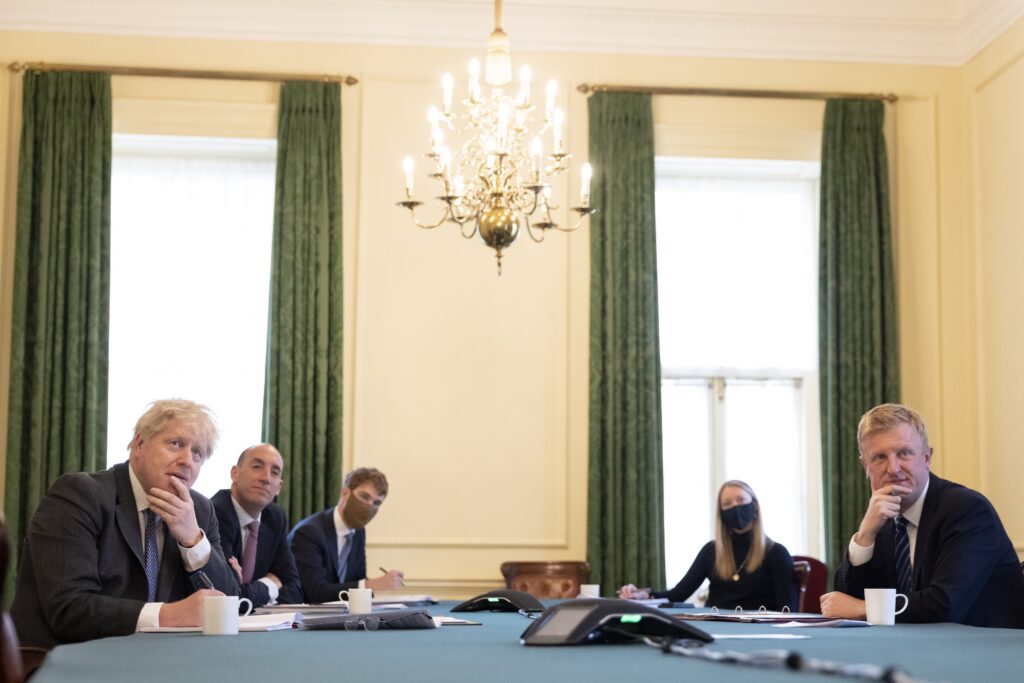
On 24 June 2022, the Conservative party chairman, Oliver Dowden, resigned in the immediate aftermath of two disastrous by-election results.
The by-election defeats, in Tiverton and Honiton and Wakefield, were taken to confirm the deep unpopularity of Boris Johnson’s government after the “Partygate” scandal. It came just 18 days after Johnson survived a “no-confidence” vote in which 148 of his own MPs – 41% of the parliamentary party – had backed removing him.
The Tiverton and Honiton by-election followed the resignation of Conservative MP Neil Parish, who admitted to watching pornography in the House of Commons chamber.
The Wakefield contest was triggered by the resignation of Imran Ahmad Khan after a criminal conviction for child sexual assault.
Dowden was appointed as Conservative Party chairman in September 2021, shortly after the Tories suffered the major electoral shock of losing the previously safe “blue wall” constituency of Chesham and Amersham to the Liberal Democrats. He then oversaw the Conservative campaign in the December 2021 North Shropshire by-election, which resulted in another symbolic victory for the Lib Dems.
***
The double defeat was electorally symbolic.
It marked the first occasion since the 1991 Kincardine and Deeside and Langbaurgh by-elections that a sitting British government had lost two seats in by-elections held on the same day.
The Conservatives lost Wakefield, a totemic “red wall” constituency, to the Labour Party. The Labour candidate, Simon Lightwood, won 13,166 votes (47.9%), overturning a Conservative majority of 3,358. The contest represented the first time Labour had captured a Conservative seat in 10 years.
The blue wall seat of Tiverton and Honiton, meanwhile, was won by the Liberal Democrats.
In Tiverton and Honiton, the Liberal Democrat candidate, Simon Foord, overturned a Conservative majority of 24,239; at the time, this was the largest numerical majority ever to be reversed in a British by-election. The result represented a swing of almost 29% away from the Conservatives – the sixth-largest swing against the governing party since 1945.
The contests were also notable for the limited presence of the Liberal Democrats in Wakefield and Labour in Tiverton and Honiton – seats they were always unlikely to win – suggesting a significant degree of tactical voting among the electorate, and even informal cooperation among the parties.
The Labour vote collapsed by 15.8 points in Tiverton and Honiton; in Wakefield, the Liberal Democrat vote fell by 2.1 points. Both parties lost their deposits in these contests.
Pollster Matt Singh responded: “Labour lost its deposit in Tiverton and won Wakefield on a decent swing. The Lib Dems lost their deposit in Wakefield and won Tiverton and Honiton on a huge swing. This is an unmistakable hallmark of tactical voting on a massive scale.”
Dowden’s curt resignation letter, posted on social media at 5:33 am, found space for a series of coded swipes at Johnson’s leadership.
The outgoing cabinet minister said the party’s supporters were “distressed and disappointed” and that “somebody must take responsibility”.
Dowden wrote: “I want to take this opportunity to pay tribute to our excellent Conservative volunteers and staffers who work so tirelessly for our cause. They are the backbone of our great party and deserve better than this.”
Keir Starmer, the leader of the Labour Party, responded that the Conservatives were “absolutely imploding” after the by-election results and Dowden’s resignation.
Starmer said: “What a judgment this is on the Tories and Boris Johnson – out of touch, out of ideas, and if they had any decency they would get out of the way for the sake of the country.”
Johnson vowed to “keep going” as prime minister in the wake of the defeats.
Speaking in Kigali, Rwanda, where he was attending a Commonwealth Heads of Government summit, the prime minister said: “It’s absolutely true we’ve had some tough by-election results.
“They’ve been, I think, a reflection of a lot of things – but we’ve got to recognise voters are going through a tough time at the moment.”
Johnson added: “I think as a government I’ve got to listen to what people are saying – in particular to the difficulties people are facing over the cost of living, which I think for most people is the number one issue.
“We’re now facing pressures on the cost of living, we’re seeing spikes in fuel prices, energy costs, food costs – that’s hitting people.
“We’ve got to recognise there is more we’ve got to do and we certainly will, we will keep going addressing the concerns of people until we get through this patch.”
Dowden was replaced as Conservative chair by Andrew Stephenson.
***
Dowden’s departure was the first cabinet-level resignation in what would prove to be the final chapter of Johnson’s premiership.
Mere days later on 30 June, Chris Pincher resigned as deputy chief whip following allegations that he had drunkenly groped two men at the Carlton Club in London. Initially, Downing Street insisted that the prime minister considered the matter closed and that Pincher would remain a Conservative MP, having lost only his government job.
This position quickly became untenable as a storm of new allegations about Pincher’s past behaviour emerged over the following days. The critical political question became what Boris Johnson knew about these previous allegations when he appointed Pincher to the whips’ office in February 2022.
As Downing Street’s initial position unravelled, Javid and Sunak resigned as health secretary and chancellor respectively.
The wave of resignations that followed forced Johnson to announce his own departure, against his obstinate wish to remain in office, on 7 July.
It was reported that Conservative MPs were planning to change the 1922 committee’s rules in order to compel a further vote of confidence in his leadership.
Dowden supported Rishi Sunak’s candidacy in both the July-September 2022 and October 2022 Conservative leadership contests.
He served as deputy prime minister from April 2023 to July 2024, succeeding Dominic Raab.

Politics.co.uk Newsletters
DAILY
Politics@Lunch
WEEKLY
Week in Review