David Cameron elected Conservative leader in landslide victory
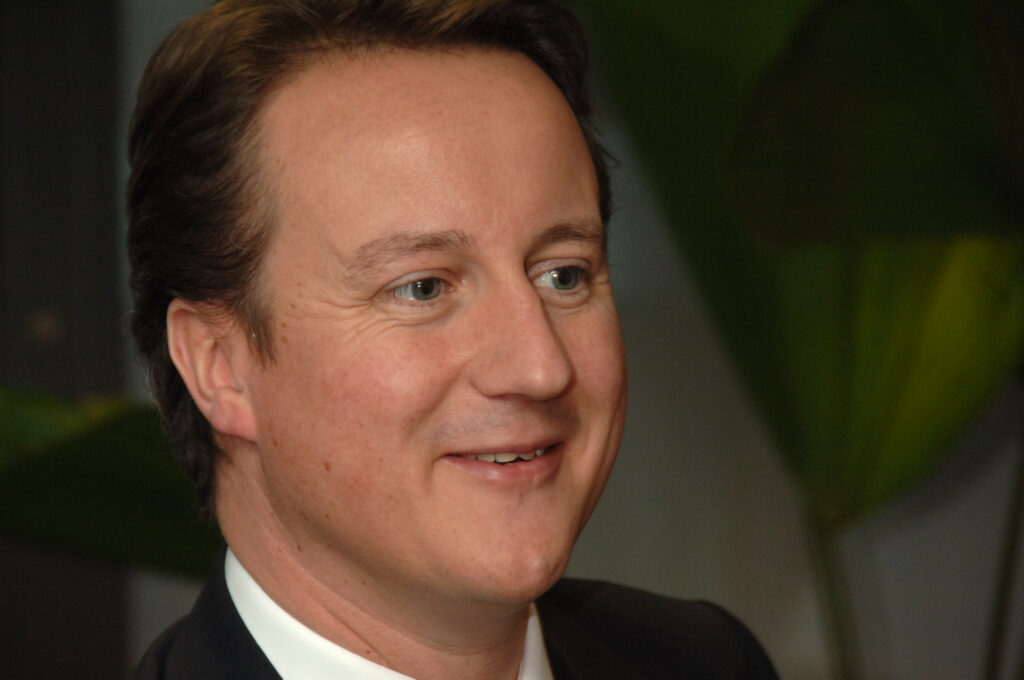
On 6 December 2005, David Cameron was declared the new leader of the Conservative Party, securing a decisive victory over his rival David Davis. In a ballot of party members, the 39-year-old Old Etonian won 134,446 votes (68%) to Davis’ 64,398 (32%).
***
The contest was triggered by the resignation of Michael Howard on 6 May 2005, following Labour’s third consecutive victory in the recent general election. Howard initially delayed his departure to attempt a reform of the party’s leadership rules. In a document titled A 21st Century Party, he proposed returning the power to elect Conservative leaders to Tory MPs, undoing the reforms overseen during William Hague’s from 1997 to 2001.
The existing leadership rules were responsible for Iain Duncan Smith’s victory in 2001. Two years later, following a successful ‘no-confidence’ vote in Duncan Smith’s leadership, Howard was elected as leader unopposed – thereby avoiding the crucial ballot of Conservative members.
However, the proposed 2005 reforms did not achieve the required 66% threshold of the party’s constitutional college, composed of MPs, peers and MEPs, and party volunteers. The 2005 leadership contest, it was confirmed, would be decided according to the existing rules: MPs would narrow the race down to a final two, who would then face a final ballot of the Tory membership.
David Davis, the shadow home secretary, entered the race as the clear frontrunner.
Cameron, who first entered parliament at the 2001 election, was initially seen as an outsider. A virtual unknown beyond Westminster, Howard had appointed him as shadow education secretary in his post-election reshuffle.
Cameron campaigned on a programme of “modernisation”, a long-standing source of contention in the Conservative Party, which his fellow candidates, including Kenneth Clarke and Liam Fox, had not embraced. (The contest marked Clarke’s third attempt to secure the Conservative leadership, following his 1997 and 2001 campaigns).
On this point, Davis argued that his party “must change” – but he implicitly warned “so-called” modernisers not to “chase an ebbing political tide” by aping New Labour.
In an article for the Sunday Telegraph, published on 5 June 2005, Davis rejected the “phoney” battle between modernisers and traditionalists, adding: “Equally, we should not abandon timeless Tory principles that are universal in their appeal. Why should anyone believe us if we believe nothing ourselves?”
Davis wrote: “It would be extraordinary if we appeared to abandon policies that have transformed Britain so successfully that even our political opponents pay lip service to them. The Conservative Party pioneered the approach of low taxes and free markets that has put this country at the head of Europe’s economic league.”
***
Meanwhile, Cameron’s “moderniser” allies included George Osborne, his campaign manager and the MP for Tatton; Oliver Letwin, the former shadow home secretary and shadow chancellor; Boris Johnson, the MP for Henley, sometimes Have I Got News For You host and Spectator editor; Ed Vaizey, the Wantage MP and Guardian columnist; and Michael Gove, the Surrey Heath MP and Times journalist.
The Conservative Party’s annual conference in Blackpool on 4 October is remembered as a breakthrough moment for Cameron. In his 20-minute speech at the party’s Blackpool conference, Cameron eschewed the standard politician’s lectern, roaming the stage sans notes. There was an audacity to the 38-year-old’s central pitch.
“Some say that we should move to the right”, he told delegates. “I say that will turn us into a fringe party, never able to challenge for government again.”
Cameron concluded: “I want you to come with me. We’ll be tested, and challenged, but we’ll never give up. We’ll never turn back. So let the message go out from this conference, a modern compassionate Conservatism is right for our times, right for our party – and right for our country.
“If we go for it, if we seize it, if we fight for it with every ounce of passion, vigour and energy from now until the next election, nothing and no one can stop us.”
Opinion polls of party members conducted in the days following the speech showed a significant surge in support for Cameron, catapulting him into a commanding lead over Davis. Cameron’s principal rival had delivered a speech earlier in the week that was judged steady but uninspiring. None of the other contenders – Ken Clarke, Malcolm Rifkind or Liam Fox – seized the moment.
The “beauty contest” format, with each candidate given 20 minutes to convince the Conservative faithful, played directly into Cameron’s strengths as a communicator and political operator. Indeed, Rifkind, who subsequently dropped out of the race, had delivered a similar ‘no notes’ speech days before Cameron – but without anything like the same impact.
The conference also saw the emergence of some issues for Cameron. He reportedly told a dinner for newspaper executives that he was the “heir to Blair” – a declaration treated with disdain by Davis. He also inspired something of a media storm with his refusal to answer questions about past drug use.
The News of The World seized on the story with a front page splash headlined: “Top Tory, Coke and The Hooker”. The splash was based on a 12-year-old photograph of George Osborne with a woman known variously as “Mistress Pain” and “Miss Whiplash”, reported to be the girlfriend of one of his friends.
Cameron was ultimately forced to admit that he had not snorted cocaine since becoming an MP.
The saga did not prove to be a knock-out blow. In the first ballot of Conservative MPs on 18 October, Cameron outperformed expectations with 56 votes. Davis had established only a narrow lead with 62 votes. Clarke was eliminated after securing just 38 votes. In the second ballot, Cameron placed first with 90 votes. Davis’ support declined to 57, and Liam Fox (51) was eliminated.
During the latter stages of the campaign, Cameron urged listeners tuning into one local radio station to “keep it real”.
Davis and Cameron also clashed in a series of televised debates. During a special edition of the BBC’s Question Time programme, Davis stressed his experience and said voters were tired of the “era of spin”.
He added: “So frankly, this is the worst moment for the Conservative Party to imitate Tony Blair.”
Cameron prevailed in the final ballot of Conservative members with 134,446 votes on a 78% turnout. Davis secured 64,398 votes.
***
In his victory speech at the Royal Academy of Arts, Cameron promised to move away from the “Punch and Judy politics of Westminster, the name calling, backbiting, point scoring, finger pointing.”
He declared: “People in this country are crying out for a Conservative Party that is decent, reasonable, sensible, common sense and in it for the long term of this country and that is the party we are going to build.”
The defeated Davis hailed Cameron as “the next Conservative prime minister”.
Gordon Brown, widely seen as the next Labour prime minister, dismissed claims that a young opponent would make him look old. “I think that’s a bit unfair, as the father of a two-year-old I feel pretty young”, he told BBC Radio 4‘s Today programme.
Baroness Thatcher said Cameron had won with a “clear result” and that she “wishes him well”.
Davis was retained as shadow home secretary on Cameron’s frontbench. He resigned this role in July 2008 to fight a self-imposed by-election as a protest against the “slow strangulation of fundamental British freedoms”. The decision came a day after Brown’s government had narrowly won a House of Commons vote (by a margin of nine) to extend the maximum pre-charge detention period for terror suspects from 28 to 42 days.
Cameron did not reappoint Davis to the shadow cabinet upon his re-election.
Cameron led the Conservative Party into the 2010 general election. The Conservatives won 306 seats with 36.1% of the vote, a net gain of 96 MPs compared to the notional 2005 result. The incumbent Labour party, led by prime minister Gordon Brown, lost 91 seats, returning 258 MPs on a 29.0% vote share. He emerged from the election as prime minister at the head of Britain’s first coalition government since the Second World War.
In 2012, together with former leadership rival Liam Fox, Davis founded Conservative pressure group Conservative Voice to amplify the voice of grassroots members – which they argued was being lost in the party.
Speaking at the group’s launch, Davis said Conservative Voice would provide a “home for the professional and voluntary wings of the Conservative Party and who are united in their belief in popular, radical conservatism”.
He added: “Our aim is to encourage seriously ambitious policy development and to help improve the party’s campaigning edge in really practical ways.”
“Our approach is to work from inside the party and alongside the leadership and to actively engage with think tanks, campaigning organisations, academics and business people.”
Davis was appointed as secretary of state for exiting the European Union in July 2016 by Theresa May, Cameron’s successor as prime minister.

Politics.co.uk Newsletters
DAILY
Politics@Lunch
WEEKLY
Week in Review