Commons bars atheist MP Charles Bradlaugh from taking his seat
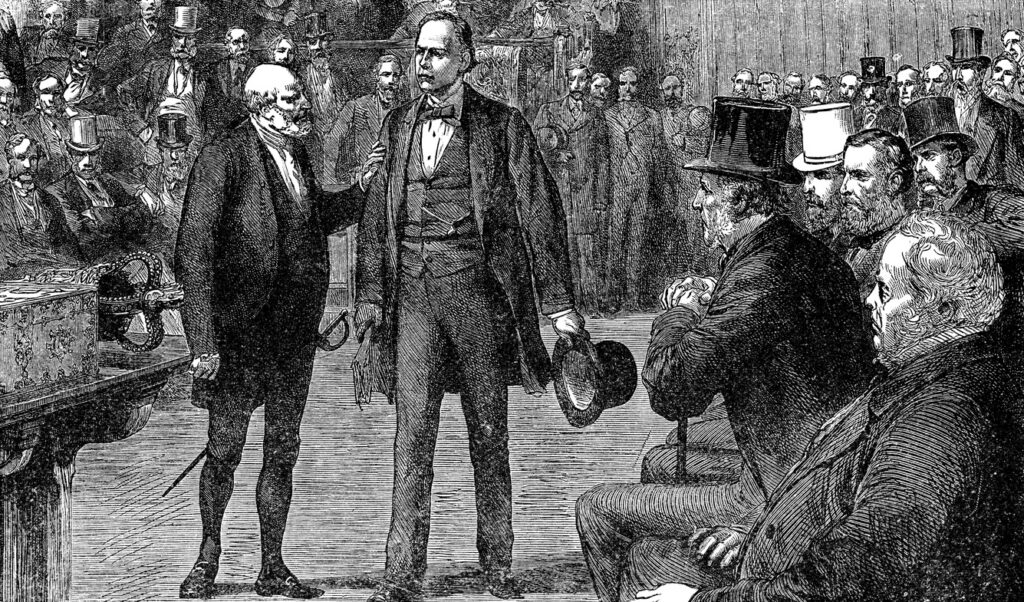
On 22 June 1880, the House of Commons voted to formally bar the radical Liberal and atheist Charles Bradlaugh from taking his seat. The decision effectively disenfranchised the constituency of Northampton, which had returned Bradlaugh in the general election held two months prior.
Bradlaugh was barred from sitting as an MP because, as an avowed atheist, he asked to affirm his allegiance to the crown rather than take the religious oath on a Bible. The vote represented the inaugural blow in a protracted political and constitutional struggle.
***
Bradlaugh first contested the constituency of Northampton in 1868. He stood in every subsequent general election and by-election, including in 1874 – when his defeat sparked a riot of around 7,000 people. Bradlaugh continued to contest the seat until he was finally endorsed by the voters of Northampton in 1880.
Northampton returned two MPs in 1880, both Liberals, in Bradlaugh and Henry Labouchère. Bradlaugh won 3,827 votes; his colleague, a leading Radical MP, secured 4,158.
In a statement upon his election, delivered to the commons on 3 May 1880, Bradlaugh expressed his desire to affirm rather than swear the oath.
He wrote: “I, the undersigned, Charles Bradlaugh, beg respectfully to claim to be allowed to affirm, as a person for the time being by law permitted to make a solemn affirmation or declaration, instead of taking an oath.”
The speaker, Henry Brand, said that he had “grave doubts” about the request, and the commons agreed that a select committee should be formed to determine whether Bradlaugh could be “admitted to make an affirmation or declaration instead of an oath in this House.”
The committee ultimately reported that Bradlaugh could not make an affirmation.
Bradlaugh responded by offering to take the oath. “I shall, taking the oath, regard myself as bound not by the letter of its words”, Bradlaugh said in an open letter to the Times newspaper, “but by the spirit which the affirmation would have conveyed had I been permitted to use it”.
He added: “I am sorry for the earnest believers who see words sacred to them used as a meaningless addendum to a promise, but I cannot permit their less sincere co-religionists to use an idle form in order to prevent me from doing my duty to those who have chosen me to speak for them in parliament.”
***
Bradlaugh’s statement was regarded as provocative by his opponents.
As such, when he returned to the commons to take the oath on 21 May, Conservative MP Henry Drummond Wolff objected.
Wolff stated that Bradlaugh was a “professed Atheist – and by the common law of England an atheist is not entitled to take an oath.”
He added: “I do not believe [Bradlaugh] himself denies that he is an atheist; but I have procured certain works that are published by the Free Thought Publishing Company, and among them I find a pamphlet entitled, A Plea for Atheism, written by the honourable gentleman, and advertised and sold under his name. At the beginning of the pamphlet are these words – ‘It is as a propagandist of Atheism that I pen this essay.’”
Wolff argued that it was clear from Bradlaugh’s open letter in the Times that he regarded taking the oath “as a proceeding of a meaningless character”.
He concluded: “[Bradlaugh] has, indeed, declared that no oath would be binding on his conscience. Therefore, it may be fairly asked, is the House to allow that formality now to be gone through which the honourable member himself avows will be a mere formality, and nothing more?”
Wolff thereby moved a resolution to bar Bradlaugh from the House.
William Ewart Gladstone, the Liberal prime minister, warned the House against interfering with a member’s right to take their place in parliament. Gladstone pointed to the “extreme delicacy of the ground on which the House stands”.
Gladstone proposed a resolution in response, referring the matter to a second select committee. The prime minister sought to determine whether the House could “prevent a duly elected member, who is willing to take the oath prescribed… from so doing”.
John Bright, a longstanding Radical MP, referred to the 18th-century case of John Wilkes, who was similarly barred from the House. Bright noted the “degree of humiliation the crown and parliament were brought by the conduct of parliament” over the Middlesex election affair.
Conservative MP Lord Randolph Churchill, speaking in support of Wolff’s resolution, argued that the House should not allow itself to be “trampled upon” by an avowed atheist. Churchill condemned the government for introducing “pettifogging technicalities” into a debate that should be decided by the “unerring instinct of the House of Commons.”
Both Churchill and Wolff were members of the so-called “fourth party” of Conservative troublemakers, who acted as a quasi-autonomous force in opposing the Liberal government and, sometimes, the opposition frontbench.
Liberal MP Robert Lyons argued that admitting Bradlaugh would turn the commons into an “advertising agency for the advocacy of his wretched and unfortunate views throughout the country.” This, Lyons warned, could produce a “diminished, a deteriorated, a vitiated, … a diseased population.”
Ultimately, the commons endorsed Gladstone’s select committee motion by 289 vote to 214, effectively deferring a definitive decision on Bradlaugh’s competency to take the oath.
***
This second select committee began deliberating on 1 June 1880. It considered a paper from Thomas Erskine May, the clerk of the commons, who cited several precedents for barring MPs over their refusal to take the oath.
Bradlaugh, in giving evidence to the committee, said that he would be willing to take the oath and consider it binding on his conscience.
This committee decided against Bradlaugh. It concluded that “under the circumstances, the compliance by Mr Bradlaugh with the form used when an oath is taken would not be the taking of an oath within the true meaning of the statutes”. The MPs, however, recommended that Bradlaugh be allowed to affirm so that this principle could be considered by the High Court of Justice in a subsequent case.
On 21 June, Labouchère moved that his colleague from Northampton be allowed to affirm, arguing that the House was at the risk of having “partially disfranchised” a major constituency. Hardinge Giffard, a Conservative MP, responded with an amendment to bar Bradlaugh from both the oath and affirmation. Giffard contended that the second committee’s recommendation was “extraordinary” and “ultra vires” because it effectively advised the House to “do what is unlawful, and leave it to the Courts of Justice to say whether it is right or not.”
Conservative MP Charles Warton begged that every MP who believed would vote against the “fool who hath said in his heart there is no God.”
Charles Newdigate Newdegate, also a Conservative, argued that atheism was “no passive principle. That might be illustrated by the modern history of France.”
Alexander Martin Sullivan, an Irish nationalist, rejected any comparison between Bradlaugh’s case and the earlier controversy over whether Daniel O’Connell, a Catholic, could take the parliamentary oath in 1828. Sullivan argued that the latter did not purchase admission by “asking for the overthrow of the religious foundations of the nation.” He described Bradlaugh as seeking to “pick the lock, not to force the gate.”
Gladstone invoked the Middlesex election affair, referring to the series of by-elections that followed the House’s decision to exclude Wilkes from taking his seat.
The prime minister declared: “You set Wilkes at defiance; you set the constituency for which he sat at defiance…
“By degrees you found that that was a conflict in which you could win little and might lose much. The energies that impelled you grew more and more slack. Then the House of Commons ceased to act against Mr Wilkes after resisting him three times.”
Gladstone, a devout high church Anglican, assailed the religious objection of the Conservatives as logically inconsistent. He argued that by admitting Jews, Catholics and Nonconformists, the House had already abandoned its status as a Christian institution. To draw a final line at simple theism, he argued, represented a meaningless distinction.
He stated: “We have been driven from the Church ground; we have been driven from the Protestant ground; we have been driven from the Christian ground; and the final rally is made upon this narrow ledge of the Theistic ground… For my own part, I see no profit or advantage either to charity or to reason, or to common sense, in making distinctions of this kind.
“In accordance with your principles, if I understand them, you would allow a Mahomedan to sit in this House without question; you would probably allow a Parsee to sit in this House; but you could not, with any consistency, allow a Buddhist to do so…
“Well, there is a theory that it does not matter what God you worship provided you worship some God or other. In my opinion there is greater danger of irreverence and impiety in this kind of loose, rambling debate, clutching at some remnant of what we on this side of the House think to be intolerance, than there is in any frank acknowledgment of the absolute separation that has been drawn in the spirit of the law of this land, and, I believe, in the letter of the law of this land, between civil duty and religious belief.”
Giffard’s amendment was passed by 275 votes to 230 – a majority of 45. The House resolved that “having regard to the reports and proceedings of two select committees… Mr Bradlaugh be not permitted to take the oath or make the affirmation mentioned in the statute”.
***
On 23 June, Bradlaugh returned to the commons chamber. Erskine May, addressing the speaker, stated: “Mr Bradlaugh claims the right to take the oath.” The speaker informed Bradlaugh of the House’s decision taken on the previous day and called on him to withdraw.
But Bradlaugh was also permitted to address the chamber from the bar of the House of Commons. (The bar marked the boundary of the House.) He treated the occasion as a de facto maiden speech, declaring: “I stand here, Sir, as no criminal. I stand here as the chosen of a constituency of this country, with my duty to that constituency to do.”
He argued that MPs were measuring “themselves against the right of the constituencies of England”.
He stated: “I am no more ashamed of my own opinions – which I did not choose – I am no more ashamed of my opinions, into which I have grown, than any member of this House is ashamed of his; and, much as I value the right to a seat in this House, much as I believe the justice of this House will accord it me before the struggle ceases, I would rather relinquish it for ever than it should be thought that, upon any shadow of hypocrisy, I had tried to gain a feigned entrance here by pretending to be what I am not.”
He declared: “If this House arrays itself against an isolated man – if it be its huge powers against one citizen that you are thinking to use – if it must be that, then the battle must be, too”.
Bradlaugh accused MPs of seeking to “supersede the rights of the people of this country”.
He concluded: “But there is a court to which I shall appeal – the court of public opinion… I appeal to public opinion against the iniquity of a decision which overrides the law and denies me justice.”
Bradlaugh once again withdrew to allow the commons to deliberate. Gladstone successfully beseeched Labouchère to withdraw his motion to rescind the previous day’s resolution banning Bradlaugh from taking the oath. He argued that the House should not be pressed to form an opinion upon a motion “of the adoption of which there cannot be the smallest reasonable hope”.
Bradlaugh was called back to the table and told that the ban stood. But he categorically refused to withdraw, arguing that he could not “obey the orders of the House, which are against the law.”
Stafford Northcote, the Conservative leader in the commons, moved that the speaker enforce the withdrawal. The motion was passed by 326 votes to 38.
Bradlaugh, who remained at the table of the commons while the division occurred, was then approached by the sergeant-at-arms, Ralph Gosset.
But Bradlaugh still refused to withdraw, declaring: “I understand that I am ordered out of the House. I claim my right as a member of this House to take the oath and to take my seat.”
Northcote moved that Bradlaugh be taken into custody for “disobeying the orders and resisting the authority of the House.” Charles Stewart Parnell, the leader of the Irish nationalist bloc, rose to oppose the motion. Parnell, who had not yet intervened in the debate on Bradlaugh’s fate, conceded that he was at odds with the majority of Irish MPs. But he argued that the motion to imprison a member was “repugnant to the feelings of the people” of Ireland. The IPP leader argued that “he did not believe the Irish constituencies would wish even an Atheist to be imprisoned.”
But Northcote’s motion was passed by 274 votes to just seven and Bradlaugh was committed into the custody of the serjeant-at-arms. The Radicals had at this point left the House.
Bradlaugh spent a night in custody in the clock tower beneath Big Ben before his release the following day. He was the last person to have been held in the prison room of Elizabeth Tower.
***
The debate over Bradlaugh’s status continued for some days until, on 28 June, Gladstone gave notice of a resolution designed to allow any member to “make and subscribe a solemn affirmation”, provided they claim a legal right to do so. The Conservative Party under Northcote’s leadership signalled its opposition.
Edwyn Burnaby, a Conservative MP who opposed the motion, told the House that he had received correspondence from a wide range of religious authorities expressing opposition to Charles Bradlaugh taking his seat. These included the bishop of London, the bishop of Ossory, the bishop of Ratho, the archbishop of Dublin, the prominent Baptist preacher Charles Spurgeon, the bishop of Galway, the bishop of Argyll and the Isles, representatives of the Moravian Church, the superior of the Greek Orthodox Church, and even the secretary to the pope in Rome. The chief rabbi was also reported to feel “strongly” on the matter.
Responding to this list of religious interventions, some MPs called on the House to seek the view of “the sultan” or “the shah”.
In the end, the motion was agreed on 1 July by 303 votes to 249.
As a result, Bradlaugh returned to the chamber on 2 July, affirmed and finally took up his seat. He made his first contribution on 3 July during a debate on the Relief of Distress (Ireland) Act (1880) Amendment Bill. Irish MP James Finigan commended his speech, saying he had shown “a spirit which self-styled Christians would do well to follow.”
But upon taking his seat, Bradlaugh was immediately the victim of action which questioned the legality of his affirmation. This action, it later emerged, was the result of machinations by Conservative MP Charles Newdegate. It came under the Parliamentary Oaths Act 1866, which outlined that any MP who had not taken a valid oath was liable to a penalty of £500 for every vote cast. Their seat would also be vacated.
The high court ultimately found against Bradlaugh. By consequence, on 11 March 1881, which Bradlaugh having delivered several speeches in the interim, Conservative MP John Gorst called for the writ to be moved for a by-election to be held for the seat of Northampton. Bradlaugh, Gorst stated, had “voted as a member of the House of Commons… without having made and subscribed the oath by Law appointed.”
On 14 March, when Bradlaugh rose to present a petition, Gorst objected on the grounds that he was not “a member of this House”. He insisted that the first time Bradlaugh voted, his seat became vacant “exactly as if the holder of it were dead.”
The attorney general, Henry James, reminded the House of Bradlaugh’s right to appeal. Bradlaugh himself indicated that this was his intention, but he volunteered to vacate his seat, subjecting himself to a by-election.
Bradlaugh’s appeal was rejected days later, and his Northampton seat declared vacant.
In a subsequent by-election, Bradlaugh was returned as the MP for Northampton with a majority of 132 votes over the Conservative candidate.
On 26 April, he once again appeared before the commons to take the parliamentary oath. But as Bradlaugh prepared to go through the motions required of him, Northcote, in an unsurprising turn of events, objected. He argued that it was “not our duty to sit by and to make ourselves parties to what I cannot but consider a profanation of a sacred form.” Northcote moved a familiar motion to prevent Bradlaugh from “repeating the words of the oath prescribed by the statutes”.
Liberal MP Horace Davey moved an amendment, arguing that if a member is duly elected, the House has no legal right to use “information extraneous to the transaction” to prevent them from taking the oath.
Bradlaugh, before withdrawing, was permitted to speak from the bar of the House.
He stated: “I, a penniless man, should have been ruined, if it had not been that the men in the workshop, pit, and factory had enabled me to fight this battle…
“The law gives me no remedy if the House decides against me. Do not mock at the constituencies. If you place yourselves above the law, you leave me no course save lawless agitation, instead of reasonable pleading.
“It is easy to begin such a strife, but none knows how it would end. I have no Court, no tribunal to appeal to; you have the strength of your votes at the moment. You think I am an obnoxious man, and that I have no one on my side.
“If that be so, then the more reason that this House, grand in the strength of its centuries of liberty, should have now that generosity in dealing with one who tomorrow may be forced into a struggle for public opinion against it.”
Northcote’s motion was approved by 208 votes to 175 and the speaker ordered Bradlaugh to withdraw. Gladstone once more voted with the minority and refused to help the speaker enforce the ban, stating: “I desire to leave it to the majority to carry out its will.”
Bradlaugh refused the instruction of the speaker and the sergeant-at-arms was instructed to remove him. A scuffle ensued as Bradlaugh battled to advance beyond the bar of the House. The commons, having been plunged into chaos, agreed to adjourn.
Bradlaugh returned on 27 April and once more refused to withdraw, prompting the sergeant-at-arms to intervene. Labouchère called for a bill to be introduced that would allow for affirmation. Gladstone initially refused, arguing that parliamentary time should be dedicated to the Irish Land Bill.
Two days later on 29 April, Gladstone announced the government’s intention to bring in a bill to amend the Parliamentary Oaths Act. He requested a Tuesday morning sitting so legislative proceedings could begin quickly. Churchill vowed to lead the opposition to the bill.
A debate on 6 May was dominated by opponents of the proposed bill. The commons agreed to a morning sitting by 128 votes to 122. But the minister on duty, the Marquess of Hartington, ultimately yielded to the “extremely determined” opposition of Conservative MPs, abandoning plans for a morning session.
***
Bradlaugh returned to the chamber on 10 May and was accosted by the sergeant-at-arms.
This latest exclusion precipitated a change of tack on Bradlaugh’s part. In a letter dated 4 July, he wrote to the House of Commons speaker, describing the ruling issued on 10 May barring from the House as “absolutely illegal”.
Bradlaugh cited advice that anyone who forcibly prevented him from taking the oath could be “lawfully resisted and overcome by me”. He said he was willing to wait for any legislation related to his right to take the oath, but, with the House not having formed an opinion, he now felt compelled to act. He gave notice that he would again present himself at the table of the House “to complete the fulfilment of the duty imposed on me by law”, effectively warning the speaker about an imminent confrontation.
Addressing the commons, the speaker responded by reiterating his ruling of 10 May: “That the serjeant-at-arms do remove Mr Bradlaugh from this House until he shall engage not further to disturb the proceedings of the House.”
Bradlaugh soon notified the speaker, the clerk of the House and the serjeant-at-arms of his intention to present himself at the bar of the House in early August. He was true to his word.
On 3 August, Bradlaugh – at the head of a large crowd of supporters – was seized at the door of the commons by at least 10 individuals, including police officers, who escorted him off of the premises.
The Times reported: “In the passage leading out to the yard Mr. Bradlaugh’s coat was torn down on the right side; his waistcoat was also pulled open, and otherwise his toilet was much disarranged. The members flocked down the stairs on the heels of the struggling party, but no pause was made until Mr Bradlaugh was placed outside the precincts and in Palace Yard.”
Labouchère told the commons that his colleague had been “hurried out of the lobby” by force. The speaker explained that since Bradlaugh had given written notice that he would “resist and endeavour to overcome” any force used against him, he had directed the serjeant-at-arms to conduct him “beyond the precincts of the House”.
John Bright, the chancellor of the Duchy of Lancaster, claimed that Bradlaugh had been dragged through Westminster Hall in a “deathly fainting” condition.
He stated: “No such scene has heretofore been recorded in the annals of the British House of Commons.”
Bright added: “I will put the question to honourable members opposite… Where are they leading us? This is now a manageable affair… but this is exactly one of those things which grow, and the House, if it persists in its present course, will bring us into some most unfortunate and calamitous position.”
Philip Callan, an Irish nationalist MP, delivered a different account of events. “So far from Mr Bradlaugh being in a fainting condition at the time he was left outside”, Callan stated, “in a far worse condition was the officer of this House, whose collar he had never let go through the struggle outside of the House”.
Callan concluded: “In a brutal manner Mr Bradlaugh committed an assault for which he should be prosecuted; and if he does not, it is because this House lacks moral courage, because it lacks backbone.”
Labouchère moved a motion claiming the speaker exceeded his powers as set out in recent resolutions. It was rejected by 191 votes to seven. Instead, the House expressed its approval as to “the action of Mr Speaker and of the officers of this House acting under his orders.”
Bradlaugh returned to the commons in February 1882, his health recuperated, to take the oath. A familiar objection was lodged.
Bradlaugh once more addressed MPs from behind the bar of the House, concluding: “I have no fear. If I am not fit for my constituents, they shall dismiss me; but you never shall. The grave alone shall make me yield.”
The commons approved an identically worded motion depriving Bradlaugh of the ability to take the oath by 286 votes to 228. The Liberal MP, ordered to withdraw, eventually obliged.
On 21 February, Labouchère called for a new writ to be issued for the constituency of Northampton and a by-election to take place. He argued that MPs did not have a right to “prevent a gentleman from sitting and voting here without giving the constituency the immediate opportunity, by issuing a new writ, of electing someone else in his place.” Labouchère’s motion was rejected by 307 votes to 18.
After the division was finished, Bradlaugh advanced to the table, read the oath, reportedly “kissing” a copy of the New Testament in the process, and took his place in the chamber.
The speaker ordered Bradlaugh to withdraw. He obliged, before swiftly returning to his place. He dismissed the protests of the speaker, declaring: “I did obey your directions, Sir; and now, having, in pursuance of the law, taken and subscribed the oath, according to law, I have taken my seat.”
Churchill argued that Bradlaugh had taken his seat without lawfully subscribing to the oath as required by the Parliamentary Oaths Act 1866. Under the terms of the statute, Churchill contended, Bradlaugh’s seat for Northampton was therefore automatically vacated “as if he were dead.”
Gladstone called for careful consideration of the 1866 act, which specifically penalised those MPs who had sat “during any debate”. Gladstone said the question therefore arose over whether “Bradlaugh sat in the House ‘during a debate?’” To further consider this matter, the debate was adjourned.
On 22 February, the commons considered Churchill’s motion to require the speaker to issue a writ for an election in Northampton. Gladstone argued that while he personally believed the House was acting “beyond its powers” by barring Bradlaugh, he admitted that the Liberal MP’s actions constituted “flagrant disobedience.”
Northcote proposed a more limited amendment that would simply “prevent” Bradlaugh from stepping foot in parliament. Churchill dismissed the proposal of his own frontbench as overly cautious, arguing that it fell well short of the action he believed the situation required. He mocked the amendment with the Latin phrase parturient montes, nascetur ridiculus mus – “the mountains will labour, and a ridiculous mouse will be born.”
The debate was upended, however, when Bradlaugh walked past the bar and took a seat on the benches within the House.
It was Conservative MP Lord Claud Hamilton who drew attention to this fact. “Bradlaugh is sitting in the House on the third bench below the gangway on the other side of the House”, Hamilton declared. “He has taken his seat during the debate.”
Northcote responded by withdrawing his amendment and submitting a motion for Bradlaugh’s expulsion. In the division that followed, Bradlaugh voted with the Noes. The Liberal MP’s expulsion was ultimately approved by 297 votes to 80.
The commons resolved that Bradlaugh, “having disobeyed the orders of the House, and having, in contempt of the authority of this House, irregularly and contumaciously pretended to take and subscribe the oath required by law, be expelled”.
The speaker subsequently issued his warrant to the clerk of the House to make out a new writ for a by-election in Northampton.
In March 1882, Bradlaugh was re-elected as the Liberal MP for Northampton with a majority of 108 over the Conservative candidate.
Following the by-election, Northcote moved to reaffirm the exclusion order to prevent Bradlaugh from taking the oath at a time when the House might be “thin and exhausted.”
He argued: “The ground upon which the great majority of the House objected to Mr Bradlaugh going through the form of taking the oath remains exactly the same – namely, that we consider that we are parties to the taking of the oath, and that we consider that the taking of the oath by Mr Bradlaugh in the circumstances known to the House is in the nature of a profanation of that oath.”
Northcote’s motion was agreed. It came after a Liberal amendment, calling for legislation to resolve the crisis, was rejected by 257 votes to 242.
***
In total, Bradlaugh’s seat was declared vacant three times, but on each occasion – in by-elections in 1881, 1882, and again in 1884 – the voters of Northampton defiantly re-elected him.
An affirmations bill that would have allowed Bradlaugh to take his place was introduced by the government in February 1883. It received its first reading by 184 votes to 53 on 19 February. The Conservative opposition dismissed the proposed legislation as a “Bradlaugh Relief Bill” .
The bill was debated across five days at second reading. Addressing the House on the first day, Liberal MP William Torrens warned against “abjuring and ignoring all responsibility to Heaven.” He referred to the “demoralisation and madness to which France had been brought by atheistic revolution.”
On the final day, Newdegate framed the bill as the “final rush” of atheism predicted years earlier during the debates over Jewish emancipation.
He recalled a warning delivered some decades previously: “If you set the door of the House ajar for the admission of the Jew, the day must come when the atheist will make his rush.”
The climax of the three-year controversy arrived with the division on the bill’s second reading. It was rejected by 292 votes to 289.
On 4 May 1883, Bradlaugh appeared before the House to respond to this latest setback and was permitted to address MPs from the bar. He reminded the commons that he had been elected three times and that “vileness imposes no legal disqualification, no one within these walls has the right to challenge the return of my constituents.”
But MPs re-endorsed Northcote’s motion barring Bradlaugh from the House.
On 11 February 1884, Bradlaugh once again attempted to self-administer the oath. Northcote moved the traditional resolution and Gladstone, continuing his long-standing policy, refused to lead the House in enforcing a ban he considered “unconstitutional”. Bradlaugh proceeded to vote in the division that followed.
The next day, a writ was moved for a third by-election in Northampton. Bradlaugh was returned with a 368-votes majority.
The commons, on firmly familiar territory, answered by rapidly recommitting to its ban on Bradlaugh taking the oath.
Bradlaugh was later fined £1,500 for voting illegally.
***
On 19 June 1885, Bradlaugh, having voluntarily stayed away while the government tested the legality of his self-administered oath in the courts, again signalled his intention to take his seat by way of a letter to the commons speaker.
The court of appeal had found against Bradlaugh on the grounds that, as someone who did not believe in the existence of a supreme being, he was legally incapable of taking the oath of allegiance required under the Parliamentary Oaths Act 1866 as amended by the Promissory Oaths Act 1868.
This was also a moment of transition between the outgoing Liberal government under Gladstone and the incoming Conservative administration under the Marquess of Salisbury. On 6 July, MPs voted to maintain Bradlaugh’s expulsion.
Bradlaugh was re-elected as the Liberal MP for Northampton at the 1885 general election (held from 24 November to 18 December) with 4,315 votes – a majority of 425.
Finally, on 13 January 1886 – some six years after his original election as the MP for Northampton – Bradlaugh was sworn in and took his seat. This historic development followed a unilateral ruling by the speaker, Arthur Peel, who had taken the chair in February 1884 shortly after Bradlaugh’s self-administration of the oath and subsequent re-election.
The speaker ruled that the many resolutions passed in the previous parliament between 1880 and 1885 to exclude Bradlaugh had lapsed. “They are void, they are of no effect in reference to this case”, he said.
Peel ruled that a speaker has no original authority to interfere between a returned MP and his obligation to take the oath. Nor, he declared, did the commons have the right to cast judgement over a member’s private thoughts. He allowed Bradlaugh to take the oath, but warned that he did so “under whatever risks may attach to him in a court of law”.
The speaker refused to allow any motion or debate to intervene.
Bradlaugh walked to the table and took the oath in the normal fashion.
Bradlaugh went on to secure a permanent legislative victory by introducing the Oaths Act of 1888, which established the right of MPs to make a solemn affirmation instead of swearing an oath. Ever since, MPs have possessed the right to choose how they swear their allegiance to the crown.
***
On 27 January 1891, Liberal MP William Hunter introduced a motion proposing that the House’s decision to prevent Bradlaugh from taking the oath “be expunged from the journals of the House, as being subversive of the rights of the whole body of electors of this Kingdom”.
The language of the motion deliberately echoed the precedent established during the controversy surrounding John Wilkes in the 18th century. In 1782, the commons similarly voted to expunge from its journals all orders and resolutions declaring that Wilkes was incapable of sitting in parliament, despite his repeated re-elections by the voters of Middlesex.
Both cases are today regarded as instances in which the House of Commons overstepped its authority and effectively denied voters the right to choose their own representatives.
Gladstone was among the supporters of the resolution, arguing that the House’s actions previously represented a “manifest excess of jurisdiction.” He said that failing to expunge the decision take in June 1880 would “leave upon our records the seeds of future mischief to be appealed to and turned to evil account in evil times.”
The Grand Old Man, however, called for the words “subversive of the rights of the whole body of electors of this kingdom” to be removed.
Labouchère, speaking not for the first time as Bradlaugh’s representative, indicated that his colleague would accept a motion phrased in these terms. The leader of the House, William Henry Smith (W. H. Smith), agreed that this wording was acceptable.
Conservative MP Walter Barttelot said the commons would, by accepting the motion, have “done a generous act to a man who has endeavoured to do his duty.”
The commons thereby resolved unanimously (without a division) that “the resolution of this House of the 22nd day of June, 1880 – that, having regard for the reports and proceedings of two select committees, appointed by this House, Mr Bradlaugh be not permitted to take the oath or make the Affirmation – be expunged from the journals of this House”.
Bradlaugh, having served as an MP for five years, died from kidney disease three days later on 30 January 1891, aged 57.
Bradlaugh’s funeral was attended by 3,000 mourners, including a young Mohandas Gandhi. In his time as an MP, Bradlaugh became known as the “member for India” for his advocacy of the interests of Indian people.

Politics.co.uk Newsletters
DAILY
Politics@Lunch
WEEKLY
Week in Review