Churchill condemns defence complacency in ‘locust years’ speech
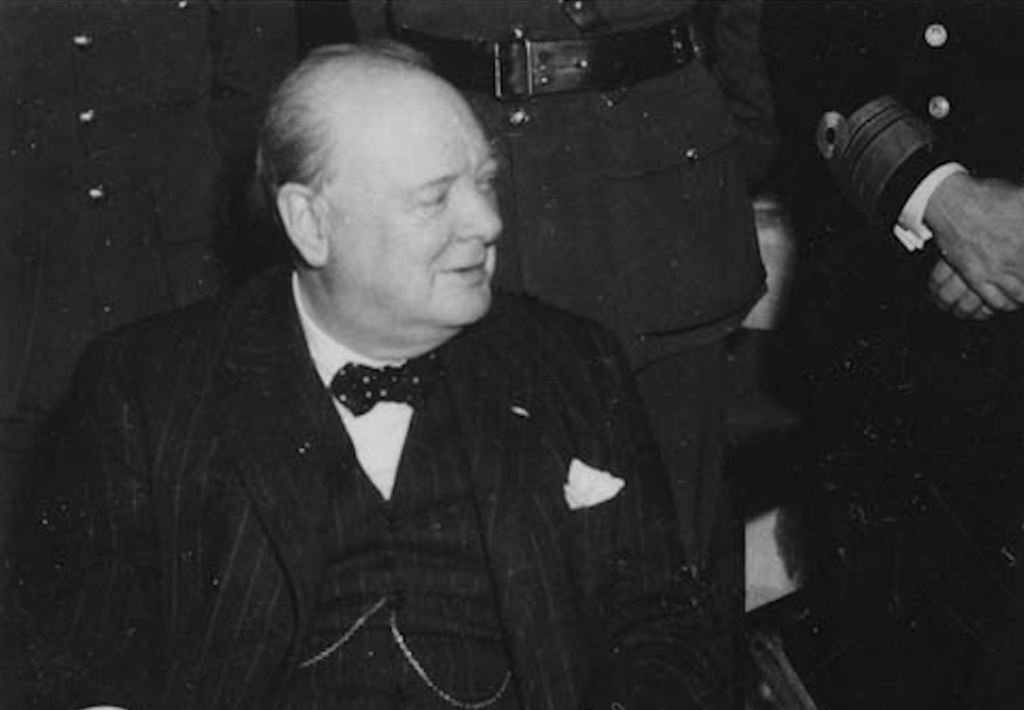
On 12 November 1936, Winston Churchill delivered a famous indictment of the government’s indecision and failure to rearm in the face of Nazi Germany’s mobilisation.
Speaking during the debate on the address in the House of Commons (the response to the king’s speech), Churchill condemned the Conservative-led National Government for its “complacency” over national defence.
He referred to the “locust years” – a period when the government missed opportunities for Britain to re-arm.
***
Since Adolf Hitler’s rise and consolidation of power from 1933-1934, German rearmament had accelerated rapidly. On 7 March 1936, Hitler reoccupied the Rhineland, a de-militarised zone under the terms of the Treaty of Versailles. Nazi forces did so unchallenged.
The National Government, led by Stanley Baldwin as prime minister, had not adopted a policy of rapid rearmament in response to Germany’s mobilisation. Baldwin spelt out his government’s position during the 1935 general election campaign, assuring voters: “I give you my word that there will be no great armaments”.
In October 1935, Baldwin maintained that there “has not been, there is not, and there will not be any question of huge armaments or materially increased forces.”
At this stage in his career – the height of his “wilderness years” as a backbencher – Churchill had primarily devoted himself to warning of the threat posed by Germany.
In his famous 1936 speech, Churchill referred to the period since 1932 and 1933 as “the years which the locust hath eaten” – quoting a previous speech by Thomas Inskip, the minister for coordination of defence.
Churchill proposed to develop Inskip’s Biblical allusion and “see which are these ‘years which the locust hath eaten’, even if we do not pry too closely in search of the locusts who have eaten these precious years.”
He chronicled Hitler’s rise to power, Germany’s rearmament – a development he insisted was “general public knowledge in this country” – and warned that Britain could not afford further delay.
Churchill reproached Baldwin for failing to keep his specific pledge to “see to it that in air strength and air power this country shall no longer be in a position inferior to any country within striking distance of its shores.”
He contended that ministers had been “very slow in accepting the fact, the unwelcome fact, of German rearmament”, preferring instead to cling to the “experiment” of one-sided disarmament.
He said that even after the “government had realised that a world of armed and arming menace was springing up around them, no measures were taken for a long time equal to the situation or to make up for the years that were lost.”
Moreover, he rejected the suggestion that the government lacked an electoral mandate for rearmament, insisting that “the responsibility of ministers for the public safety is absolute and requires no mandate”.
Churchill scorned the government’s indecision; he said the National Government could not “make up their minds, or they cannot get the prime minister to make up his mind.”
He added: “So they go on in strange paradox, decided only to be undecided, resolved to be irresolute, adamant for drift, solid for fluidity, all-powerful to be impotent. So we go on preparing more months and years – precious, perhaps vital to the greatness of Britain – for the locusts to eat.”
Turning to the specific state of the land forces, he said the “the army lacks almost every weapon which is required for the latest form of modern war.”
He questioned the specific shortages in equipment, asking: “Where are the anti-tank guns, where are the short-distance wireless sets, where the field anti-aircraft guns against low-flying armoured aeroplanes?”
Churchill then drew attention to the decline of the Tank Corps. “During the War we had almost a monopoly in, let alone the leadership in, tank warfare, and for several years afterwards we held the foremost place”, he said.
“All that has gone now. Nothing has been done in the years that the locust has eaten to equip the Tank Corps with new machines.”
On air power, he reminded the House that “we were promised most solemnly by the government that air parity with Germany would be maintained by the home defence forces”.
He calculated that at “the present time [we are] only about two-thirds as strong as the German Air Force” and demanded the creation of a Ministry of Supply to compel industry to prioritise munitions.
Referring to the state of Britain’s armed forces, Churchill said he feared a “terrible reckoning, a very terrible reckoning, and those who take the responsibility so entirely upon themselves are either of a hardy disposition or they are incapable of foreseeing the possibilities which may arise.”
Finally, he warned: “The era of procrastination, of half measures, of soothing and baffling expedients, of delays, is coming to its close. In its place, we are entering a period of consequences.”
Churchill said that unless parliament resolved to find out the truth for itself, it would have committed “an act of abdication of duty without parallel in its long history”.
***
Baldwin responded to Churchill’s challenge with “appalling frankness”.
He insisted that the government could not prioritise defence “irrespective entirely of the effect on commerce, industry and finance”.
He added: “We are fully determined to press forward the plans already worked out, to modify, to extend them if necessary in the light of developments, but we do not feel justified in bringing about the dislocation of trade which must follow any attempt to proceed upon the more lavish scale advocated in some quarters.”
The prime minister recalled the political climate of 1933, noting that there was “probably a stronger pacifist feeling running through this country than at any time since the [First World War]”.
He referred to the East Fulham by-election, held in October 1933, which saw the National Government candidate defeated “on no issue but the pacifist”.
He said: “Supposing I had gone to the country and said that Germany was rearming and that we must rearm, does anybody think that this pacific democracy would have rallied to that cry at that moment?
“I cannot think of anything that would have made the loss of the election from my point of view more certain.”
There is some disagreement over whether Baldwin, with these remarks, was referring to the East Fulham by-election or the 1935 general election. Moreover, his caution reflected real constraints: public fear of another war and pacifist sentiment were widespread, and rearmament would have diverted resources from economic recovery after the Great Depression.
But for his critics, this declaration amounted to a blunt admission that the National Government placed politics before country by failing adequately to rearm. In other words: the fear of losing an election motivated Baldwin’s failure to rearm.
Privately, Churchill rubbished the prime minister’s stance as reprehensible.
In a letter to Sir Archibald Boyd-Carpenter, a friend and fellow Conservative MP, Churchill wrote: “I have never heard such a squalid confession from a public man as Baldwin offered us yesterday.”
***
Churchill became the prime minister of the United Kingdom on 10 May 1940 – on the same day that Nazi Germany launched its invasion of France and the Low Countries.
The change brought an end to the era of appeasement, pursued by Baldwin and his successor, Neville Chamberlain, and ushered in a policy of total war against the Axis powers.
Churchill later wrote: “I felt as if I were walking with Destiny, and that all my past life had been but a preparation for this hour and for this trial.”
Churchill harboured resentment for Baldwin and his policy long after the war.
In June 1947, he was invited to send a letter to mark Baldwin’s 80th birthday.
Churchill responded: “I wish Stanley Baldwin no ill, but it would have been much better if he had never lived.”

Politics.co.uk Newsletters
DAILY
Politics@Lunch
WEEKLY
Week in Review