Charles Stewart Parnell revealed as adulterer in O’Shea divorce case
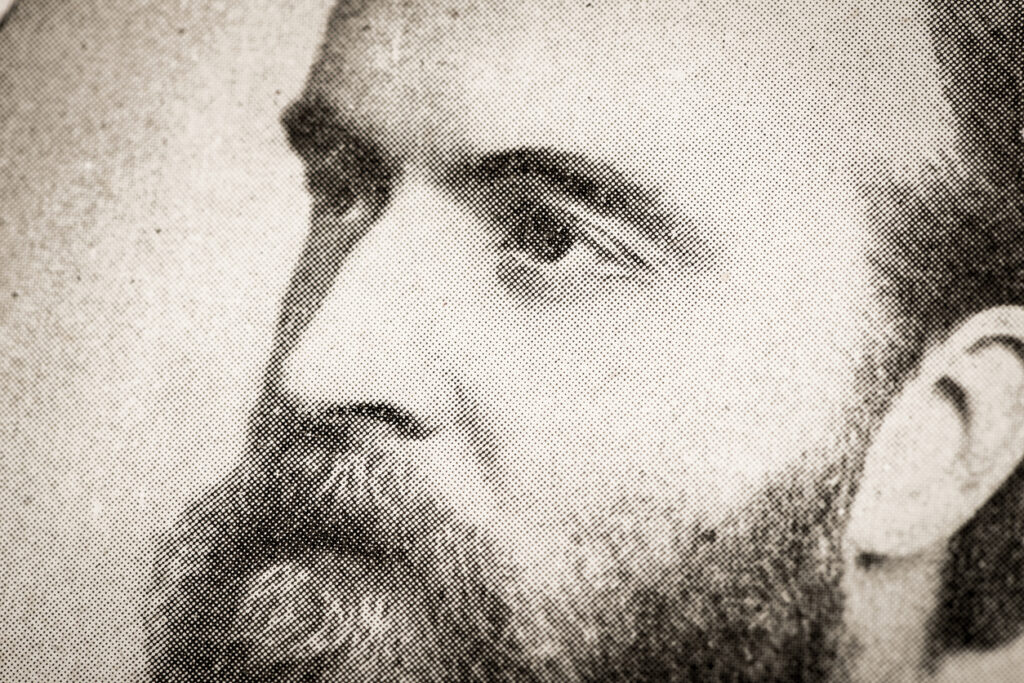
On 17 November 1890, a decree nisi was granted in the case of O’Shea v. O’Shea and Parnell. This development confirmed that Charles Stewart Parnell, the leader of the Irish Parliamentary Party (IPP), had committed adultery with Katharine O’Shea.
The ruling, which Parnell had not contested, transformed what had been a long-standing rumour and open secret in some parts into a national scandal. It precipitated a formal schism in the IPP and the downfall of a giant of Victorian and Irish politics.
***
Parnell’s position at the vanguard of Irish nationalism looked unassailable in the late 1880s. The man contemporaries considered the “uncrowned king of Ireland” commanded 85 seats in the House of Commons and, critically, had formed a political alliance with Liberal Party leader William Ewart Gladstone for the express purpose of securing home rule for Ireland.
The court proceedings, however, shattered Parnell’s political ascendancy.
They revealed details of a long-running affair between the IPP leader and Katharine O’Shea, the wife of Captain William O’Shea. The court heard that Parnell had visited the O’Shea household regularly since 1880, sometimes using aliases such as “Mr Fox” and “Mr Preston”. It was also (falsely) reported that Parnell had once fled the O’Shea residence by clambering down a rope-ladder fire escape to avoid detection by Captain O’Shea – only to return moments later through the front door.
The proceedings further revealed that Katharine O’Shea had borne three children by Parnell between 1882 and 1884.
O’Shea, who was already separated from his wife, was styled as a wronged husband seeking redress for years of concealed betrayal. Justice Butt described the IPP leader – who did not even attend the proceedings – as “the man who takes advantage of the hospitality offered him by the husband to debauch the wife”.
On 24 November 1890, Gladstone wrote a famous letter to his senior Liberal colleague John Morley. He stated that Parnell’s retention of the leadership would render his own leadership of the Liberal Party “almost a nullity.”
Gladstone wrote that “notwithstanding the splendid services rendered by Mr Parnell to his country, his continuance at the present moment in the leadership would be productive of consequences disastrous in the highest degree to the cause of Ireland.”
Gladstone calculated that the Liberals could not win an election while enmeshed with a party whose adulterous leader had been dragged through the divorce courts. The ‘nonconformist conscience’, a key component of the Liberal Party’s political coalition, would not tolerate an alliance with the scandal-tainted Parnell.
Parnell’s continued prominence, Gladstone wrote, would not only place “many hearty and effective friends of the Irish cause in a position of great embarrassment, but would render my retention of the leadership of the Liberal Party, based as it has been mainly upon the prosecution of the Irish cause, almost a nullity.”
The letter threw the Liberal Party’s commitment to home rule into question.
The IPP, still unaware of Gladstone’s position, initially rallied around Parnell and re-elected him as their chief on 25 November.
The Grand Old Man, having contacted Parnell privately to inform him of his stance, then made public his opposition to Parnell remaining leader of the home rule party.
Parnell hit back on 29 November. In a manifesto, he declared that the “integrity and independence” of a section of his party was being destroyed by the “wirepullers of the English Liberal party”.
Parnell also came armed with alleged revelations regarding Gladstone’s commitment to home rule. He claimed that Gladstone had informed him that, to conciliate English public opinion, it would be necessary to reduce Irish representation in the Westminster parliament from 103 MPs to 32.
On the settlement of the land question, Parnell reported Gladstone’s position that this must be “reserved from the control of the Irish legislature”. He further revealed that, under Gladstone’s proposed scheme, the Irish Constabulary would remain controlled by “the imperial authority for an indefinite period”
Parnell declared: “Sixteen years ago I conceived the idea of an Irish parliamentary party independent of all English parties. Ten years ago I was elected the leader of an independent Irish parliamentary party….
“I believe that party will obtain home rule only provided it remains independent of any English party.
“I do not believe that any action of the Irish people in supporting me will endanger the home rule cause or postpone the establishment of an Irish parliament”.
***
But Gladstone’s intervention was ultimately fatal.
The crisis culminated in a series of meetings held in committee room 15 at Westminster in early December.
Following a meeting on 3 December, Irish bishops, with some dissenting exceptions, produced a statement that condemned Parnell as unfit to be leader on moral grounds.
After five days of debate, the party formally split on 6 December 1890. A majority of 44 MPs, led by Justin McCarthy, walked out to form the anti-Parnellite Irish National Federation (INF). A minority of 28 loyal Parnellites continued as the Irish National League (INL).
McCarthy issued a statement, signed by his anti-Parnellite MPs, setting out their case. “Mr. Parnell speaks as if he were an injured man”, he wrote, “but the facts cannot be forgotten. We must hold Parnell responsible, and he alone, for the present deplorable situation.”
There was, he argued, “overwhelming evidence” that with Parnell at the helm “the home rule party could not hope to win the general election.”
In a direct appeal to the Irish electorate, he added: “You did not elect us to serve an individual without regard to any interest to our own country; you elected us to serve our country only”.
McCarthy’s statement also responded directly to the accusations contained in Parnell’s manifesto of 29 November. The anti-Parnellite MPs dismissed the suggestion they had “submitted to the dictation of Mr Gladstone” as “transparently absurd”.
The group, led by McCarthy, stated they could not accept “Mr. Parnell’s reference to the private conversation one year old as displacing the evidence in Mr. Parnell’s public speeches delivered since that time”.
If they were inclined to submit to any man, they insisted, “all our feeling would incline us to submit to Mr Parnell, but not to Mr Gladstone.”
They rejected Parnell’s account of his private discussions with Gladstone, refusing to accept the manifesto “as displacing the evidence in Mr. Parnell’s public speeches delivered since that time”.
They stressed that Parnell had never previously communicated any “anxiety or doubt” about Gladstone’s intentions to his colleagues.
The anti-Parnellite bloc added: “Mr Gladstone, his colleagues and his party maintain and reiterate, with fresh emphasis, their pledges that the measure for home rule to be proposed by them will be satisfactory to Ireland.”
The manifesto itself, they contended, was politically ruinous; it amounted to “an appeal to the hatred between the people of Great Britain and the people of Ireland.” This ran counter to their duty as representatives of Ireland “to cultivate lasting friendship between the two peoples.”
The anti-Parnellites argued its publication meant that Parnell could no longer act “in conjunction with the Liberal Party or in the same cause as the Unionists.” But Home Rule, they stressed, “cannot be won by parliamentary means, except by a conjunction with one party or another.”
They concluded: “What possible future, then, has Parnell left open as the Parliamentary leader? What policy can be adopt? By what means does he propose to gain any real advantage for his country?”
***
The Parnellite and anti-Parnellite blocs collided in at least five by-elections from 1890 to 1891.
The North Kilkenny contest in December 1890 provided the first test of public opinion following the Parnellite schism.
The Parnellites appealed to the electorate – recently expanded by the Representation of the People Act 1884 – to recall the patriotism and parliamentary prowess of their leader. But it was a bitter campaign, marred by disturbances; Parnell himself received “a portion of [quicklime] in his face”.
In the end, the anti-Parnellite candidate, John Pope Hennessy, won by 2,527 votes (65.0%) to 1,365 (35.1%). This result, on a surprisingly sizeable majority (1,162), raised the prospect that popular opinion favoured dethroning the “uncrowned king of Ireland”.
The Parnellite campaign complained of “undue influence on the part of the priests”.
One report was tragically prescient: “Parnell vows he will fight in turn every one of the 85 home rule seats in parliament. No doubt he will, if his strength holds out; but he looked today, as he stood bareheaded in the street addressing an unruly mob, just after the poll was declared, as though another campaign would carry him to his grave.”
The North Sligo by-election in April 1891 produced another anti-Parnellite victory – this time by 768 votes.
Three months later in the July 1891 County Carlow by-election, the Parnellite rump suffered a further setback. The INF candidate prevailed with an emphatic 70.9% of the vote – a majority of 2,215.
Parnell had struck a confident figure during the County Carlow campaign. But the rolling plebiscites suggested that the centre of Irish public opinion was no longer with him.
Parnell, his health waning, and Katharine O’Shea were married in June 1891.
On 6 October 1891, Parnell died from heart failure, aged 45.
David Lloyd George, the future prime minister, described Parnell in December 1890 as a man of “iron determination, inflexible will, matchless courage and audacity and of peerless skill as a leader”. Writing in the wake of the O’Shea case, Lloyd George could not help “feeling compassion at the ruin of such grandeur”.
Parnell’s funeral is said to have been attended by 200,000 people. The day of his death is still remembered as Ivy Day.
A final, symbolic by-election was held in Parnell’s former seat of Cork City in November 1891.
The Parnellites nominated Redmond, their most prominent figure, who resigned as the MP for North Wexford to contest the constituency. But the anti-Parnellites prevailed once more. Their candidate, local butter merchant Martin Flavin, won a majority of 1,512 votes.
Redmond, lacking a parliamentary seat, stood in the December 1891 Waterford City by-election. His return, by 1,775 votes to 1,229, marked a rare victory for the Parnellite cause.
***
In 1892, Gladstone, aged 82, returned the Liberals to government as prime minister. His second attempt to legislate for Irish home rule was scuppered in the House of Lords; having successfully beseeched MPs to support the measure, peers rejected the bill by 419 votes to 41.
Gladstone had his last audience with Queen Victoria on 28 February 1894.
The anti-Parnellite and Parnellite factions of Irish nationalism did not reunite until 1900 under the leadership of John Redmond.
The parties were effectively forced together as a consequence of the challenge posed by William O’Brien, a former member of the IPP. The popularity of O’Brien’s new United Irish League (UIL), which mostly transcended the Parnellite-anti-Parnellite divide, grew quickly.
In 1900, under Redmond’s leadership, the IPP reformed as a coalescence of the INF, INL and UIL blocs. The party returned 82 MPs in the general election of that year.
The general elections of 1910 produced two hung parliaments, landing the IPP once more in the balance of power. Home rule was back on the political agenda – and, following the passage of the Parliament Act 1911, a realisable prospect in the face of peers’ unyielding opposition.

Politics.co.uk Newsletters
DAILY
Politics@Lunch
WEEKLY
Week in Review
