Cameron promises in/out EU referendum in landmark Bloomberg speech
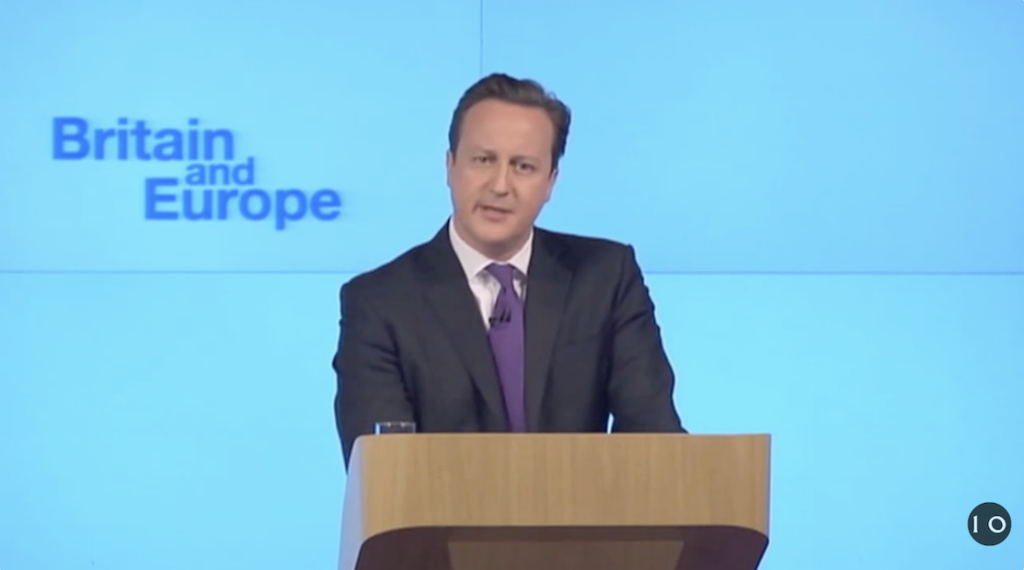
On 23 January 2013, prime minister David Cameron delivered a landmark speech at the Bloomberg headquarters in London, committing a future Conservative government to holding an “in/out” referendum on Britain’s membership of the European Union (EU).
The 56-page address represented the first major eurosceptic address by a sitting prime minister since Margaret Thatcher’s 1988 Bruges speech. It set out a two-stage strategy: a renegotiation of membership terms, followed by a public vote by the end of 2017.
***
Politically, the speech was characterised as an attempt by Cameron to manage internal pressure from eurosceptic Conservative backbenchers and external electoral pressure from the UK Independence Party (Ukip).
Political scientists have also pointed to Cameron’s own euroscepticism and concern that “an ‘ever closer union’ within the EU risked the UK’s interests.”
Speaking in 2013, Cameron argued that he wanted Britain to remain in a reformed EU and would campaign to do so with “all my heart and soul”. But the speech contained a series of criticisms directed at the development of the European project and the bloc’s integrationist ambitions.
At the outset, Cameron argued that Britain has the “character of an island nation – independent, forthright, passionate in defence of our sovereignty.”
He declared: “We can no more change this British sensibility than we can drain the English Channel…
“For us, the European Union is a means to an end – prosperity, stability, the anchor of freedom and democracy both within Europe and beyond her shores – not an end in itself.
“We insistently ask: How? Why? To what end? But all this doesn’t make us somehow un-European…
“I am not a British isolationist. I don’t just want a better deal for Britain. I want a better deal for Europe too. So I speak as British prime minister with a positive vision for the future of the European Union.
“A future in which Britain wants, and should want, to play a committed and active part”.
The prime minister added: “If we don’t address these challenges, the danger is that Europe will fail and the British people will drift towards the exit.
“I do not want that to happen. I want the European Union to be a success. And I want a relationship between Britain and the EU that keeps us in it.”
Cameron described public disillusionment with the EU as “at an all time high”.
He contended: “People feel that the EU is heading in a direction that they never signed up to. They resent the interference in our national life by what they see as unnecessary rules and regulation. And they wonder what the point of it all is…
“The result is that democratic consent for the EU in Britain is now wafer thin”.
The prime minister argued that a referendum would succeed in “confronting this issue – shaping it, leading the debate. Not simply hoping a difficult situation will go away.”
He promised that the Conservative 2015 general election manifesto would seek a mandate to “negotiate a new settlement with our European partners in the next parliament.”
***
Soon after delivering the speech, Cameron attended the House of Commons for prime minister’s questions. Ed Miliband, the Labour leader of the opposition, argued that Cameron was being “dragged” by his backbenchers and “running scared” of Nigel Farage.
Cameron repeatedly challenged the Labour leader on his stance on the proposed referendum.
Miliband responded: “My position is no, we do not want an in/out referendum…
“The prime minister is going to put Britain through years of uncertainty and take a huge gamble with our economy. He is running scared of Ukip, he has given in to his party and he cannot deliver for Britain.”
Cameron’s speech on 23 January 2013 placed Britain on the path to Brexit.
The Conservative Party’s 2015 general election manifesto stated: “The EU needs to change. And it is time for the British people – not politicians – to have their say. Only the Conservative Party will deliver real change and real choice on Europe, with an in-out referendum by the end of 2017.”
On 23 June 2016, the United Kingdom voted to leave the European Union by 51.9% to 48.1%. The result, on a turnout of 72.2%, overturned the 1975 decision to remain in the bloc and triggered a period of immense political turmoil.
In the immediate aftermath of the result, Cameron announced his intention to resign as prime minister.
In his speech outside 10 Downing Street, Cameron stated: “The British people have made a very clear decision to take a different path and as such I think the country requires fresh leadership to take it in this direction.”
Cameron had since defended his decision to promise a referendum on Britain’s membership of the EU. In his 2019 memoir, For the Record, Cameron insisted the in/out referendum policy was not a panicked response to the rise of Ukip or other political pressures.
He cited an audio diary entry from January 2012 to prove his thinking predated the rise of UKIP and the sharp increase in immigration.
On tape, the prime minister mused: “At some stage, altering Britain’s relationship with the European Union in some regards and then putting it to a referendum, I think, would be good Conservative policy for the next parliament.”
Cameron framed this audio record as a “riposte” to those who claim he was “bounced” into the referendum pledge.
He also denied promising the referendum only because he assumed he would lose the 2015 election. He insisted that the Conservative Party and the press would never allow him to trade the pledge away in coalition talks.
Furthermore, Cameron rejected the suggestion that he was “frivolous” and simply assumed the ‘Remain’ camp would win. He cited a second audio recording, dated October 2012, in which he highlighted the danger of his strategy.
Cameron reportedly stated: “This is very, very difficult and very dangerous. We could end up not being able to achieve enough to be able to put into a referendum and therefore effectively leaving the EU if we’re not careful.”
He confirmed that George Osborne, his closest political ally and chancellor, was firmly opposed to the strategy. Michael Gove, the chief whip and leading eurosceptic, was also opposed to the policy on the grounds that it should not be treated as a priority.
Meanwhile, Oliver Letwin, a leading ‘Cameroon’, was a strong proponent of the referendum pledge.
Ultimately, Cameron said that he made the “pledge because I genuinely believed it was the right thing for Britain”. He therefore accepted responsibility for the failure of his strategy.
The prime minister wrote: “It was right for us to have our say on that deal, and on our membership more broadly. It was right, if we got a better deal, to remain in the EU.
“I believed this strategy was the most likely way to keep Britain in the EU. Indeed, that’s how I put it to my fellow European leaders: this is my strategy for keeping Britain in Europe.
“The strategy failed. I failed. And that failure has had some serious consequences for the UK and Europe. But it all flowed from an attempt to do the right thing.”

Politics.co.uk Newsletters
DAILY
Politics@Lunch
WEEKLY
Week in Review