Ballot Act introduces secret voting after parliamentary battle
On 18 July 1872, the Ballot Act received royal assent, a landmark piece of legislation passed by William Gladstone’s Liberal government that introduced the secret ballot for parliamentary and municipal elections.
The legislation – formally known as the Parliamentary and Municipal Elections Act 1872 – sought to curtail the intimidation, bribery and general malpractice that characterised the existing system of open, public voting. It mandated that voting take place in private using official ballot papers, which were then folded and placed into sealed ballot boxes under the supervision of returning officers.
The first parliamentary election held under the new system was the Pontefract by-election on 15 August 1872. It featured a ballot box sealed with a liquorice stamp from a local factory.
Prior to 1872, voters declared their choice aloud at the hustings or had their vote publicly recorded in poll books. This system meant it was standard practice for tenants and labourers to be coerced into voting for their landlord or employer’s chosen candidate.
The act’s passage marked a victory for reformers and radicals, both past and present. The secret ballot was among the six demands of the Chartist movement, which campaigned for comprehensive political reform from 1838 to 1857.
The secret ballot did not entirely eradicate electoral corruption, however. Forms of bribery or “treating” (providing food and drink) still persisted. Gladstone’s second ministry (1880-1885) responded with a royal commission with a remit to investigate such electoral practice and the Corrupt and Illegal Practices Prevention Act 1883. This legislation criminalised attempts to bribe voters and regulated election expenses. Under the act, candidates found guilty of corruption would be barred from standing for election for seven years. Allegations of illegality during elections declined significantly as a result.
***
The introduction of the secret ballot followed the expansion of the franchise under the Second Reform Act of 1867. This legislation intensified concerns about the potential for intimidation and corruption. The Representation of the People Act 1867 granted the vote to all male householders who paid rates, as well as to male lodgers paying £10 or more in annual rent. In the county constituencies, the franchise was extended to occupiers of property valued at £12 per year and owners of land worth £5 per year.
Gladstone argued that this expansion of the electorate made the introduction of the secret ballot a necessary safeguard against coercion.
The Liberals were the principal beneficiaries of the Second Reform Act – changes that, with not inconsiderable irony and ideological contortion, were steered through parliament by Benjamin Disraeli, the leading Conservative, to “dish the Whigs”.
After all, Disraeli’s Conservative Party lost the 1868 general election, the first held according to the new franchise. The Liberals under Gladstone won 387 seats – a net gain of 18. The party was therefore restored to power with a stable majority.
In his first speech as prime minister, delivered in Greenwich in December 1868, Gladstone suggested he planned to build on the reforms of his political nemesis. “I have at all times given my vote in favour of open voting”, he declared, “but I have done so before, and I do so now, with an important reservation, namely, that whether by open voting or by whatsoever means, free voting must be secured.”
In July 1870, Gladstone reiterated his support for secret voting, endorsing a private member’s bill to that effect. He explained that while he had “always voted against the Ballot”, the 1867 reforms provided the “basis of the change” in his position.
The prime minister conceded that he did not view secret voting as an “unmixed good”. But he insisted that the “first duty which parliament has to perform, after having conferred the franchise under those circumstances, is to provide that it shall be exercised freely.”
He argued that the old theory of the vote being a “trust” exercised by a limited electorate on behalf of non-voters generally had disappeared, as the new franchise was now “not less wide than that of the entire nation.”
Gladstone insisted that it was “absolutely indispensable” for the vote to be exercised freely.
He told the commons: “This freedom is threatened from many quarters. It is threatened, I do not hesitate to admit, from the dictation and possible violence of more numbers, as well as from the more subtle, more extensive, and more continuous action of those influences which are connected with property.”
The prime minister cited a circular issued “in the town of Blackburn during the proceedings previous to the election of 1868” which sought to organise an intimidation campaign to secure the election of Conservative candidates.
To leave the new mass of voters who were “dependent for their bread upon their daily labour” exposed to electoral pressures and intimidation would, Gladstone said, “stultify the whole of that great operation of parliament”.
Gladstone subsequently decided that the government should proceed with its own legislation.
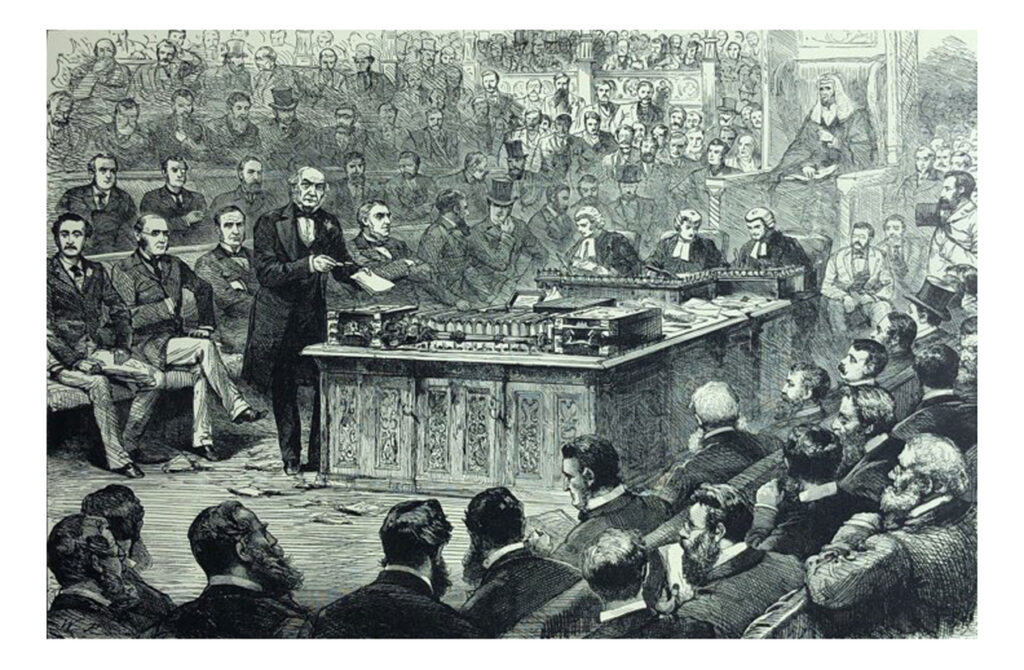
Disraeli led the opposition to the Ballot Bill during its commons stages. Addressing the House on 29 June 1871, as part of the bill’s committee stages, Disraeli accused the prime minister of “trembling at the accession of democracy.”
He referred to the “absurdity and complete hollowness” of the argument that coercion necessitated the introduction of the ballot, ridiculing the idea that modern “squires” or “Irish landlords” still coerced their tenants. He claimed that “recent legislation”, such as the Irish Land Act 1870, had rendered these figures “innocuous.”
Disraeli further dismissed the suggestion of a new “oppressor”, namely the “the manufacturer – that mild and prosperous, truly liberal, and enlightened man, who was always voting for the reduction of the county franchise.”
The Conservative leader claimed that the “employer of labour in towns, and the foreman, and the mechanic are all quite strong enough to take care of themselves.”
He concluded that the new system would “dislocate all the machinery of the state, and disturb and agitate” the public, predicting that, “because it has no real foundation of truth or policy, it will meet with defeat and discomfiture.”
Despite Disraeli’s diatribe, the Ballot Bill secured its second reading by 324 votes to 231 – a majority of 93. It subsequently received its third reading on 8 August.
Two days later, however, the House of Lords rejected the bill by 97 votes to 48. Peers argued that the bill had arrived too late in the session for proper consideration. The Duke of Richmond, the leading opponent of the measure in the upper chamber, explained that a bill which proposed to “revolutionise the whole mode of voting at elections in this country” should be considered with such “rapidity and… haste”.
***
The Gladstone government reintroduced the Parliamentary and Municipal Elections Bill in the following session on 8 February 1872.
Presenting the measure at first reading, leading Liberal W. E. Forster noted that the bill had previously been approved by “great majorities” in the commons, and the defeat of the bill by the Lords – which Forster described as “perfectly legitimate” – had not aroused any sympathy in the county at large. He argued that secret voting was now considered a “fait accompli” by the general public.
When the commons debated the proposed legislation at second reading on 15 February, Conservative MP Henry Liddell moved a motion to reject the bill, describing secret voting as “the worm at the core of this measure” and predicting it would lead to “large demands for reduction of the suffrage.”
Liddell added: “This may be the inevitable and necessary consequence of the passing of this bill. I am the more strengthened in my dislike to the bill because I do not think the country at this moment is in favour of great and fundamental changes.”
Richard Dowse, the attorney general for Ireland, evoked Cicero, defending the secret ballot proposal as “vindex tacita libertatis” (the silent protector of liberty). Dowse argued that an “existing evil must be remedied, and it could not be repugnant to the feelings and character of the people to secure to them the free exercise of the franchise.”
The bill secured its commons second reading by 109 votes to 51, and reached the House of Lords in early June.
The Marquess of Ripon, upon moving the second reading, cited testimony from Australia to demonstrate that the secret ballot produced “perfect tranquillity” at the poll. He informed the House of the opinion of James Fergusson, the governor of South Australia, who described the ballot as “generally and remarkably popular” and a “valuable protection” for minorities.
Ripon further argued that the “trustee” argument was undermined by the expansion of the franchise by the 1867 Representation of the People Act.
The Earl of Shaftesbury, a Conservative, referenced an exchange with former US secretary of state Daniel Webster during the lords debate on the bill’s second reading.
Webster reportedly told Shaftesbury: “Above all things, resist to the very last the introduction of the ballot; for, as a Republican, I tell you that the ballot can never co-exist with monarchical institutions.”
The Lords agreed to the second reading by 86 votes to 56.
***
Peers, however, fundamentally altered the bill during its committee stage.
An amendment, tabled by the Duke of Richmond, which aimed to suppress fraud by allowing ballot papers to be traced back to an individual voter was passed by 162 votes to 91. A second amendment, also spearheaded by Richmond, sought to remove the requirement for a voter to mark their paper in a “secret compartment” – a move to make the ballot “optional”.
Richmond argued that those “who took pride in voting openly” should not be forced into secrecy.
Lord Lyttelton, an opponent of the bill, nonetheless rubbished Richmond’s proposal as a straightforward wrecking amendment. The Conservative peer noted that intimidation would continue under this scheme, arguing it would be “quite practicable” for some candidate to say “Unless you vote publicly I shall assume that you have voted against me.”
Lyttelton argued this undermined the principle of the bill – as it had been agreed at second reading.
This “optional ballot” provision, however, was approved by 83 votes to 67.
Earl Beauchamp subsequently carried an amendment to adopt a “sunset clause”, thereby ensuring a “full and fair trial” for the ballot. Peers then voted by 106 to 69 to insert a provision stipulating that the act would expire on 31 December 1880.
Gladstone addressed the commons on 27 June, informing MPs that he would rather endorse “sacrificing the bill” than accept the so-called optional ballot.
The following day, 28 June, Forster argued that the optional ballot would enable any voter to be “bribed or bullied into voting openly”, taking “away many of the advantages of open voting and gives us none of the secret voting”.
Disraeli argued that the Lords had acted with “wisdom and moderation” and saved the independent voter from the “degradation of secret voting”. He argued that the bill, unamended, ran contrary to the British tradition where “publicity is now the soul of our political life”.
The Conservative leader suggested the ballot should instead be viewed as a “penal statute” to be kept in reserve “like the Riot Act”, and only “brought into use when the excesses of electoral society demanded it.”
Gladstone insisted that for the protection to be real, “within the polling-booth there should be no option at all”, asserting that to allow choice would render the bill a “mockery, a delusion, and a snare” and “betray our trust to the people of England”
MPs formally disagreed with the optional ballot by 302 votes to 234 – a majority of 68. However, the commons accepted Richmond’s amendment relating to “scrutiny” of ballot papers (tracing votes) for the purpose of fraud prevention.
On 1 July, the House further disagreed with the proposed sunset clause (by 246 votes to 165), with Forster arguing they should not “condemn a future parliament to repeat the same process” of minute discussion
When the bill returned to the Lords on 8 July, Ripon warned that insisting on an optional ballot would be equivalent to saying “we will not have this bill at all.” Peers ultimately chose not to insist on the optional ballot by 157 votes to 138
The Lords did, however, insist on the sunset clause by 117 votes to 58.
On 12 July, the commons compromised. Forster announced that the government would accept the 1880 expiration date, as well as a written declaration for illiterate voters – another demand expressed by the House of Lords. Gladstone conceded that “we have arrived at a stage when we must consider the best manner for coming to an arrangement with the other House of parliament.”
Liberal MP Vernon Harcourt nonetheless registered a protest. He argued that no more “revolutionary doctrine had been entered upon the journals of parliament since the Long Parliament.” Harcourt condemned the decision to treat significant constitutional reform as somehow “experimental”.
He added: “Such a precedent might have very serious consequences, supposing it were proposed for a few years to do without the House of Lords or the Church.”
***
The measure had a considerable and outsized impact in Ireland, which suffered from an especially suppressive landlord class. The 1874 general election, the first national contest since the passage of the Ballot Act, returned a Conservative majority under Disraeli – as well as 60 new pro-home rule Irish MPs.
The experimental Ballot Act was also in operation for the 1880 general election, which restored the Liberals to power and Gladstone as prime minister. The contest marked the beginning of the dominance of the Irish Parliamentary Party (IPP) in Ireland and precipitated Charles Stewart Parnell’s election as its leader.
The Conservatives, having deferred any decision on the Ballot Act, left it to Gladstone’s second ministry to carry the measure forward.
The first queen’s speech of the new parliament included a commitment to “renew the act for secret voting”, and, in June 1880, Gladstone expressed his intention to make the Ballot Act “permanent”.
The prime minister did not, however, fulfil this pledge. Instead, the Liberal government preserved the practice of secret voting through the Expiring Laws Continuance Act – overarching legislation designed to renew earlier enactments that would otherwise lapse.
On 28 August, Conservative MP Lord Randolph Churchill called on the government to commit to renewing the Ballot Act in a standalone piece of legislation in the next parliamentary session, rather than relying on a temporary renewal mechanism.
Irish nationalist MP T. P. O’Connor raised a perceived defect of the act, suggesting its treatment of illiterate voters – who could be cross-examined by the count’s presiding officers – were being denied the opportunity to register their vote in secret. The Marquess of Hartington responded that it was “undoubtedly the intention of the government to deal with the subject of the ballot in a separate Bill next session”.
On 2 September, Conservative MP Alexander Beresford Hope spoke against the extension of the Ballot Act, contending that illegitimate influence found “impunity in the ballot box”.
He added: “I opposed the ballot at its rise; I oppose it now in the day of its disgrace and its exposure. Let no man cast in my teeth that, in doing so, I am a reactionary, or that I am an oligarch. They may call me a Tory; but I think to be called a Tory is a compliment, when I remember that it was the great Tory Party that fought Waterloo and saved the liberties of the world.
“You may call me a Tory; but do not call me a re-actionary, nor an enemy of the liberties of the people. The ballot has been the sum and completion of all the worst tyrannies of the world. Bonapartism, with all its corruption and hypocrisy, is the child of the ballot-box.
“With the history of France before you on the one side, and the old history of England on the other, let people uphold the ballot if they please; but do not bandy it about that supporting or opposing the ballot is any test of a greater or less conscious love of liberty. Yet the men who opposed the Ballot were, I believe, the truest friends of liberty.”
Conservative MP Charles Newdegate also criticised the restoration of the secret voting scheme. He further argued that in Ireland, this secrecy merely traded landlord intimidation for clerical control. “The priest he cannot escape”, Newdegate stated, “if he commits the mortal sin of voting against the right man, he knows that at confession that sin ‘will be dragged out of him’.”
But Newdegate and Beresford Hope were isolated in their criticisms. The Expiring Laws Continuance Bill progressed smoothly, securing both its second and third readings on the voices, without the need for a formal division.
***
For the next two decades, the Ballot Act became a silent passenger in the annual omnibus bills. By 1895/96, the act was legally indistinguishable from minor industrial regulations, sharing a schedule with the Sand Grouse Protection Act and the Linen Manufactures (Ireland) Act.
In October 1902, as the commons once again debated the Expiring Laws Continuance Bill, Liberal MP Edmund Robertson described the temporary nature of the Ballot Act as a “monstrosity”. He further referred to the original House of Lords sunset clause as “unconstitutional”.
Arthur Balfour, the prime minister, acknowledged the system’s inherent irrationality, observing that he could not conceive anyone seriously regarding the Ballot Act as a “temporary measure, to be continued casually, year after year, or to be dropped if the passing mood desires it.” Rather, he argued that it had become “an essential part of the constitution of the country, not again to be changed except after mature deliberation and careful debate.”
But he did not propose a permanent solution.
Liberal MP Fletcher Moulton accused Balfour of “confession and avoidance” in his response – admitting a fault but failing to recommend a concrete remedy.
This legislative anomaly was later addressed by the landmark speaker’s conference 1916-17, which was charged with identifying a politically acceptable solution to widely acknowledged defects in the existing electoral system. The conference, which also considered the somewhat thornier subjects of women’s suffrage and electoral reform, recommended placing the Ballot Act on a permanent statutory footing.
Its report concluded simply: “The Ballot Act shall be made permanent.”
The commons considered the speaker’s conference recommendations during a debate on 28 March 1917.
The provisions relating to the Ballot Act 1872 did not receive the parliamentary attention afforded to the more contentious questions of the franchise. But Conservative MP Ernest Pollock observed that reforms like the Ballot Act had originally been granted only limited duration “because no one party or the other has ever ventured to make it a permanent Bill for fear of once more arousing controversy.”
Pollock added: “I look upon this Expiring Laws Continuance Bill as a sort of Madame Tussaud’s legislation – as a place where persons who have aroused controversy in their lifetime, and are famous or infamous, can be found.”
As such, a provision to place the Ballot Act on a permanent statutory footing was included in the Representation of the People Bill.
Viscount Peel, the leader of the House of Lords, introduced the bill to the upper chamber on 11 December 1917. Peel referred to “several acts that have been renewed from year to year are to be made permanent. Most notable among them is the Ballot Act of 1872.”
He told the House: “This act has been renewed every year for forty-four years and after having done its long service in a temporary capacity it now at last, if your Lordships will permit, is to obtain its full position on the permanent statutory staff.”
Peers did not put up a fight (on this part of the legislation at least).
On 28 January 1918, the House of Lords unanimously assented to the permanent status of the Ballot Act – with not even so much as an eyebrow raised. The Representation of the People Act subsequently received royal assent on 6 February 1918.
The secret ballot, having spent decades in legislative limbo, was finally enshrined as a permanent feature of the constitution.

Politics.co.uk Newsletters
DAILY
Politics@Lunch
WEEKLY
Week in Review