Anti-Corn Law League formed to campaign for free trade
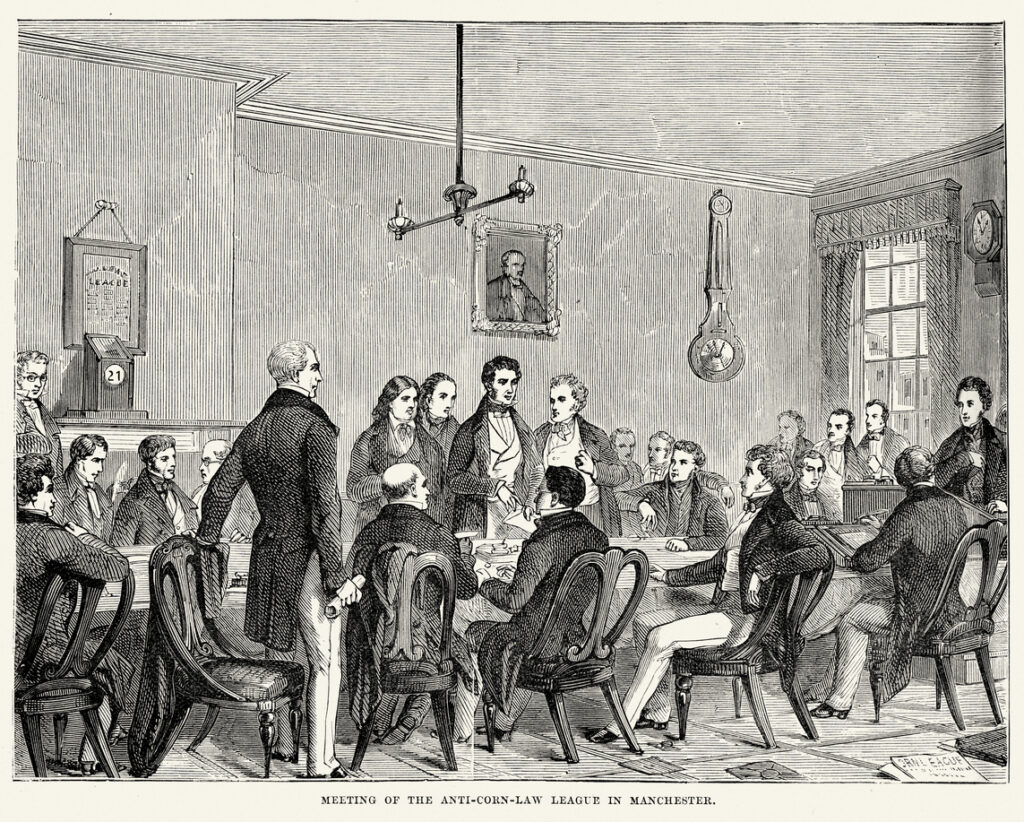
On 20 March 1839, the Anti-Corn Law League (ACLL) was formally established to agitate for the repeal of taxes levied on imported grain. The organisation would become one of the most formidable pressure groups in British political history.
The ACLL’s sole objective was the complete repeal of the Corn Laws, a series of tariffs designed to favour domestic agriculture. These laws safeguarded interests of Britain’s traditional country landowners by keeping the price of bread artificially high. First introduced in 1815, the laws pitted the landowning aristocracy, which was well-represented in parliament, against the industrial classes – growing in size and political consciousness.
Led by Richard Cobden and John Bright, the ACLL built a powerful coalition of middle-class manufacturers, who argued the laws were morally and economically injurious. Cobden, the movement’s chief strategist, and Bright, its most effective orator, both won election to parliament in the early 1840s – on anti-Corn Law, anti-protectionism platforms.
For Cobden and Bright, their anti-Corn Law position provided the spearhead of a more far-reaching liberal worldview. They argued that the embrace of free trade would augur “international fellowship and peace”. But the ACLL maintained a single policy throughout its existence – which aided the campaign’s appeal and accessibility.
Moreover, the ACLL is recognised for pioneering new methods of political agitation. It adopted tactics such as mass rallies addressed by professional speakers, fundraising activities, membership drives, voter registration, and a sophisticated propaganda operation of pamphlets and lectures to mobilise public opinion.
***
The roots of the ACLL stemmed from the establishment of the National Corn Law Association in London, in 1836, and the subsequent formation of the more centralised Manchester Anti-Corn Law Association (MACLA) on 18 September 1838.
From 1837 to 1845, Liberal MP Charles Pelham Villiers proposed a series of motions for repeal in the House of Commons. His February 1839 motion, which was supported by a deputation from the MACLA, was defeated by 361 to 172 votes. It called for an inquiry into the Corn Law and for critical petitioners to be heard at the bar of the House.
In the wake of the commons vote, a meeting of the MACLA resolved that “the refusal to hear evidence against the Corn and Provision Laws, in the manner best calculated to expose their pernicious tendency, thus virtually closing the door of Parliament against the manufacturing and commercial population, is calculated to impair the confidence of the nation in the wisdom and justice of the legislature.”
On 12 March, Villiers proposed a further motion calling for the repeal of the Corn Laws. This prompted a longer debate, extending across five days. The vote that followed, however, was hardly less conclusive. The motion was rejected by 342 votes to 195 —a majority of 147.
These developments strengthened the repealers’ resolve and directly precipitated the establishment of the ACLL on 20 March – exactly 24 years after the Corn Laws completed their passage through parliament.
The founding meeting resolved upon “the formation of a permanent union, to be called the Anti-Corn-Law League” and the establishment of a central office in Manchester.
The new group was entrusted to engage and recommend “competent lecturers”, secure positive press coverage, and establish “a stamped circular, for the purpose of keeping a constant correspondence with the local associations.”
From April 1839, the ACLL began publishing the Anti Corn Law Circular. In a few weeks it had a circulation of 15,000. The publication was soon succeeded by the Anti-Bread-Tax Circular (1841-1843); having become a weekly in December 1842, the circular was itself replaced by a new title: The League.
In 1843, The Economist was founded by James Wilson to further the cause of free trade with assistance from the Anti Corn Law League.
Between 1839 and 1843, the Anti-Corn Law League (ACLL) was the most persistent petitioner of the House of Commons. Across this period, there were 16,351 petitions for repealing the protectionist Corn Laws tabled in the House – an average of 3270 petitions and 1,153,690 signatures per session. And by 1845, the league boasted 225 affiliated associations.
***
Women played an important role in the agitation against the Corn Laws, forming local committees, collecting funds and attending meetings. In a speech delivered in Covent Garden Theatre on 15 January 1845, Cobden said that it was a “very anomalous fact” that women could not vote.
Cobden declared: “There are many ladies, I am happy to say, present; now, it is a very anomalous and singular fact, that they cannot vote themselves, and yet that they have a power of conferring votes upon other people.
“I wish they had the franchise, for they would often make a much better use of it than their husbands.”
In the same speech, Cobden boasted of bringing “four or five thousand new ‘good men and true’” onto the voter lists by encouraging supporters to “buy a freehold qualification.”
He added: “I say, without being revolutionary or boasting of being more democratic than others, that the sooner the power in this country is transferred from the landed oligarchy, which has so misused it, and is placed absolutely… in the hands of the intelligent middle and industrious classes, the better for the condition and destinies of this country.”
A petition from the Ouseburn district upon Tyne, Newcastle, dated 5 October 1841, declared that “the sole cause of all this accumulated mass of national misery… lies in the unjust, partial, and defective state of the representation”. It argued that working people were “excluded from any participation in the choice of those who are called their representatives”.
In this way, anti-Corn Laws activism at times extended beyond the immediate goal of repeal. Cobden, in particular, demonstrated his political skill by drawing on the moral authority and organisational tactics of other reform movements – all the while ensuring that the ACLL’s focus on repeal remained undiminished. This unity of purpose allowed the group to mostly avoid internal dissension over wider constitutional questions and external caricature.
During this period, ill-fated efforts were made to unite the predominantly middle-class ACLL with Chartism, the mass working-class movement for political reform. The Complete Suffrage Union (CSU), founded on 5 April 1842 by Joseph Sturge, an ACLL ally of Cobden and Bright, expressed support for a common front against aristocratic political dominance. The CSU sought to combine the League’s demand for free trade with Chartist calls for democratic reform, particularly an expanded franchise.
A CSU petition embodying these demands was debated in the House of Commons on 21 April 1842. Speaking in support, Cobden argued the “middle classes could not fight the aristocracy single-handed”, who “had trampled on one class, and had plundered another.” He urged MPs “to be consistent, and to unite with [Sturge] to improve the condition of their countrymen, as they had united with him to give freedom to the Africans in the West Indies.”
Sturge, a serial supporter of good causes, was a leading figure in the abolitionist movement of the 1830s. In fact, the ACLL borrowed tactics from abolitionist organisations such as Society for the Mitigation and Gradual Abolition of Slavery Throughout the British Dominions (or Anti-Slavery Society, founded 1823).
The call for a parliamentary inquiry into the failure of the Reform Act of 1832 and the exclusion of the working and middle classes from the franchise was rejected by 226 votes to 67. William Ewart Gladstone and Benjamin Disraeli, architects of later Reform Acts, united in the ‘No’ lobby.
The CSU ultimately failed to achieve its objective. Its collapse reflected both internal divisions within Chartism and suspicion among its more militant “physical force” wing, led by Feargus O’Connor, who distrusted cooperation with the ACLL. The league leadership, not wanting to evolve beyond its demand for free trade, was similarly sceptical.
***
Sir Robert Peel, the Conservative prime minister, converted to the policy of Cobden and the ACLL in 1846 – spurred by the failure of the Irish potato crop in 1845 and the famine that followed.
Cobden had foreseen this development.
Speaking to a popular assembly in 1845, Cobden declared: “What, if you could get at the minds of the people, would you find them thinking as to the repeal of the Corn Laws? I know it as well as if I were in their hearts. It is this: they are all afraid that this Corn Law cannot be maintained – no, not a rag of it – during a period of scarcity prices, of a famine season, such as we had in ’39, ’40, and ’41. They know it.
“They are prepared when such a time comes to abolish the Corn Laws… They are going to repeal it – mark my words – at a season of distress. That distress may come; aye, three weeks of showery weather, when the wheat is in bloom or ripening, would repeal these Corn Laws.”
In February 1846, with the prime minister preparing to bring in a repeal bill, Cobden privately acknowledged the toll of the long campaign. Writing to Bright, Cobden confessed that he was “anxious to put an end honourably to the agitation – I have taxed beyond my powers in every way.”
Peel’s move split the governing Conservative Party and precipitated his resignation as prime minister. His act of career suicide passed with a majority of 98, but two-thirds of his own MPs voted against the government. On the same day, Peel’s Irish Coercion Bill was defeated in the House of Commons by 292 votes to 219. Tory protectionists allied themselves with the opposition Whigs and Radical MPs in defeating the measure.
On 26 June, with the bill of repeal having received royal assent, Cobden proclaimed in a letter to his wife: “Hurrah! Hurrah! The corn bill is law, and now my work is done.”
In his resignation speech (29 June), Peel argued that his actions were motivated by a principled desire to “avert dangers which we thought were imminent, and to terminate a conflict which, according to our belief, would soon place in hostile collision great and powerful classes in this country.”
He added: “The maintenance of power was not a motive for the proposal of these measures; for, as I said before, I had not a doubt, that whether these measures were accompanied by failure or success, the certain issue must be the termination of the existence of this government.”
The outgoing prime minister also credited Cobden for the repeal of the Corn Laws. Addressing the opposition benches, Peel said that “neither of us is the party which is justly entitled to the credit” for repeal.
In a swan song statement to the House of Commons, Peel insisted that the name which “ought to be, and will be, associated with the success of those measures… is the name of Richard Cobden”.
The leading Conservative statesman of his era credited Cobden for pursuing reform from “pure and disinterested motives” and with “untiring energy”. The outgoing prime minister argued that Cobden had “enforced those appeals with an eloquence the more to be admired because it was unaffected and unadorned”.
Those Conservatives who remained loyal to Peel, known as the pro-free trade Peelites, included future prime ministers the Earl of Aberdeen and Gladstone. In June 1859, meeting at Willis’ Rooms, St James’s Street, the Peelites united with the Whigs and the Radicals to form the Liberal Party. Free-trade liberalism ultimately found its fullest political expression in the Gladstonian Liberal Party.
Repeal, therefore, marked a significant step towards a new era of free trade. Indeed, after Benjamin Disraeli’s 1852 budget, Cobden felt able to write to ACLL organiser George Wilson: “There was not a word or a figure in his budget that a free trader could object to. The budget has finally closed the controversy with protection… The League may be dissolved when you like”.
Disraeli had risen to prominence for his vitriolic attacks on Peel and his followers. In February 1845, he said Peel had “caught the Whigs bathing, and walked away with their clothes.”
Some decades later, Disraeli had little choice but to embrace this same political wardrobe.

Politics.co.uk Newsletters
DAILY
Politics@Lunch
WEEKLY
Week in Review