Raab grilled over Afghanistan withdrawal after cutting short holiday
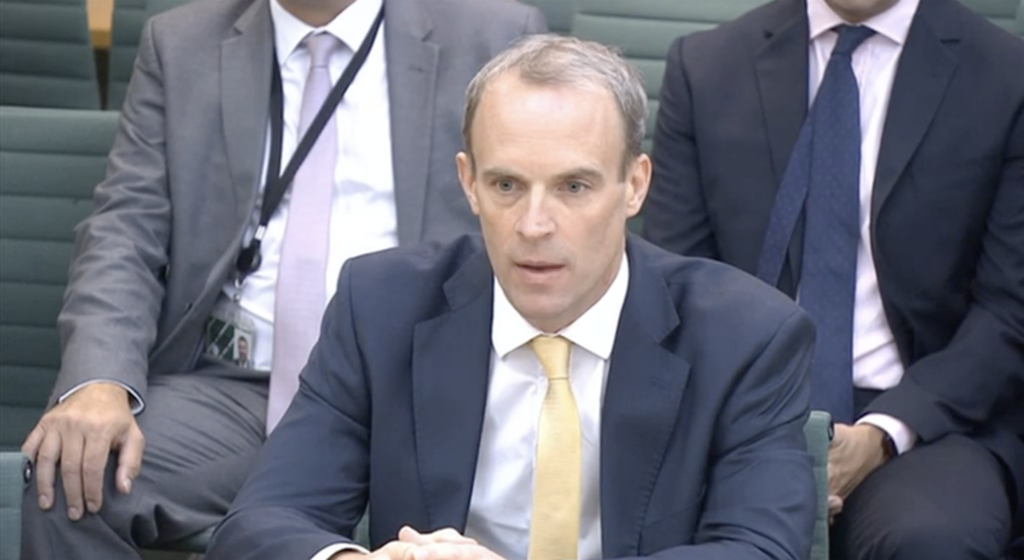
On 1 September 2021, the foreign secretary, Dominic Raab, appeared before the foreign affairs select committee to account for the government’s handling of the withdrawal from Afghanistan.
The hearing marked Raab’s first appearance before MPs following the fall of Kabul to the Taliban on 15 August, and the subsequent chaotic evacuation of British nationals and newly vulnerable Afghans. The UK’s ‘Operation Pitting’ evacuation mission ended just days earlier on 28 August.
***
The cross-party committee, chaired by the Conservative MP Tom Tugendhat, pressed Raab on why the UK had been caught by surprise by the collapse of the Afghan government.
Tugendhat described the role played by the UK in the Afghanistan crisis as the “biggest foreign policy failure since Suez”.
He said: “I stand by the view that this is the single biggest foreign policy disaster that the UK has faced since Suez in the sense that it has exposed a weakness in our alliances and in our stance.”
Raab’s central defence was that the government’s intelligence assessments indicated that Kabul was “unlikely” to fall at the time.
He told the committee: “The central assessment that we were operating to – and it was certainly backed up by both the JIC [Joint Intelligence Committee] and the military – is that the most likely and central proposition was that, given the troop withdrawal by the end of August, you would see a steady deterioration from that point and it was unlikely that Kabul would fall this year.”
He added: “The central assessment remained until late that the deterioration would be incremental.”
Responding directly to Tugendhat’s characterisation of the crisis, Raab said: “I am afraid I struggle with the Suez analogy but I understand what you are really searching for is to learn the lessons and even more generally find a path forward for Afghanistan.”
Conservative MP Bob Seely asked Raab why the evacuation had gone “so badly wrong”.
The foreign secretary blamed “optimism bias”.
He said: “I think there is a whole range of assumptions. One, there was an optimism bias about what the US might or might not do.”
He added: “Two, around the intent of the Taliban, I always cautioned that I thought the Taliban were unlikely, once the US decision to withdraw was clear, to engage in particular, meaningful dialogue around a more inclusive government and seize the opportunity to take control.
“That relates to intent. There was the much bigger question of whether they had the capacity to back up that intent.
“I think in fairness, and collectively across allies, clearly the assessment that they would not be able to advance at that speed was not correct. We will need to look and assess why that was the case.”
***
Across the two-hour evidence session, Raab also faced criticism over his personal conduct.
The foreign secretary was on holiday in Crete as the Taliban were advancing across Afghanistan. Throughout the crisis and its aftermath, he was roundly criticised for staying there until after Kabul fell, returning at 1:40 am on 16 August.
Labour MP Chris Bryant asked whether Raab was already on the Greek island on 11 August when the US was warning the group was likely to take power.
The foreign secretary insisted that he would not answer such a question, labelling it a “fishing expedition”.
Bryant responded: “Of course, it is perfectly legitimate for Ministers to go on holiday. Everybody has that right… The difficulty for us is that the prime minister was on holiday, the deputy prime minister, yourself, was on holiday, and, as I understand it, the permanent under-secretary was on holiday – all three at the same time – when British nationals were at risk, thousands of people, by your own estimation, who stood by us in a difficult time in Afghanistan were in peril of their lives, and there was still not a proper crisis centre up in place.”
Raab responded: “I am afraid I don’t agree with that analysis. Of course, I have been clear with the benefit of hindsight that I would not have gone away at all…
“The truth is, Chris, judge us by the results because… between 15 August and the end of August we delivered over 15,000 people out of the country, which I think is certainly the most challenging evacuation of its kind in living memory.”
Stewart McDonald, a Scottish National Party (SNP) MP, doubled down on this line of questioning. He asked repeatedly when he left the UK to go on holiday to a luxury hotel in Crete.
The foreign secretary dismissed McDonald’s questioning, describing it as “pretty partisan” and a “political attack”.
He insisted he was contactable “at all material times”.
McDonald described Raab’s inability to answer his questions as “absurd”.
Bryant also questioned Raab over how he could have challenged his department in the lead up to the crisis, particularly with regard to the intelligence he was receiving.
The foreign secretary countered that no one in the Foreign Office “thinks I do not challenge official advice rigorously – I do.
“If anything, I get accused of being over-inquisitorial.”
He added: “The caricature of critique against me is that I am either lazy and delegating too much or a control freak. The truth is that you need to exercise grip but you also need to be willing to delegate.”
Under concerted questioning, Raab was unable to say how many Afghans who aided Britain’s efforts in Afghanistan – individuals who were therefore vulnerable under Taliban rule – had been left behind when the final UK troops were evacuated.
Raab said he could not produce a “definitive figure”.
He added: “I can’t give you a definitive answer. I’m not confident with precision to be able to give you a set number, but I am confident that the prime minister [Boris Johnson] is right, that we’ve got the overwhelming number out.”
But, under question from Labour MP Neil Coyle, he admitted that some of those left behind included Afghans who worked as guards at the British embassy in Kabul.
He said: “We wanted to get some of those embassy guards through but the buses arranged to collect them, to take them to the airport, were not given permission to enter. That is, I am afraid, a reflection of the conditions on the ground/”
Raab said the number of British nationals left in Afghanistan was down to the “low hundreds”, adding: “If I could give you any more precision… I would.”
Asked if he considered resigning as foreign secretary amid the furore over his holiday, Raab said: “No. I considered getting on with the job of what has been a Herculean task of getting 17,000 people out.
“Now I am focusing on getting out the remaining people that we want to see out via third countries and helping to forge internationally – which the prime minister is leading on, I believe, and confident – on all of those priorities that I have mentioned.”
***
The Afghanistan withdrawal was deeply damaging to the foreign secretary.
Two weeks later, on 15 September 2021, Boris Johnson demoted Raab to the role of justice secretary. In the surrounding cabinet reshuffle, Raab was also made deputy prime minister – an appointment that cushioned his fall from the Foreign Office.
A subsequent report by the foreign affairs committee described the UK government’s leadership during the Afghanistan withdrawal as “missing in action”.
The report pointed to a “systemic failure in terms of strategic planning, policymaking and operational management”.
The withdrawal, the committee said, was a “betrayal of our partners in the country and, worst of all, undermined the security of the United Kingdom by encouraging our enemies to act against us.”
The report also accused the Foreign Office of effectively obstructing the inquiry. It stated that officials repeatedly gave answers “that, in our judgement, are at best intentionally evasive, and often deliberately misleading”.
It added: “The relationship between the committee and department relies on a degree of candour and rigour, and this appears to have been sadly missing, with the integrity of the department’s senior leaders called into question.”

Politics.co.uk Newsletters
DAILY
Politics@Lunch
WEEKLY
Week in Review
