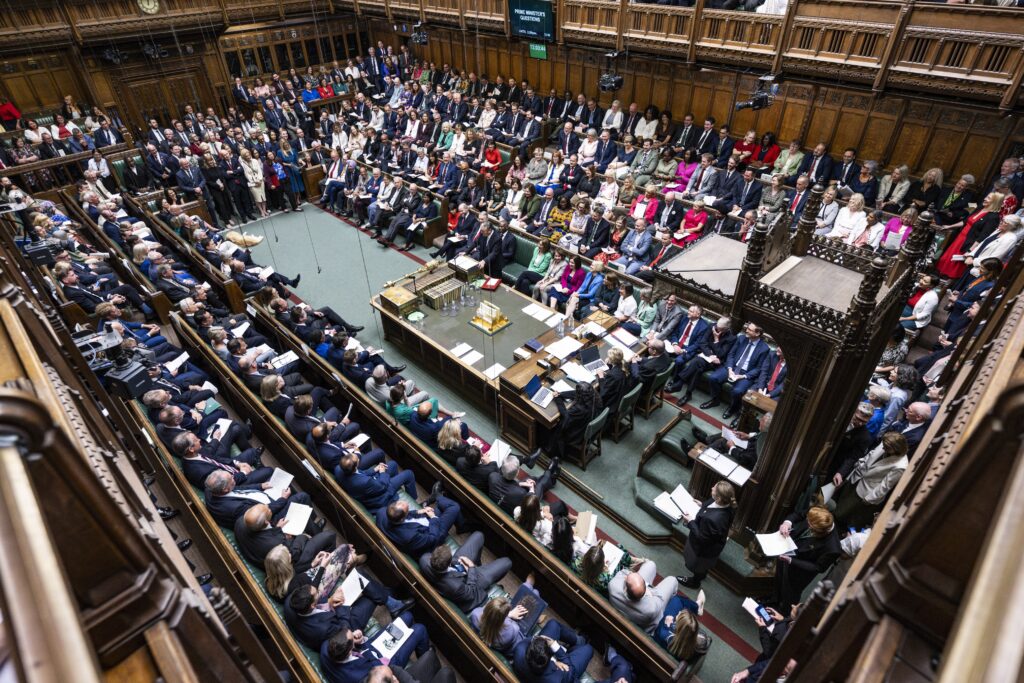
The basic annual salary for a member of parliament is £98,599 (as of April 2026). This figure is set and reviewed annually by the Independent Parliamentary Standards Authority (Ipsa), the body created to oversee MPs’ pay and business costs independently of parliament and government.
From April 2025 to April 2026, the salary stood at £93,904.
From April 2024 to April 2025, the salary stood at £91,346.
In April 2010, the salary was £65,738.
The salary for MPs is a subject of consistent public debate. Opinion polls, such as those conducted by YouGov (2012) and Electoral Calculus (2021), suggest the public believes the salary for MPs is too high.
For comparison, in April 2025, the Office for National Statistics (ONS) reported that the median gross annual earnings for full-time employees in the UK was £39,039.
The role of Ipsa
Following the 2009 expenses scandal, responsibility for MPs’ pay, pensions and business costs was transferred to Ipsa (established under the Parliamentary Standards Act 2009). Ipsa’s primary role is to ensure that MPs are reimbursed for costs necessarily incurred in the performance of their parliamentary functions, and that their pay is set in a fair and transparent manner.
Each year, Ipsa determines the MPs’ salaries, typically by using the average annual change in public sector earnings for the preceding year. This link was established to ensure MPs’ pay remains broadly in line with that of the wider public sector.
Latest Ipsa update: April 2026
In March 2026, Ipsa announced that the basic salary for an MP would rise by 5% to £98,599 a year from April 2026.
Ipsa said it was also aiming to move towards a salary of around £110,000 by the end of the parliament (2029).
Richard Lloyd, the Ipsa chairman, said the role of an MP had “evolved”, with parliamentarians “dealing with higher levels of complex casework, and abuse and intimidation”.
Lloyd added: “In reaching our decision for 2026-27 we have benchmarked MPs’ pay against other responsible, senior roles in civic society and similar worldwide democracies, as well as considering our own core principles and the wider economic context.”
Salaries for ministers and office-holders
MPs who serve as ministers or hold specific parliamentary offices are entitled to an additional salary on top of their basic MP’s salary. However, the ministerial portion of these salaries has been voluntarily frozen by successive governments since 2010.
- Prime minister: £174,039 (actual) – comprising the £98,599 MP salary and a frozen claimed ministerial salary of £75,440. (Legal entitlement for ministerial salary is £80,807).
- Cabinet ministers (chancellor, secretaries of state, etc): £166,104(actual) – comprising an MP’s salary and a frozen claimed ministerial salary of £67,505. (Legal entitlement for ministerial salary is £72,454).
- Minister of state: £130,279 (actual) – comprising an MP’s salary and a frozen claimed ministerial salary of £31,680. (Legal entitlement for ministerial salary is £34,742).
- Parliamentary under secretaries of state (including exchequer secretary to the Treasury): £120,974 (actual) – comprising an MP’s salary and a frozen claimed ministerial salary of £22,375. (Legal entitlement for ministerial salary is £24,947).
- Attorney general (if member of commons): £193,049 (actual) – comprising an MP’s salary and a frozen claimed ministerial salary of £94,450. (Legal entitlement for ministerial salary is £100,819).
- Solicitor general: £156,561 (actual) – comprising an MP’s salary and a frozen claimed ministerial salary of £57,962. (Legal entitlement for ministerial salary is £62,368).
- Government whips (comptroller/vice-chamberlain/junior lord/assistant whip): £116,516 (actual) – comprising an MP’s salary and a frozen claimed ministerial salary of £17,917. (Legal entitlement for ministerial salary is £20,261).
Ministers in the House of Lords do not receive an MP’s salary. Their total pay consists solely of their ministerial salary. Because they do not have the £93,904 base, their ministerial pay is higher to compensate. For example, cabinet ministers who sit in the House of Lords, such as the leader of the Lords or a standard secretary of state, claim £104,360. (The legal entitlement is £106,363).
A full list of ministerial salaries can be found here.
Senior parliamentary offices
- Speaker of the House of Commons: £178,359 – comprising an MP’s salary and an office-holder salary of £79,760.
- Leader of the opposition: £165,020 – comprising an MP’s salary and an office-holder salary of £66,421.
- Chairman of ways and means (senior deputy speaker): £140,924 – comprising an MP’s salary and an additional salary of £42,325.
- Deputy chairs of ways and means (junior deputy speakers): £136,304 (total) – comprising an MP’s salary and an additional salary of £37,705.
- Chairs of select committees: £117,421 (total) – comprising an MP’s salary and an additional office-holder salary of £18,822.
- Members of the panel of chairs: £117,421 (total) – comprising an MP’s salary and an additional office-holder salary of £18,822.
Pensions for parliamentarians
MPs are members of the Parliamentary Contributory Pension Fund (PCPF). There is also a scheme for ministers called the Ministerial Pension Scheme.
Ipsa is responsible for setting the rules of the PCPF scheme. The minister for civil service, a position held by the prime minister, is responsible for setting the rules of the Ministerial Pension Scheme.
Benefits in both schemes are accrued on a career average revalued earnings (Care) basis.
The case for higher salaries
It is argued that the salary offered to an MP directly affects the calibre of candidates who choose to enter and remain in parliament. When compared to senior roles in both the public and private sectors, an MP’s salary is presented as modest, potentially deterring highly skilled individuals from careers in politics.
For example, chief constables in major police forces and headteachers of large secondary schools can earn significantly more than an MP. Proponents of higher pay argue that this disparity makes politics a less attractive career path for proven leaders.
A further argument is that a more substantial salary would reduce the perceived need for MPs to take on second jobs, allowing them to focus entirely on their parliamentary and constituency duties.
The case against higher salaries
Opponents of higher pay argue that a public service ethos, not financial reward, should be the primary motivation for entering politics. They note that many individuals, including one Keir Starmer (a former director of public prosecutions), gave up more lucrative careers to become MPs.
It is also argued that MPs are already well-remunerated compared to the general population, especially when considering the pension scheme and expenses system. Critics suggest that higher salaries risk attracting candidates motivated by financial gain rather than a desire to serve the public.
History of MPs’ pay (1911-2009)
The Chartist movement proposed salaries for MPs in 1838. But it was not until August 1911 that a scheme for MPs’ pay was agreed. An allowance of £400 per annum was granted by a vote of 265 to 173, due largely to pressure from the nascent Labour Party.
Although the idea of paying people for a career in politics was strenuously contested at the time, the move was also seen as a critical step in both the democratisation and “professionalisation” of politics. With parliamentary work being paid, it was no longer necessary to be an individual of independent means to seek elected office.
The reform, championed by David Lloyd George, the Liberal chancellor of the exchequer, was presented as an overdue step towards democratising parliament. Critics suggested that a salaried parliament would produce a group of “professional whole-timers”.
The Liberal Party had long advocated payment for MPs. But the issue was forced by the 1909 ‘Osborne Judgment’, which declared it illegal for trade unions to use their political levy to fund Labour MPs. The ruling threatened the financial viability of working-class representation in parliament.
The proposal was staunchly criticised by the Unionist opposition. Arthur Lee warned the motion would create a class of “paid professional politicians” – thus attracting undesirable characters and violating the “principle of gratuitous public service”.
Lee told MPs of his concerns: “I believe we will get a different type of member in this House from that which we have been used to.
“We will get a type of member and a much larger proportion of men, resembling the paid professional speakers of political parties today, and, while these men are able men and do good work, I do not believe they will be a satisfactory substitute for the present personnel of the House of Commons.”
The wage for politicians was reviewed irregularly in its early years.
Lloyd George had sought to repel criticisms of this consequence by emphasising the term “allowance”, as we have seen. But the resolution itself referred unambiguously to a “salary”; as a result, the Inland Revenue initially taxed the full amount.
However, from 1912 a quarter (£100) was treated as tax-free expenses – creating an ambiguity whereby the £400 payment covered both pay and expenses.
The lump sum was temporarily reduced in October 1931 (to £360), due to the surrounding economic crisis. It recovered to £400 in July 1935.
In 1937, it was increased to £600.
The Ministers of the Crown Act 1937 established paid salaries for specified office-holders, including the prime minister and senior ministers, as well as for certain opposition figures such as the leader of the opposition. Under the Act, the prime minister was paid £10,000 annually, department heads including the chancellor of the exchequer received £5,000, and the leader of the opposition was entitled to £2,000.
The salary for MPs was increased again in 1946 (to £1,000 per annum) and in 1957 (to £1,750).
In 1963, the Lawrence committee was set up to review payments to MPs and ministers. Its first recommendations were accepted by parliament in 1964, increasing the parliamentary salary from £1,750 to £3,250. Pensions for MPs were provided for the first time by the Ministerial Salaries and Members’ Pensions Act 1965.
The Top Salaries Review Body (TSRB), established in 1971, ended the ad hoc revision of parliamentary salaries. The body was set up with a responsibility to advise the prime minister on appropriate remuneration.
A 1979 TSRB report affirmed that the ministers should not receive the full salary of a backbench MP, on the grounds that office impinged on a minister’s ability to undertake the full range of parliamentary responsibilities.
In 1996, the Senior Salaries Review Board (SSRB) took over that responsibility.
MPs subsequently voted to adopt the SSRB’s proposals of a pay-rise to £43,000 (an increase of some 26% over the previous salary of £34,085), and adopted procedures for automatically uprating pay “by the average percentage by which the mid-points of the senior civil service pay bands”. That year (1996), ministers were permitted to claim the full parliamentary salary (overruling the previous 1979 report).
In 1999, the SSRB was invited to undertake a “review of the parliamentary pension scheme and assess it against current good practice.” The SSRB subsequently reported that trustees of the Parliamentary Contributory Pension Fund were in favour of increasing the pension accrual rate to 1/40th.
The SSRB, however, concluded that the existing pension accrual rate (1/50th) – in place since 1983 – was fair. “In our view the current 1/50th rate is fair”, the report stated, “its relative generosity helps to compensate for the unusual features of an MP’s job”.
In a commons debate on the report recommendations, Conservative MP John Butterfill, a PCPF trustee, introduced an amendment to increase the accrual rate to 1/40th. Despite the opposition of the government, the amendment was passed by 215 votes to 172.
At the same time, MPs voted to give themselves a pay rise of £4,000 on top of their existing £49,822 salaries.
Labour MP Chris Mullin, who had recently resigned as a minister, tabled an amendment proposing that the annual uprating be tied to the increases recommended for nurses, teachers and doctors. This was rejected by 260 votes to 66.
Addressing the debate, Mullin argued that voting in favour of a pay rise would add “to the great ocean of cynicism lapping at the foundations of the democratic process.”
The SSRB Review of Parliamentary Pay, Pensions and Allowances (2007) report recommended that MPs should be able to opt for a 1/60th accrual rate in exchange for reduced contributions. It referred to this as the “the least bad option”.
This recommendation was approved by ministers.
In response to this review, the government also announced that it considered it “inappropriate that MPs should vote on their own pay and pensions.”
In January 2008, Sir John Baker, the retiring chairman of the SSRB, was asked to carry out a review “to make recommendations for a mechanism for independently determining the pay and pensions of MPs which does not involve MPs voting on their own pay”.
Evaluation question
Did the introduction of an independent body to set MPs’ pay represent an abdication of parliamentary sovereignty – or a necessary step to restore public trust?
He reported back in June of that year with a recommendation for MPs’ pay to be increased each year in line with the previous year’s increase in public sector average earnings, with a review by the SSRB each parliament. This was intended to keep MPs’ pay in line with the earnings of public sector workers generally.
Baker’s report began: “Parliament is sovereign and MPs rightly guard that sovereignty on behalf of us all as citizens. Hitherto, MPs have regarded determining their own pay and expenses (allowances) as an essential aspect of their exercise of sovereignty.
“But times have changed: very few people are able to set their own pay and expenses, and the practice of MPs doing so has properly been questioned, inside and outside the House of Commons.”
The Constitutional Reform and Governance Act, which achieved royal assent in April 2010, conferred powers on IPSA to determine MPs’ salary and pensions.
The 2009 expenses scandal
In May 2009, the Daily Telegraph began publishing a series of explosive revelations about the widespread misuse of parliamentary allowances by members of parliament, triggering a major political scandal that profoundly damaged the reputation of Westminster.
The newspaper had obtained a full, unredacted record of all MPs’ expense claims over the previous four years. Over several weeks, the Telegraph detailed how politicians from all parties had claimed public money for items ranging from the trivial to the lavish and the utterly frivolous.
The Telegraph’s daily disclosures sparked a wave of public anger, ended political careers, and prompted the first resignation of a House of Commons speaker in more than 300 years. The saga also precipitated significant public demand for wide-ranging political reforms.
Among the most damaging revelations were claims for clearing a moat, buying an ornate duck house, and “flipping” – the practice of repeatedly changing a designated second home to maximise claims on different properties. The vast majority of claims were not illegal under the existing rules, but they were regarded by the public as a misuse of taxpayers’ money during a time of economic hardship in the wake of the 2008 financial crisis.
The speaker of the House of Commons, Michael Martin, was forced to resign for his perceived role in trying to block reforms and conceal the extent of the problem. In his resignation statement, Martin told MPs: “I have always felt that the House is at its best when it is united. In order that unity can be maintained, I have decided that I will relinquish office of speaker on Sunday 21 June.”
Several MPs announced they would not stand for re-election, while others were defeated upon first contact with voters in 2010. Seven parliamentarians, two peers and five MPs, were sent to jail for false accounting
In total, 390 parliamentarians were ordered to repay £1.3 million of misclaimed expenses. (This total was reduced by £185,000 after MP appeals). The order came after the publication of the Sir Thomas Legg’s review of the Additional Costs Allowance (ACA), also known as the “second homes” allowance, which was condemned as “deeply flawed” and “vague”.
The review read: “[The ACA expenses] system was deeply flawed. In particular, the rules were vague, and MPs were themselves self-certifying as to the propriety of their use of the allowance.
“Taken with the prevailing lack of transparency and the ‘culture of deference’, this meant that the Fees Office’s decisions lacked legitimacy; and many of them were in fact mistaken.”
The largest sums ordered to be repaid by sitting MPs, following appeals, were £42,458 by Barbara Follett (Labour), £36,250 by Bernard Jenkin (Conservative), £31,193 by Andrew Mackay (Conservative), £29,691 by David Heathcoat-Amory (Conservative), £29,398 by John Gummer (Conservative), £29,243 by Julie Kirkbride (Conservative) and £24,878 by Liam Fox (Conservative).
In response to the crisis, IPSA was established.
The scandal is widely regarded to have left a lasting scar on British politics, severely eroding public trust in politicians.
Operation of Ipsa since 2010
Since the 2010 general election, responsibility for determining MPs’ pay and pension arrangements has rested with Ipsa.
Ipsa is accountable to the speaker’s committee for the Ipsa, which was also established under the Parliamentary Standards Act 2009.
In May 2012, Ipsa launched a major review of MPs’ pay. Ipsa stated that its aim was “to put in place a new settlement which will come into effect with the election of the new parliament in 2015”.
The consultation paper, published in October 2012, added: “Our parliamentary democracy is of the highest importance. Parliament and parliamentarians deserve our respect. An element of that respect is having appropriate pay and pension arrangements.”
In July 2013, Ipsa recommended that MPs salaries should increase to £74,000 (from £67,060 on 1 April 2014), and be “indexed to annual growth in average earnings in the whole economy thereafter.”
Ipsa also called for a new pension on a par with other parts of the public sector, moving from a “final salary” to the “career average” scheme.
The reaction to the recommendations, from the public, press and politicians, was hostile. Michael Gove, the education secretary, told Ipsa to “stick” the planned £6,000 pay rise.
Gove called Ipsa “silly” and said parliamentarians were “well paid”.
Asked whether the extra increase should go ahead, Gove said: “Absolutely not. MPs are incredibly well paid at the moment anyway, as are ministers.”
He added: “Ipsa – it’s a bit of a silly organisation really and pay rise? They can stick it.”
A Downing Street spokesman stated: “The cost of politics should go down, not up. And MPs’ pay shouldn’t go up while public sector pay is, rightly, being constrained.”
Nick Clegg, the deputy prime minister, said he would not take the pay increase.
Following further consultation, Ipsa proceeded. The pay rise went ahead as planned, and, from 2016, MPs’ pay rose in line with the rate of annual change in average earnings, published by the Office for National Statistics (ONS) each April.
The 2024 general election triggered a statutory requirement for IPSA to review the entire remuneration package within the first year of the new parliament.
The Parliamentary Standards Act 2009, as amended by the Constitutional Reform and Governance Act 2010, states: “The Ipsa must review the current determination (and make a new determination as appropriate)… in the first year of each parliament… [and] at any other time it considers appropriate.”
For the 2025-26 financial year, Ipsa determined that salaries should rise by 2.8%, resulting in the current basic salary of £93,904 (effective from 1 April 2025).
In November 2025, Ipsa introduced a change to the Parliamentary Contributory Pension Fund. Recognising that many MPs serve well into their 70s or 80s, Ipsa introduced a “partial retirement” rule. This allows sitting MPs who have reached the minimum retirement age to claim their tax-free pension lump sum while remaining in office, with the remainder of their pension benefits held until they finally leave parliament.
Quotes
“Just as [nurses] have the highest standards in your profession, we must show that we have the highest standards for our profession. And we must show that, where mistakes have been made and errors have been discovered, where wrongs have to be righted, that that is done so immediately. We have also to try hard to show people and think hard about how a profession that, like yours, depends on trust – the most precious asset it has is trust – how that profession too can show that it is genuinely there to serve the public in all its future needs.” – Prime minister Gordon Brown, responding to the expenses scandal, in May 2009.
“It is the responsibility of those we elect to behave properly. Not just legally, not just within the rules, but to the highest ethical standards.” – Conservative leader David Cameron, responding to the expenses scandal, in May 2009.
“The idea that MPs are overpaid is frankly ridiculous. Being an MP, never mind a minister, isn’t like most jobs. The nature of it means that MPs need two offices, often two homes, and travel regularly. Much of the cost is covered by the expenses system, but the hours are still long, the disruption to family life is huge, the level of exposure and public scrutiny is beyond what most of us would find tolerable, and the abuse, harassment and open vitriol is increasing. All for a salary that in many private sector roles would be paid to middle management?” – Emma Revell of the Centre for Policy Studies, commenting in the Times (2024).
“MPs should not be paid more. If MPs are paid more it would be actively detrimental to our democracy. If we were to increase the salary of MPs we would attract more people in professions that we don’t want into parliament. We are more likely to get highly paid lawyers and bankers, which would tilt the social and economic experience of parliamentarians and their attitudes even further away from the majority of people who live in this country.” – Parth Patel, senior research fellow at the Institute for Public Policy Research, commenting in the Times (2024).
Additional resources
- Independent Parliamentary Standards Authority (Ipsa): https://www.theipsa.org.uk/
- MPs’ staffing and business costs: https://www.theipsa.org.uk/mp-staffing-business-costs
- Register of Members’ Financial Interests: https://www.parliament.uk/mps-lords-and-offices/standards-and-financial-interests/parliamentary-commissioner-for-standards/registers-of-interests/register-of-members-financial-interests/

