Starmer announces defence spending hike ahead of Trump meeting
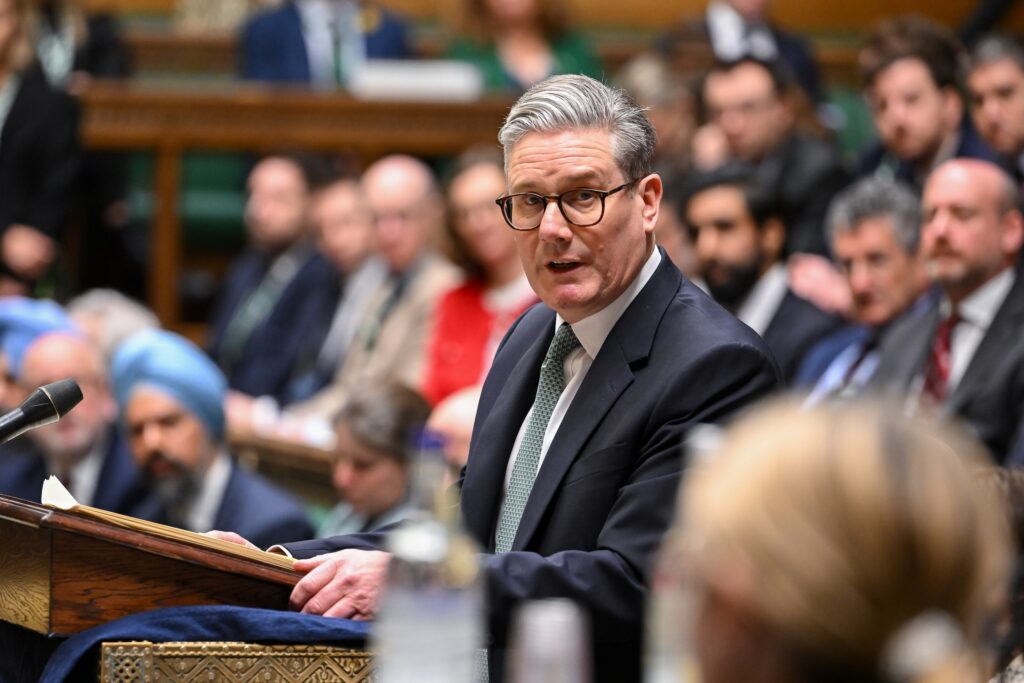
On 25 February 2025, Keir Starmer as prime minister unveiled plans to raise defence spending to 2.5% of GDP from April 2027, funded by cuts to overseas aid. The announcement was timed to precede a crucial meeting between the prime minister and the new US president, Donald Trump.
The spending uplift was designed to demonstrate the UK’s commitment to Europe’s defence. The US president had been critical of European countries for appearing to rely on American military support.
***
Starmer was appointed prime minister in the aftermath of the 2024 general election, which resulted in a landslide Labour majority. The party’s manifesto featured a commitment to “set out the path” to increase defence spending to 2.5% of GDP.
The manifesto also stressed Labour’s commitment to “restoring development spending at the level of 0.7% of gross national income [GNI] as soon as fiscal circumstances allow.”
The defence spending announcement, delivered to the House of Commons, came during a period of intense geopolitical turmoil – precipitated by Trump’s return to the White House. The US president had cast doubt on America’s continued support for Ukraine in the ongoing Russo-Ukrainian war, while signalling a willingness to negotiate directly with Vladimir Putin and Russia.
Starmer was widely expected to address these issues with the US president in their high-stakes meeting scheduled for 27 February. The central issue was whether the US would provide a “backstop” of security guarantees for Ukraine in the event of any peace settlement.
In his commons statement, Starmer rejected any “false choice between our allies – between one side of the Atlantic and the other.” He described the United States as providing Britain’s “most important bilateral alliance.”
The prime minister added: “So this week, when I meet president Trump, I will be clear. I want this relationship to go from strength to strength.”
The statement’s most significant announcement came when Starmer announced a rise in defence spending from 2.3% to 2.5% of GDP, funded by a reduction in the UK’s aid budget from 0.5% of gross national income to 0.3% in 2027.
Starmer also set out his government’s “clear ambition” to increase defence spending to 3% of GDP after the next general election.
The prime minister described the uplift as the “biggest sustained increase in defence spending since the end of the cold war.”
He referred to the decision to cut the aid budget as a “hard choice” but one that would fully fund “our increased investment in defence.”
Starmer told MPs: “I want to be clear to the House that this is not an announcement that I am happy to make… But at times like this, the defence and security of the British people must always come first. That is the number one priority of this government.”
The policy shift was welcomed by the Conservative opposition, led by Kemi Badenoch, but sparked criticism from non-governmental organisations, development charities and some MPs. UK aid spending was previously reduced from 0.7% to 0.5% of GNI in 2021.
Conservative MP Andrew Mitchell, a former international development secretary, criticised Starmer’s plan as “short-sighted and damaging”.
The announcement came mere weeks after the foreign secretary, David Lammy, described Trump’s dramatic aid cuts as a “big strategic mistake”.
***
Critically, the move was welcomed by Trump and contributed to a roundly well-mannered meeting in the White House.
Starmer’s opening pitch included an invitation from King Charles III for an unprecedented second state visit. Trump described the invite as a “great honour”.
The letter stated: “As you will know this is unprecedented by a US president. That is why I would find it helpful for us to be able to discuss, together, a range of options for location and programme content.
“In so doing, working together, I know we will further enhance the special relationship between our two countries of which we are both so proud.”
Trump also praised Starmer’s defence spending announcement, describing the uplift as “a great thing to do.”
The US president said: “I know that they’re raising it. I just read an article, a great article, about the work you’re doing in the UK, as to the military, you’re raising it quite a bit, which is a great thing to do for your country.
“It’s sad that we need that, but [we] probably need that. So congratulations on that. I know you got it through. After years of chronic underfunding there’s an urgent need to catch up for some countries.”
The meeting was widely described as successful.
However, Starmer’s post-Trump honeymoon was cut short by the resignation of Anneliese Dodds as international development minister.
In a letter to the prime minister, Dodds said the cuts to international aid would “remove food and healthcare from desperate people – deeply harming the UK’s reputation.”
Dodds, who served as shadow chancellor from 2020 to 2021, said she had delayed her resignation until after Starmer’s meeting with the US president.
The Labour MP stated: “I know you have been clear that you are not ideologically opposed to international development. But the reality is that this decision is already being portrayed as following in President Trump’s slipstream of cuts to USAID.”
She added: “The effect will be far greater than presented, even if assumptions made about reducing asylum costs hold true.
“The cut will also likely lead to a UK pull-out from numerous African, Caribbean and Western Balkan nations at a time when Russia has been aggressively increasing its global presence.”
Mitchell said Dodds had “done the right thing”.
He posted on X: “Labour’s disgraceful and cynical actions demean the Labour Party’s reputation as they balance the books on the backs of the poorest people in the world.
“Shame on them and kudos to a politician of decency and principle.”

Politics.co.uk Newsletters
DAILY
Politics@Lunch
WEEKLY
Week in Review
