Johnson government unveils ‘levelling up’ white paper
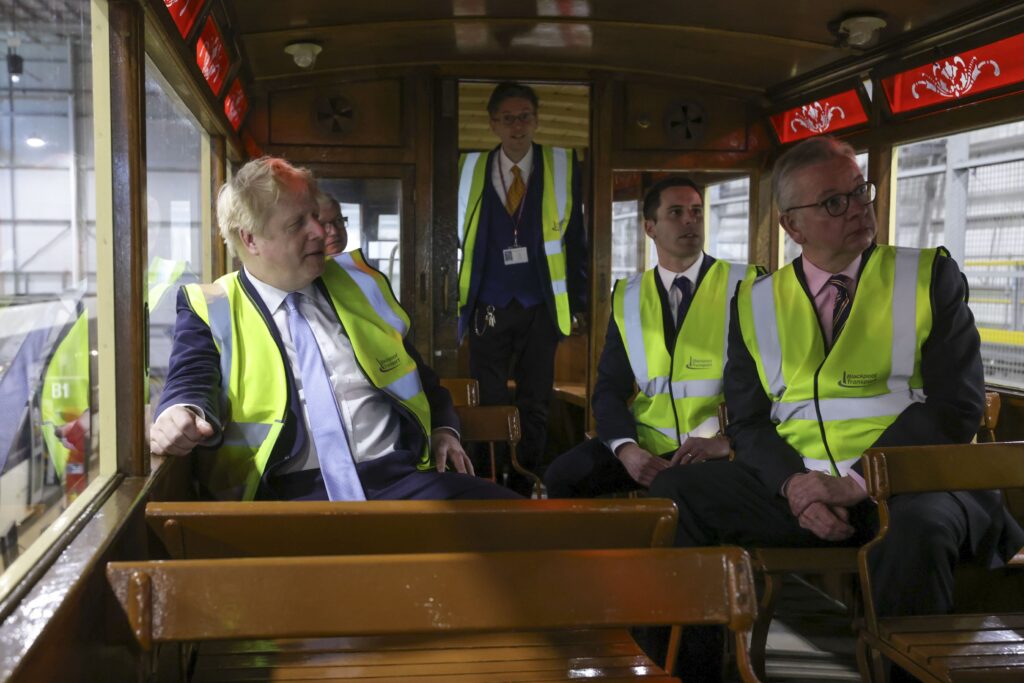
On 2 February 2022, the government published its levelling up white paper, a 332-page document dedicated to Boris Johnson’s flagship policy. The white paper, spearheaded by Michael Gove as levelling up secretary, established 12 national “missions” to be achieved by 2030 – targeting gaps in pay, productivity, health and transport infrastructure.
The “levelling up agenda”, a central pillar of Johnson’s political vision, encompassed a loosely connected set of policies designed to reduce regional economic inequality. The February 2022 white paper represented the most detailed expression of the government’s ambition in this regard.
***
In his first speech as prime minister, Johnson spoke of a need to “level up across Britain” and “answer the plea of the forgotten people and the left-behind towns”. He said it was time to unleash “the productive power not just of London and the South East but of every corner of England, Scotland, Wales and Northern Ireland”.
The theme of levelling up also featured prominently in the Conservative Party’s 2019 election manifesto. The document included a pledge to “use our post-Brexit freedoms to build prosperity and strengthen and level up every part of the country”.
A £4 billion levelling up fund was announced in November 2020 as part of the spending review. The purpose of the fund was to invest in “local infrastructure that has a visible impact on people and their communities and will support economic recovery”. Local authorities were able to submit one bid for every parliamentary constituency within the local authority boundary, with all local authorities eligible to submit at least one bid.
The 2021 queen’s speech stated the government would “level up opportunities across all parts of the United Kingdom, supporting jobs, businesses and economic growth and addressing the impact of the pandemic on public services.”
In his foreword to the 2022 white paper, Johnson described levelling up as “the defining mission of this government”.
The 12 national missions included living standards, transport infrastructure, skills, health and housing. Underpinning the missions were four “focus areas”, namely:
- Boost productivity, pay, jobs and living standards by growing the private sector, especially in those places where they are lagging.
- Spread opportunities and improve public services, especially in those places where they are weakest.
- Restore a sense of community, local pride and belonging, especially in those places where they have been lost.
- Empower local leaders and communities, especially in those places lacking local agency.
The government described this formula as a “contemporary Medici model”, citing the Italian city states that powered the Renaissance in the 15th and 16th centuries.
The document also proposed a “devolution revolution”, offering every part of England the opportunity to have a mayor.
The white paper stated: “By 2030, every part of England that wants one will have a devolution deal with powers at or approaching the highest level of devolution and a simplified, long-term funding settlement.”
The white paper opened with an expansive historical survey, tracing human development back some 10,000 years to Jericho, referenced as the earliest known permanent urban settlement.
In total, three pages were devoted to the history of Jericho, Rome and renaissance Europe.
The document read: “The city had natural irrigation from the Jordan River, allowing it to produce and export the most expensive essential oil in the ancient world. This enabled Jericho to become a hub not only for commerce and trade, but for people and skills, culture and finance…
“The strategic importance of London’s location was first recognised by the Romans, with the town of Londinium established around AD 47-50.”
On 2 February 2022, Gove delivered a statement to the House of Commons, marking the publication of the white paper. He described the government’s objective as enabling “overlooked and undervalued communities to take back control of their destiny.”
He added: “While talent is spread equally across the United Kingdom, opportunity is not. Our country is an unparalleled success story, but not everyone shares in it.”
Lisa Nandy, the shadow levelling up secretary, described the white paper’s missions as “12 admissions of failure”.
Nandy stated: “After all the delays, all the slogans and all the big promises, is this it? Is this really it?
“The sum total of ambition for our coastal and industrial towns, our villages and our great cities is a history lesson on the rise of the Roman empire, and ministers scurrying around Whitehall, shuffling the deckchairs and cobbling together a shopping list of recycled policies and fiddling the figures.
“Is this really it?”
Reporting at the time found that parts of the white paper had been plagiarised from Wikipedia.
One section read: “Constantinople was the capital of the Roman/Byzantine Empire (330-1204 and 1261-1453), the Latin Empire (1204-1261) and the Ottoman Empire (1453-1922).”
This passage, the Independent reported, was identical to the first line of the Wikipedia page for Constantinople.
Another section of the white paper, a full-page timeline of the largest cities in the world since 7,000 BC, was reported to be identical to a table on Wikipedia’s “List of largest cities throughout history” entry.
Eight of the document’s 12 missions were said to have been the same as those included in former prime minister Theresa May’s industrial strategy, which was published in 2018.
***
The levelling up agenda, widely viewed as a distinctive expression of Boris Johnson’s political identity and his vision for post-Brexit Britain, was embraced more cautiously by his Conservative successors as prime minister.
Liz Truss resigned as prime minister before she was able to make any substantive announcements relevant to the levelling up agenda.
Rishi Sunak remained nominally committed to the programme during his tenure as prime minister. In a September 2023 report, the Institute for Government (IfG) noted that the levelling up agenda had “lost momentum since Johnson resigned in July 2022.”
In April 2024, Gove admitted that progress was incomplete, comparing the policy to a “half-built cathedral”.
He told the Financial Times: “You know, if I’m in the middle of building a cathedral, you might say, ‘well some of it looks great but the rest of it is just a mess’… but that’s because we are still constructing it. You’ve got to dream great if you want to achieve anything.”
Following the 2024 general election, the new Labour government led by Keir Starmer formally scrapped the phrase “levelling up.”
The Department for Levelling Up, Housing and Communities was renamed the Ministry of Housing, Communities and Local Government. Jim McMahon, the then minister of state for local government, stated that the phrase was “only ever a slogan” and was being “firmly Tippex-ed out of the department.”
McMahon said: “It is a reshaping of the department. It is a refocus, but frankly it is also just grown up politics.”
In July 2025, a report commissioned by the Ministry of Housing, Communities and Local Government found that 95% of levelling up fund projects in rounds one and two were running behind schedule.
The report stated: “Almost all (95%) of LUF [levelling up fund] projects reviewed as part of this evaluation reported delays, relative to the timeline set out in their bid. Of those reporting delays, 38% were delayed by more than one year.”
Speaking on the Lord Speaker’s Corner podcast in December 2025, Gove reflected on the levelling up agenda’s apparent failure, attributing it to institutional scepticism across Whitehall.
Gove said: “The original impetus behind coming up, of course, came from Boris, and the white paper was… I thought a very effective way of giving effect to what he’d been talking about in very high level terms.
“But folk in the treasury were skeptical about what we were doing. They thought that this was just old-fashioned regional policy in new clothes. And other government departments didn’t like the idea in particular of devolving areas.”
Gove noted that the Department for Education opposed devolving elements of the skills budget to local areas, while the Department for Work and Pensions objected to devolving responsibility for employment support.
He added: “And as I say, Treasury ministers overall in particular thought that we were attempting to push water uphill. And that if you really wanted to promote growth, then making a particular emphasis on left-behind areas was a very long-haul exercise that would not generate the rapid growth the country needed.”

Politics.co.uk Newsletters
DAILY
Politics@Lunch
WEEKLY
Week in Review
