Jeremy Corbyn re-elected after Labour leadership challenge
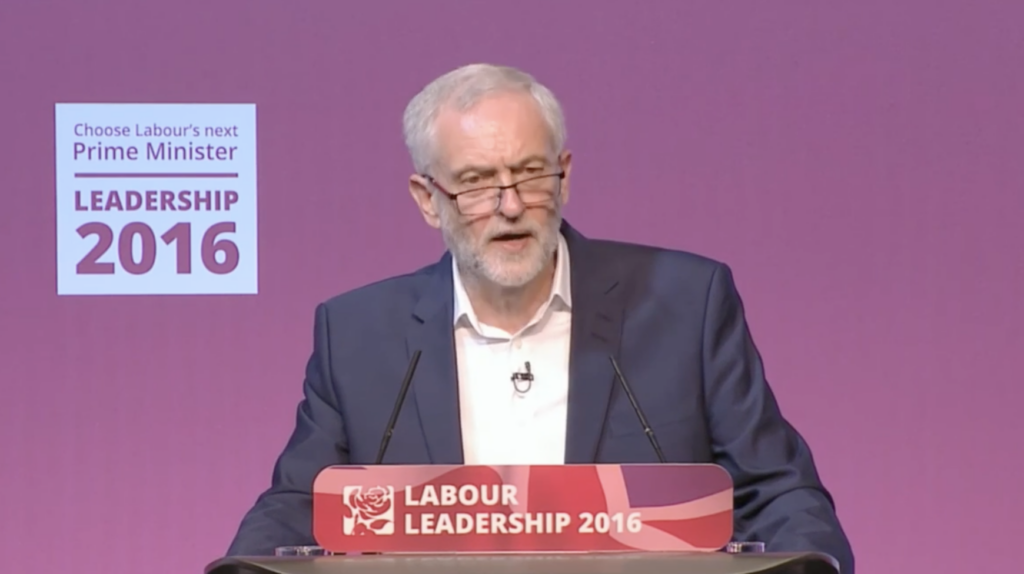
On 24 September 2016, Jeremy Corbyn was re-elected as leader of the Labour Party, defeating challenger Owen Smith.
The result, announced at a special conference in Liverpool, saw Corbyn win 313,209 votes (61.8%) to Smith’s 193,229 (38.2%). It came on a turnout of 77.6% of the more than 650,000 eligible members and supporters.
***
The leadership contest was triggered by the bitter internal fallout that followed the 2016 Brexit referendum. A significant contingent of the Parliamentary Labour Party (PLP) accused Corbyn of mounting only an unenthusiastic case for ‘Remain’, leading to mass resignations from his shadow frontbench.
The walkout was coordinated by the shadow foreign secretary, Hilary Benn, whom Corbyn sacked for allegedly plotting to oust him.
It was hoped that the resignations would force Corbyn, who had been elected Labour leader in September 2015, to stand down from his post. But Corbyn refused. On 28 June, he suffered an emphatic defeat in a ‘no confidence’ vote among Labour MPs; 172 voted against Corbyn, with just 40 signalling their support.
Corbyn, defiant, issued a statement declaring that he would not “betray” the trust of those party members who had elected him leader. He argued that the confidence motion, held via a secret ballot of MPs, had “no constitutional legitimacy” under party rules.
Labour Party rules did not require Corbyn to resign as a result of the vote.
Corbyn’s refusal to stand down prompted Labour rebels to shift towards a formal leadership challenge. Challengers needed to secure the nominations of at least 20% of the combined membership of the PLP and European parliamentary Labour Party (51 MPs/MEPs at the time).
Some weeks later, after Angela Eagle launched and quickly abandoned her leadership bid, Owen Smith, the former shadow work and pensions secretary, secured enough nominations from MPs and MEPs to trigger an internal election.
In total, Smith secured 162 MP and MEP nominations. Eagle had accrued 72 nominations before dropping out the race.
An acrimonious campaign followed. In August, the high court struck down the six-month cutoff point imposed by members of Labour’s National Executive Committee (NEC) for members to vote in the leadership contest.
There was also a procedural debate over whether Corbyn should automatically be included on the ballot paper. The last leadership challenger against an incumbent – the contest between Neil Kinnock and Tony Benn in 1988 – saw both candidates seek nominations. However, the NEC ruled on 12 July – by 18 votes to 14 – that Corbyn would be included on the ballot paper.
***
During the campaign, Smith vowed to appoint Corbyn as party president in the event that he won. Smith praised the incumbent leader for helping Labour “rediscover its radical roots”, but maintained he did not have the qualities to be prime minister.
Smith vowed to be “just as radical as Jeremy Corbyn” and spoke positively about the prospect of a second Brexit referendum.
He called for a symbolic re-edit of Clause IV of Labour’s constitution, which advocated the “fight against inequality”.
Smith said: “I want to re-write clause four to put tackling inequality right at the heart of everything we do.”
In a head-to-head debate on 8 September, Smith said Corbyn would condemn the party to opposition “for a generation”.
Corbyn offered to “wipe the slate clean” and reach out to his opponents were he re-elected.
Ed Miliband, the former Labour leader, endorsed Smith’s candidacy.
***
Corbyn’s victory saw him increase his vote share from 2015 (59.5%) and renew his internal mandate. The membership, swollen by new and registered supporters, remained supportive of his anti-austerity, unapologetically socialist platform.
Once again, Corbyn won comfortably in each of the three categories: winning the support of 59% of party members, 70% of registered supporters and 60% of affiliated supporters.
The Conservative Party chairman, Patrick McLoughlin, responded: “172 Labour MPs don’t think Jeremy Corbyn can lead the Labour Party – so how can he lead the country?”
In his victory speech, Corbyn thanked the “more than 300,000 supporters” who had given him a “second mandate in a year to lead our party”.
He also extended his thanks to Smith for the “good-humoured debates” during the contest, stressing that “we are part of the same Labour family and that’s how it’s always going to be”.
He said that “things are sometimes said in the heat of the debate on all sides which we sometimes later come to regret” and called on the party to “wipe that slate clean from today”.
Corbyn, quoting murdered Labour MP Jo Cox, added: “Always remember in our party, we have much more in common than that which divides us.”
The newly re-elected Labour leader said the time had come “to focus every ounce of our energy on exposing and defeating the Tories”.
Finally, he stated that while it was his responsibility as Labour leader to “unite this party”, it was “also the responsibility of the whole party: members of parliament, councillors, party members and our wonderful supporters across the country to work together and respect the democratic choice that’s been made.”
Corbyn concluded: “Labour is a party brimming full of ideas, of talent, of creativity, and so is this country. Unleashing that potential is the job of all of us. Let us work together for real change in Britain. Thank you very much.”
Smith responded: “There is no doubt that the Labour Party has changed under [Corbyn’s] leadership, he has mobilised huge numbers of people over the last 12 months, many of whom are here at conference in Liverpool, and he deserves the credit for that, and for winning this contest so decisively.
“I have no time for talk of a split in the Labour movement – it’s Labour or nothing for me… although today’s result shows that our movement remains divided, it now falls primarily to Jeremy Corbyn, as Labour leader, to heal those divisions and to unite our movement.”
***
Corbyn’s relationship with the PLP remained fundamentally broken.
A tense truce saw many of the MPs who initially resigned from Corbyn’s shadow cabinet return to the frontbench. Among them was one Keir Starmer, who endorsed Smith’s candidacy.
Corbyn’s standing was secured by the 2017 general election, when Labour unexpectedly gained 30 seats. But relations soured markedly over the course of the 2017-2019 parliament.
In March 2018, Corbyn sacked Smith from the shadow cabinet after he backed a second Brexit referendum.
Corbyn resigned as Labour leader in the wake of the 2019 general election, which saw Labour collapse to 202 seats – the party’s worst result since 1935.
Smith stood down as an MP at the 2019 election. In a letter to Corbyn, he cited “personal and political reasons”.
Politics.co.uk Newsletters
DAILY
Politics@Lunch
WEEKLY
Week in Review