Government ‘plot’ to oust John Bercow as commons speaker defeated
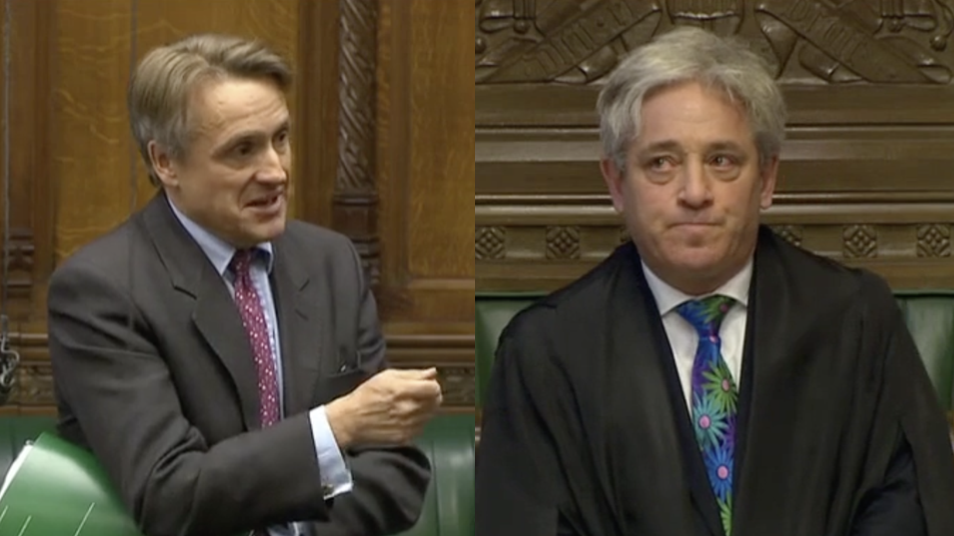
On 26 March 2015, the final day of commons business before parliament dissolved for the general election, the government suffered a humiliating defeat on a motion widely seen as an attempt to oust the speaker, John Bercow.
The proposal, spearheaded by the leader of the House of Commons, William Hague, sought to introduce a secret ballot to re-elect Bercow as speaker in the next parliament. This would have brought the process for re-electing an incumbent speaker into line with the rules used for a contested speakership election.
Crucially, a secret ballot would have provided political cover for critical Conservative MPs who wished to remove Bercow from his post.
The saga was Hague’s final major contribution to commons business; the Conservative frontbencher and former party leader had already announced his intention to stand down at the 2015 general election. Michael Gove, the chief whip, was also said to be a key proponent of the measure.
***
The timing of the motion sparked an acrimonious and at times emotional debate. Critics, comprising Labour, Liberal Democrat and some Conservative MPs, condemned the move as a cynical ploy to remove Bercow – who was unpopular with many on the government frontbench.
In a deeply unusual final sitting day, Bercow was said to have granted three urgent questions to buy supportive MPs more time to rush back to the commons to defeat the government measure. Just one hour had been allotted by the government for MPs to debate the measure. And while the vote was nominally a ‘free vote’, Conservative MPs had been instructed to remain in parliament on a three-line whip.
Hague argued that a secret ballot would free members “from pressure from the chair or from their parties.”
He dismissed that argument that status quo should be maintained because it is a “familiar procedure”, pointing to the use of the secret ballot for “the great majority of elections in the House, and all elections out in the country”.
The commons leader stated: “That has been a general principle of our democracy since the 19th century. Whenever voters elect someone to a position of power and authority over them, the principle is that they should be able to do so without fear or favour.
“It is how we elect our party leaders, it is how we elect our select committee chairs. It is certainly how we elect our party’s leader. It also frees MPs from pressure from the chair or from their parties.”
Angela Eagle, the shadow leader of the House, expressed her “genuine sorrow and anger” at the government’s actions. She referred to an “appalling situation with only one hour to discuss an issue that we could have discussed in great detail.”
The Labour frontbencher said that in her 23 years in parliament, she had “never seen a government behave in such a grubby and underhand manner.”
Eagle argued that every MP had a “direct interest in what [Hague] suddenly proposed out of the blue late last night. This is an appalling and shabby way to treat the House.”
Sir Gerald Kaufman, a veteran Labour MP, accused Hague of a “grubby, squalid and nauseous” attempt to change the rules.
Labour MP Chris Ruane, during an earlier urgent question, asked Hague if he was bothered that his legacy would be that of a “grubby, cowardly assassin”.
Similarly, Conservative MP Jacob Rees-Mogg expressed the “deep sadness that many of us feel that his career should end with his name being put to a bit of parliamentary jiggery-pokery that has come about, representing grudges that some people have against Mr Speaker”.
During the main debate, Conservative MP Gregory Baker sparked uproar when he questioned Bercow’s suitability to chair the debate due to the “sensitive nature of this discussion”. The commons speaker responded to this suggestion angrily, declaring: “It is commonplace for the speaker to be in the speaker’s chair. I am genuinely sorry if that disquiets you”.
Charles Walker, the Conservative chair of the commons procedure committee, said he had been “played for a fool” by ministers in a tearful speech.
Walker, like the rest of the House, had been given virtually no notice of the government’s intention to bring the motion. He was informed of the government’s intention to consider the procedure committee’s report on the election of the speaker, published on 6 February 2013, on the evening before the debate.
The report endorsed the existing arrangements for speakership elections. At the time, Walker called for a debate to be held “in prime time, so the whole House could come to an informed decision.”
The Conservative MP told the commons: “I do say to the government that this is not, I think, how they expected today to play out. The government were hoping that the party would be kept here under a three-line whip for a party meeting and that others would have gone home.
“This does not reflect well on the government.”
Walker concluded: “May I just say that how one treats people in this place is important? This week, I went to the leaving drinks for the leader of the House. I spent 20 minutes saying goodbye to his special adviser yesterday. I went into his private office and was passed by the deputy leader of the House yesterday.
“All of them would have been aware of what they were proposing to do. I also had a number of friendly chats with our chief whip yesterday, yet I found out at 6.30 pm last night that the leader of the House was bringing forward my report.
“I have been played as a fool. When I go home tonight, I will look in the mirror and see an honourable fool looking back at me. I would much rather be an honourable fool, in this and any other matter, than a clever man.”
MPs, including a Conservative backbencher, rose to their feet to applaud Walker’s contribution – a symbolic break with commons convention. A tearful Bercow rose to bring the House to order.
Having presided over the debate, Bercow was visibly emotional upon announcing the result. The government’s motion was defeated by 228 votes to 202 – a majority of 26. Opponents of the measure included 23 Conservative MPs and 10 Liberal Democrats.
The Conservative opponents of the motion included Bob Blackman, Peter Bone, Graham Brady, Zac Goldsmith, David Davis and Jacob Rees-Mogg.
The result was a personal victory for Bercow.
The debate nevertheless highlighted tensions between the government and the speaker that would find still greater expression during the fraught debates on Brexit from 2016 to 2019.
***
Bercow was re-elected unopposed as speaker of the House following the 2015 election.
Rees-Mogg, who nominated Bercow, said it was vital for “constitutional reasons” that incumbent speakers were generally re-elected.
Rees-Mogg stressed that the speaker’s role is to defend the independence and rights of the commons “against the Lords and sometimes against the judges, but perhaps most particularly against the executive.”
He added: “The historians here will know that some seven speakers lost their heads for championing the commons against the executive – something that we hope is no longer necessary.”
He argued that if MPs regularly defenestrated sitting speakers, they would find that “the speaker spent the whole time paying regard to what the frontbench on one side or the other were thinking as to how he should rule, lest he should not continue in office after a general election.”
Rees-Mogg said the last time this had happened was in “1835, when Charles Manners-Sutton was booted out by the Whigs for being too much of a Tory.”
He continued: “I am glad to say that there are not very many Whigs left to behave in that way.”
This remark was a reference to the 2015 general election outcome, which reduced the Liberal Democrats to eight seats. Alistair Carmichael later welcomed Bercow to the chair on behalf of “the elite cadre of Liberal Democrats” who had been returned at the election.

Politics.co.uk Newsletters
DAILY
Politics@Lunch
WEEKLY
Week in Review
